
The conversation
About this episode
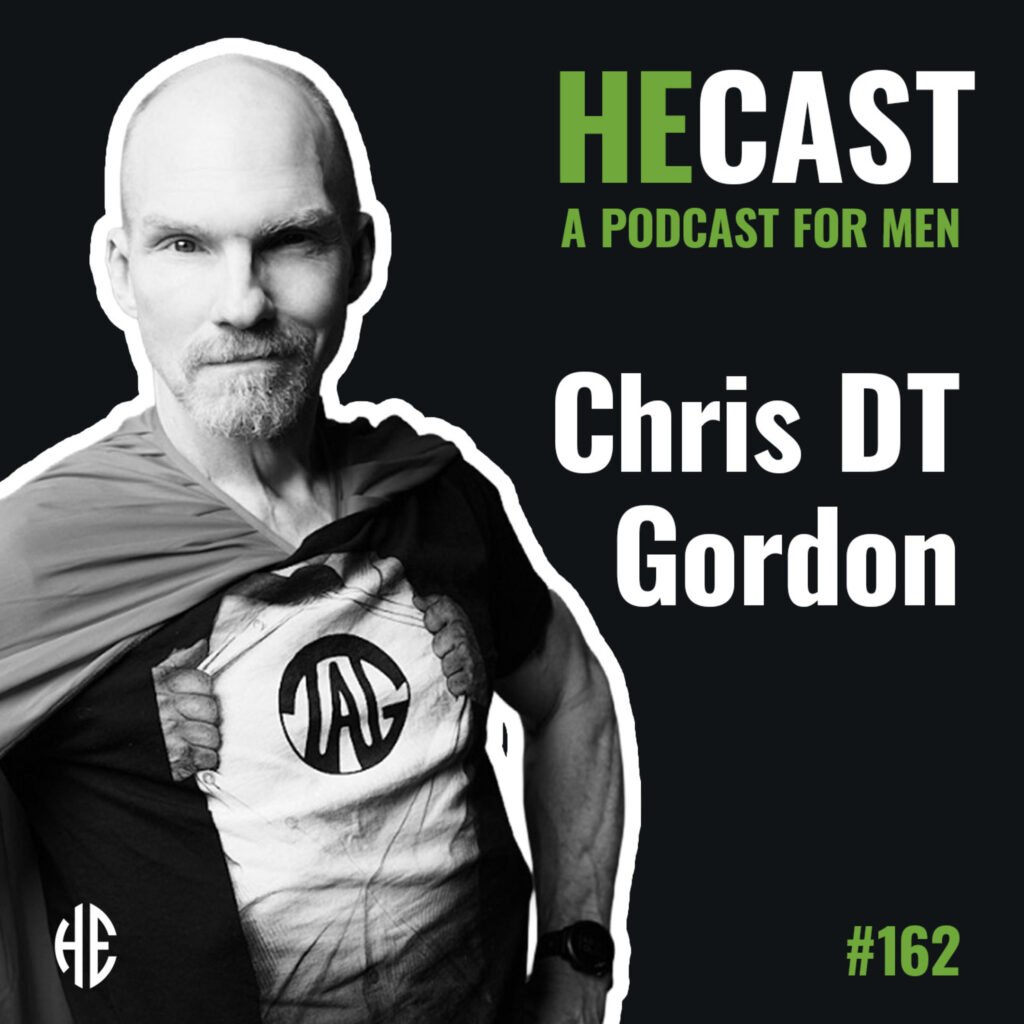
Episode 162 of heCast features Chris DT Gordon in a powerful and inspiring conversation about gratitude, resilience, survival, perspective, relationships, community, and turning life’s hardest moments into purpose.
Chris DT Gordon is a family man, online middle school special education teacher, professional speaker, author, runner, martial artist, and pop culture enthusiast. He is also a survivor of a life-threatening disease who now uses his story to inspire others to overcome challenges with positivity and resilience, strengthen their relationships, fortify their communities, and achieve greatness on their own terms.
In this episode, Mike and Chris talk about Chris’s life-threatening battle with flesh-eating bacteria, waking from a coma, facing septic shock, and confronting the possible loss of his arm. Instead of allowing that experience to define him as a victim, Chris found a way to turn pain into purpose through gratitude, humour, perspective, and resilience.
Chris shares how gratitude can impact us as individuals, strengthen our relationships, and help build stronger communities. Through his “attitude of gratitude” message, he offers practical ways to reframe adversity, recognize the good around us, appreciate the people in our lives, and create moments that help others feel seen and valued.
This episode is for anyone facing a difficult season, supporting someone through hardship, or looking for a reminder that scars do not have to be the end of the story. They can become proof of survival, strength, and the ability to keep moving forward.
Listen to heCast, the official podcast of HeChangedIt.
Download the HeChangedIt app for more tools, content, and support on your mental wellness journey.
Read transcript
Transcript supplied via Spotify RSS.
Welcome to he cast the official podcast of he changed him.
As always, I am Mike Chisholm as always.
I'm so excited to have conversations around the world
of men's mental Wellness. I constantly I'm a broken
writer. I shouldn't do the same intro
over again. Can we just OK, for if you're a
viewer and listen to the show, can you just assume and know
that I'm going to be enthusiastic about the guests
that we have here and not hold it against because I am I'm so
enthusiastic about these conversations and these people.
Today is no exception. This guy and I, man, we're
brothers from another mother, Chris DT Gordon is his name and
Chris. So Chris Gordon, the DT is a
beautiful distinction. If you want to go find his book
or look for him as a speaker, Chris, DT Gordon, he, Chris is
an awesome guy. Boy, did he go through an
ordeal, a medical ordeal a few years ago.
And what that did was he's fine now and he's and he survived it.
But he has, you know, we talked about how success leaves clues.
Sometimes going through really hard things leaves clues.
Sometimes the success is surviving something.
And boy did he and he has shared it.
He's got a book from Survivor to Striver how how gratitude can
turn you into a superhero. Clearly he talks about
gratitude, but it's so much more.
He gives 3 questions during this conversation that I think
everybody should write down and ponder.
A really great guy who has, you know, gone to the depths almost
of death and back and has done a, a phenomenal job of, of, of
framing that in a way that has helped himself, his family and
others as well. He's a big comic nerd the way
that I am. And so we have a lot of fun
talking today. I'm really grateful for the
conversation that we just had here.
And, and, and I would have said that whether it was about
gratefulness or not, I'm super grateful.
I hope you will be too. Please enjoy my conversation
with Chris DT Gordon. I get a little Flack, not Flack,
but people talk about how enthusiastic I always am in my
intro and and I always say, oh, I'm really excited to talk about
this person And I am I'm always excited to talk to people around
have conversations around the space of Bens mental Wellness,
to hear their story and and and and to to share perspective so
we can help people. But today, I mean, I'm always
excited, but today when I get a fellow comic book enthusiast,
when I get somebody who has wrapped in the lore of, of, of,
of the mythology of my youth and is excited about that as well.
Chris honestly if you were to turn the camera around to the
other side of the podcast studio, you would see 3 display
cases set up and most of the the statues or the Hot Toys or the
things that are in there are comic book, their comic book
referenced. And so having you on today
brings a special kind of joy. Chris, welcome to he cast.
Oh, thank you Mike. I greatly appreciate the intro
and the and the energy you're bringing and really quick before
I forget, I must do the same to you.
I, I will bring my computer to show you that I am legit.
You can see some Hello Kitty inspired cardboard paintings and
then I'm working on it. There it is, I got.
Some Transformers. Yeah, yeah, I was a big.
In the corner, in the corner there's Fortress Maximus holding
blaster. Yep, like an like an 80s break
dancer. And behind me I got the Ninja
Turtles. And of course you know I am also
Star Wars, so I have 6 right here.
I'm a big Star Wars guy. 6 Yep, Yep, that's fantastic.
And it's funny because, you know, you're going through what
you've gone through and we'll get into all that, But, but, but
the idea that that that you went through, you know, something
that many people would call horrific and, and, and, and
perhaps you yourself at times called it that.
But then now the way that you refer to it as your origin
story. I, I love that because, you
know, you talk about the Transformers that are back
there. I was more AGI joke guy, but I
love Transformers too. I, you know, the idea of, of
transforming from one thing into another as a result of an epic
event that happens in our life. You are the poster child for
that. I want to talk about, you know,
your biography a little bit, special edge, special Ed
educator, correct? Yes, yes, I am a special
educator, licensed and learning disabilities and autism spectrum
disorder and I've been. Teaching a growth industry safe
to say a growth industry since you started this.
Yes, yes, I I will never run out of students.
I, I, the numbers when it comes to, you know, spectrum or, or,
or autism, you know, the things that I don't even want to call
it an affliction anymore. It just seems to be that brains
are so complex and the way that that has in our lifetimes, the
level of knowledge that we have had has grown in that area so
much. I can only understand.
And I jokingly called it a growth industry.
Boy oh boy, the changes that you have seen and my good the
support that you must have seen in your career must just be
astounding. Yes, it is white the eye
catcher. It does get attention.
You're right, Mike, especially within the last 20 years since
brain research has just illuminated what are, you know,
what we can do mentally, but also what struggles we have.
And I think that people who aren't as well versed in, you
know, in psychology or in, you know, and just in how the brain
functions thinks that oh, well, this is something made-up.
Or they might even think that it's, you know, some kind of
scam. And I know I'm maybe speculating
a little too much, but I think it just goes to the show how
advanced we are as a society that we can find these new
idiosyncrasies within the brain and things that we would have
institutionalized people for a number of years ago.
Or just oh, well, you know, it's just because of this, you know,
someone who just popped in my head, Forrest Gump, you know,
that movie character who people thought he was stupid and slow.
And we, you know, yes, he sometimes could not function as
well as others in one way, but he had other talents.
And we need to realize we're all Forrest Gump in some way, shape
and form that yes, there are some ways that we struggle, but
there are other ways that we are geniuses or that just click for
us. And I think that, you know, as
you said, it's a growth industry.
I'm not going to argue that. I mean, there seems to be more
and more, you know, people diagnosed on some level of
autism, but that just comes with the understanding what we are as
people. And I think the more we realize,
well, we all have some semblance of abnormality, you, whether
it's, you know, like a lower, you know, like a lower level or
maybe it affects us at a greater degree, it's OK.
That's what makes us us. Yeah, I think that's very well
put. You use the word as you were
talking about this idiosyncrasies within the brain.
I love that the reframe of what we might think that is you talk
about Forrest Gump. I, I, I've got a, a family
that's very close to me in my, in my financial career.
And, and, and they've got a couple of autistic boys and they
work very, very closely with all of the different activist groups
and, and support groups that are, that are up here in, in, in
my area of Western Canada. And, you know, I was talking to,
to the, the, the gal's husband and we were going through and he
was talking about The Big Bang Theory.
And he said, boy, I just wish that, you know, Sheldon is
Sheldon in The Big Bang Theory, but I just wish that they would
actually take the leap and, and, and, and put the label.
And now that labels are a good thing, But but at least, you
know, create the awareness there that that that's, that's the
character that they have. And because it's quite a it's,
it's, it's, it's in many ways a remarkable, you know, the
idiosyncries that we're talking about many times are remarkable.
And, and we've come a long way, you know, since Rain Man and,
and to where we are now. And it's, it's very cool to see
that and, and you doing that as a vocation, you being involved
in that. First off, I'm grateful.
I'm very, very grateful that you're able to help members of
our society that have these things that are perhaps outside
of the box of convention and, and, and doing that.
So, so that, that says a lot to your heart right there, never
mind the story and, and, and all the other stuff.
So, so I just wanted to say thank you for doing what you do.
You're making the world a brighter place and I'm glad that
there is more awareness that's out there.
I'm curious, from your perspective, the awareness
that's out there sometimes jumps on a freight train and it goes
whether it leaves a station and it gets going fast, whether or
not the information is correct or not.
As you've seen this happen in your in this 20 years that
you're talking about here, are there some misconceptions that
are out there that you still wish would be cleared up?
Yes. I think that something that
really gets people's attention is, like you mentioned, Rain
Man. And you know, when you think
about the character of Raymond, he was extraordinarily talented
at numbers. Yep.
And that's just the way his brain was wired.
And I think that a lot of people really think, well, all you
know, all people who are artistic, are autistic, have,
are just incredibly powerful math skills.
Yep. And it's no, yeah, no, you know,
it's not that at all. It, you know, it just happens
that some, some people who are autistic actually are artistic.
You know, that's the way their brain is wired, you know, And I
think if we think of the brain as a computer, which it is, I
mean, it is powered by electricity, when you think
about it. Absolutely.
Many computers are geared towards some capacity, some
applications more readily than others.
And our brains are like that. And every computer, every
computer powers on the same way. But after that, the functions
that it completes can be varied, and so can our brains.
And so I think, you know, thinking less of people as being
just good at things or bad at things, it's just like, well,
that might be the case, but I think that's a broad stroke.
I just think we need to, you know, look at the person and
say, OK, you know, yes, you are good at this and maybe you're
not good at this, but let's not just put that as your identity.
Exactly. And, and, and that's, that's
exactly what I was referring to, like saying, you know, we've
come a long way since, since Rayman, because I think that,
you know, awareness is good, but at the same time, when it's
incorrect awareness or, or there are assumptions that get made,
that's where we get into trouble when it comes to things.
I want to get into. By the way, congratulations on
writing a book many times. My wife and I are both, you
know, we went, we went through something, you know, with our,
with our granddaughter a few years ago, a health crisis.
And thank goodness, she's all good.
She's everything's, everything's fine with her.
But through that process, we learned a lot about ourselves
and we wrote a book about it. And, and, and it's such AI
always loved talking to authors who, you know, my, when we wrote
our book, My, my, my, my 12th grade English teacher, you know,
he wrote back to me and he said, Hey, congratulations, you
finally had something to say. And, and, and I think when we
write and we put things out there, you know, the whole idea
of we want to have something to say is a huge part of it.
Your book certainly has done that.
It has certainly done exactly what your motto is, you know,
being the attitude of gratitude, always being grateful, taking a
hard situation and trying to make some good out of it.
And clearly that's what your book has done.
Can we please talk about that for a little bit and talk about
what you went through and the genesis of the book and, and,
and, and take it from there? Yeah, certainly.
If you give me a second, Mike, I have the real life here.
No, no, no. Here's Sammy.
He's a 7th poodle. We love him.
He's also getting into something real quick I have to clear out.
No, Do what you gotta do, man. Get here.
Dogs track well on the show. People like people like the
puppies. We're fine with that.
Yeah. And while you're doing that, you
know the title of the book from Survivor to striver, how
gratitude can turn you into a superhero.
And and right there, you know, ours is a long title too.
It had it had a it had a semi colon in it with a with a a
brief kind of description in the title as well.
And and I think a lot of these books that, you know, seek to
help people try and share a little bit more in the title
than have that that, you know, that punchy whatever you know
from survivor to strive or how gratitude can turn you into a
superhero. You know, the survivor part,
reading your story, knowing what you've gone through.
Holy smokes, you're lucky to be here today.
And I mean, you know, sometimes it takes a moment like that
where that's where gratitude can come from.
It's like a wake up call. It's like a cold shower where
you suddenly, you know, are thrust into the present moment
and there's a realization there what that the present moment
might be very different or might not even be happening.
And, and, and, and so sometimes that could be a, a, a charge to
gratitude. Was gratitude something that you
had already gone down the path of before you went through what
you went through? No, I was an incredible jerk all
through my life. It was unbelievable.
I'm surprised I survived getting to 40 in the 1st place.
Really. No, I'm just kidding.
I was. I was a nice guy.
Oh. My God, I had me.
Yeah, I mean, yeah, I was raised by two.
Yeah. I was raised by, you know, 2
middle class people, you know, from both from Pennsylvania and,
you know, they, they had strong upbringings of, you know, how
you should treat people. So yeah, I, I mind my PS and QS
and I was always trying to show kindness, kindness to people.
I would always use someone's name when we're in a restaurant
if I see their name tag or at the store.
And obviously I still do that, but it wasn't intentional.
It wasn't a, a, a solid practice.
It's just something I did. So, you know, after my ordeal is
when I really started putting it into intentional practice, you
know, developing strategies so it can just have that much more
effect. I'm glad that you said that
because at the end of the day, I think gratitude is one of those
things where I don't know that a lot of people have necessarily
turned it into an intention. You know, we throw out the
ideas, OK, I'm going to have a good day today.
I'm going to try and have a good attitude today.
I'm going to be happy today. But the idea of I'm going to be
grateful today or, or, or intentionalness and saying, OK,
hold on, let's take a moment here.
What are three things that I'm grateful for right now?
And I mean, as you know, and you're going to talk about here,
because it changed your life in many respects, that right there
is something that can really be an extra gear as we're going
down the highway of life. Like like, like, like actually
just sitting there for a second. And whether we write it down or
we, we really just kind of focus on two or three things that
we're grateful for right there in that moment.
That is an exercise that again, you talk about how it can turn
you into a superhero. I literally say I call it a
superpower and, and, and so I'm glad you talked about that
before you even talked about what led you to this place
because we can all do that. And that is a it keeps a bunch
of things away. It's very difficult to have
crippling anxiety and be grateful at the same time.
And while, OK, you can also make a decision to be grateful and to
focus on gratefulness for 5 or 10 minutes.
And if that's the case and you're feeling anxious, Oh my
gosh. And that's so that's what I
found anyway. And I, I can't wait for you to
talk about this a little bit more.
I mean, I'm certain that you agree with everything that I
said. If you want to add to that,
let's do it. And then let's get into what it
was that gave you this wake up call.
Yeah. So to your point about
gratitude, you know not having not sharing the same space as
anxiety. So something that I had said
before, but I had not verbalized it as eloquently is that until
now. And so I just thought of it.
You can't be both glad and mad because when you are angry about
something, you're not thinking about.
Wow, I, I appreciate this so much.
You are focused on the anger that amygdala is firing and you
are thinking about how can I feel better by making someone,
something or someone else worse. Yep.
But when you are glad or grateful for something, you're
seeing the value in it. And I'm not saying you should
never be angry. I'm not saying that you
shouldn't feel the spectrum of human emotion, but at the same
time you got to think about what emotions are affecting you with
the greatest benefit at that time.
And so being able to experience the emotion, experience the
anger, experience the frustration, but then quickly
key, key into your gratitude, say, OK, yeah, this sucks.
I and I got to deal with this. But let's see what, what do I
have that I might add to my disposal that I can use right
now? Yes.
And sometimes we get tongue tied and we get tripped up in our
words. But the effort of working
through that, either verbally or mentally, is in itself something
for which we should be grateful because.
Pressure and struggle is a privilege and so.
Struggle is a privilege. Let's let's go down that path a
little bit. Let's reframe because there's a
lot of guys who are listening to this or watching this that are,
that have been in struggle for a long time and have been feeling
pressure for a long time. Like perhaps it's silent as
well. Perhaps it's something that
they're feeling, you know, it's, it's, it's, it's something that
they're holding onto themselves. They haven't really opened up to
people about it. So the idea of being able to
maybe find a way out of there by reframing it, the idea of
reframing it, how is, you know, pressure a privilege?
Well, you've probably heard this before.
If you don't change, you die. You know, every living thing
goes through change and some changes are more painful than
others. Now I'm not going to say that
every single struggle you face is great.
I mean there are some that just suck.
I mean getting skinned alive and almost losing your arm is not
fun. But being able to recognize that
you are more powerful than the struggle that you know we
because you have scars, because you survived.
Yes. And being able to say, OK, I'm
in this hole, how can I dig myself out?
How can I climb out? What can I do to, you know,
remove myself from the situation?
Do I have to call for help? Do I have to, you know, use the
strength within me from, you know, you know, key into skills
that I already have and use them in a different way?
Yep, I think that is very well put.
You know, my wife and her part of the book, we both wrote the
book together. And her part of the book, you
know, she, she, she rallied around the, the colloquialism or
the phrase or whatever you want to call it.
Sometimes a blessing comes like a kick in the teeth and, and at
the end of the day, you know, to get us, you know, to wake us up
and, and, and, and the idea of, hey, if I've survived that scar
is a remnant of my survival. And so many people love to to
focus on the scar and make the scar the identity.
You certainly are in a place where you could have gone down
that path. I'm curious if you did.
That's a question that I have. So as you tell your story, and
again, we don't want to make your story the entire story of
this podcast, I'm certain that that that a lot of people can do
that when they go through something the way that you did.
But at the end of the day, like, like, like the question that I
have for you is at what point did you realize that you didn't
have to be a victim or a martyr or to someone who focused on the
scar, maybe even as it was forming?
I'm super curious how far into the journey it was before you
had this kind of insight of of of your attitude is a little bit
more in your control than what the circumstances might dictate.
I could say that this illumination happened far into
the future, you know, many, many years or so after my
hospitalization. But actually it was when the
within a few days of waking up for my coma to OK go.
Back briefly, you've set the hook right there to waking up
after the coma a few days out the hot what the hell?
OK, so to let's let's go through the story here and and let's get
to this point because that is a that's a great hook right there.
Oh my gosh, this guy's been through some stuff, folks.
He really has. Yeah, so March 18th, 2015, I am
helping my wife Becky get our three little kids.
They're not so little now, but at the time they were little
into the van so she could take them to daycare and school and
then I can go to her job as a school teacher here in New Ulm.
I was flying one of the twins. We had a six year old and two
year old twins at the time. I picked up one of the twins and
was flying them back and forth to our detached garage.
I went too far to the right though and scratched my right
hand on a garage on our garage wall.
And to quote one of my favorite movies of all time, tis but a
scratch. It wasn't bleeding.
No harm no foul. And you know, being from Canada,
you know if you're not bleeding, you're fine.
So I put the kid into the car seat, kissed them all goodbye.
Becky drove them on their way. I went back to the house to wash
off my non bleeding wound and start my day of online teaching.
Yep. Three days later, it's a
Saturday. I wake up and I finally look a
lacrosse ball size bump on my right elbow.
Go to the urgent care clinic. They're thinking it's Bursitis,
which is an inflammation of the Bursa SAC in your joints.
They say keep an eye on it. I say, OK, doc.
So I go home and I keep an eye on that ball, that little
lacrosse ball on my elbow as it grows and grows and grows until
my right arm is 3 triple the size of my left.
How many days? I like to say that I'm the.
What's that? How many days between as as keep
an eye on it to what you just described?
What 3 days did I scratch my hand to the lacrosse ball?
So from the time I noticed the the lacrosse ball to three times
the size 10 hours. Oh my God.
OK, so keep an eye on it. At the end of the day, it's
worse than just keep an eye on it.
Like, Oh my God. And I and I was thinking
throughout the day, I was thinking, OK, it's got to go
down sometime, right? I mean, eventually it's I'm
going to stop hulking out. I did look like the Incredible
Hulk and mid transformation, which I do benching in the book.
I have a fun picture of that on the book.
So Becky takes me to the to the emergency room.
Now they keep me overnight for observation, at which during
which time they noticed that I had also gotten septic.
My blood pressure is all over the place.
My body was starting to go into shock.
So that next morning that attending doctor says something
to me like I will never forget, she said.
Mr. Gordon, this is beyond us. We can do nothing more for you
here. Where do you want to go?
And quickly I say Mayo as in the Mayo Clinic in Rochester, MN
because not only is it the Mayo Clinic, it's world renowned, but
Becky's parents live in Rochester.
OK. So I knew that we would have a
home base if we needed for whatever would entail, you know,
whatever it shows. That you're still thinking
logically, You're still able to think logically in that place.
Like that's a very measured response.
Yeah, OK. So I and thank you by the way,
so they fly me to Mayo, fly to fly me to Rochester.
It's about a 20 minute flight from where I live here and they
get me to the hospital, to Saint Mary's in Rochester and it's
there where they diagnose me with flesh eating bacteria or
necrotizing fasciitis. Yep.
And so from there, and they've seen it before, they're not a
small town hospital. They've been around, they
quickly get me into surgery. And from that first surgery, I
was out for five days. In that five day span, they
removed all the infected skin and tissue from my arm,
shoulder, chest and back. In fact, the infection got so
far went up to the base of my neck.
Wow. They cleaned it all out and
while when they did that they noticed the infection had gone
so far into my right arm, they told Becky they would have to
amputate. They were preparing to amputate.
That was on their schedule to amputate.
Mike, what am I holding up? Your right arm.
My right arm right arm because they took a flap of skin from my
left thigh and placed it on my right hand and forearm.
Since this is my thigh and my hand, I lovely call this my
thand. So I I, I probably am the only
person in but one of the very, very few people in Minnesota who
have a fan So but now. I have is the thing that saved
you. This is This is what saved my
arm. This flap is what saved my arm.
Scanning graphs cover my totality of my right side.
I look like a discount Deadpool. I mean, we're going to take this
show to almost PG13 here. But you notice, I mean, I don't
have a nipple, Mike. If I ever get cited for, you
know, indecent exposure, they can only charge me 50%.
All right, so I'm saving money here.
How did you notice all around here?
Thigh how did that save your arm?
How did that happen? What was?
What was the process there? Because that caused?
That there's a part of it, there's an artery that goes that
in the part of my leg that they had to attach to keep the blood
flow going to my hand. OK.
So it's all about blood flow. They they.
Use it was ultrasound. Machine.
Yeah. Yeah, they they actually use an
ultrasound machine to check the the fan to make sure that it was
getting blood flow. So they put the ultrasound goo
on there and then they massage it and get the reading and make
sure that was it was able, it was holding.
But after they attached it, they realize, they now realize, well,
we have this giant hole in this guy's leg.
Yeah. So they actually had to take out
one of my quadricep muscles and and then install what's called a
Jacob's Ladder. And it's a, it's like a
shoestring type contraption that is anchored by two knobs that
were installed in my leg. And then they had these guys,
they had a righty, tighty, lefty loosey, those knobs to close my
wound And then. We can do.
After that, things we can do. Yep, Yep.
After that, they still had to cover up all this infected skin
and tissue, this exposed skin and tissue.
So that's when they took the skin graft harvester, which I
call a cheese grater on steroids and ran it down my up and down
my legs and my back. And let me show you, Mike.
Now I'm a ginger. I'm not sure you can tell I am a
ginger. So canning is already hard for
me. Uh huh.
You can just do the the change in skin color.
Yep. From here to here.
Yep. This is no skin graft
harvesting, skin graft harvesting.
So he's got. A perma farmer's tan, Yes.
I I I I now swim in sunscreen every time I go outside in the
spring and summer. There's a lot to unpack here.
OK, OK, so how long from you get to the Mayo Clinic and you're
out for five days until the last skin graft, until the last
healing is done? What?
What time frame are we talking here?
All right, so out for five days. I was still getting skin graft
surgeries, like they were still taking skin graft samples from
my legs four weeks after I had woken up.
I remember one time good. I was just, I was going to say,
I remember one time after coming back from a session of
hyperbaric oxygen treatment, which was in another hospital
that's part of the Mayo, Mayo Clinic system, that I was
getting out, I was getting off the Gurney and I was getting
into my hospital bed. I had lost my balance and I just
touched, just grazed my hospital bed.
I screamed so loud. 2 nurses ran in.
But then they saw that I was OK. But gosh, Chris Cos went serious
and they went back out. But the nerves, it just shows
what the nerves as you're, as you're, as you're creating.
Do you Speaking of nerves like OK, so now all these years
later, do you have feeling like do you have the same kind of
feeling that you had before or are there is it, is it patchy?
Oh, it's, it's all, it's simultaneously numb and burning.
And what I mean burning is skin grafts don't have sweat glands.
OK, first pores, so they're not poor.
So I don't sweat in this area, which means, first of all, I
haven't had to use deodorant in my right armpit for 11 years.
Talk about looking at the bright side of things.
Oh my gosh. Wait, I I can make a stick of
urine last for six months? I just told my wife today, hey,
I need to pick up my my semi annual stick of deodorant.
But on the flip side, yeah, there's no homeostasis.
There's no heat exchange. So this is cooking right now and
it's not, I mean, it's bad. I'm just sitting here.
It, it feels radiant when I'm running long distances like like
when I did, I ran a couple marathons last year and I would
take a sip of water from the water stand and I would pour
most of the water on my arm to cool it down.
So and I do have a little loss of grip strength or grip
dexterity in my right hand. Yeah.
But it is and minimal compared to not having a hand.
Absolutely. I'll I'll take it.
But that perspective is it doctors?
Yeah, doctors initially said your goal should be to feed
yourself with your right arm and.
Crazy how people people will say something like that and it
limits us, you know, because they give us a perspective.
The goal should be to feed yourself at a certain point or
when you heard it even were you like, screw that, I'm going to
do more than that, or was it something that just developed?
I was, I, I was, I was fuming internally.
I mean, I, I said OK, that sounds good.
I was livid when he said that because the week before I had
gone in the hospital, I had run a 5K, technically a Pi day race
to a three-point 14K in 1929, which is a low 6 minute mile
average. I'm a decent athlete.
Them telling me I can I should work towards feeding my right
arm was like it lit a fire. And so that's, that's one of the
main reasons why I am now straight, you know, striving
towards qualifying for Boston. And that's why I earned a first
3 black belt in Taekwondo. That's why I do as much as I
can, because I want to not only show myself that I can do, but I
want to show others. Your limitations are only as
powerful as you make them. Thank you for saying that.
There are guys listening to this right now who their ears have
perked up and, and, and whatever it is that they're going
through, whatever it is that they're going through.
A great question is, am I limiting myself based on the
scar, based on the thing that's happening, the circumstance?
Am I limiting myself as to what the outcome could be?
You're certainly, certainly shining.
And I want to go back to that original question.
At what point did you know? And you said it was when you
woke up, you're, you're talking the beginning of the journey is
when you knew and, and clearly a bunch of that athletic attitude,
that champion mindset that, that, that, that you were
building at the time. Now it sounds great as to when
you talk about where you are now, the journey getting there.
I mean, you know, I, I imagine that brushing the side of the
Gurney and having your nerves explode on you, screaming out.
I imagine that that's the tip of the iceberg of the journey of
what has brought you to this place.
Yes, yes, it is, Mike. So when I woke from my coma, I
had a giant cast covering the upper right side of my body.
I my I had my leg incapacitated because of that wound.
Yep. I had one of those.
I had a pic line in my left arm. Yeah.
I, I look like a cow. I look like it was so many, so
many medical utters, you know, and then I had a, one of those
leg pumpers on my right leg so my, I wouldn't get a blood clot.
And I had all of this going on, you know, for the first couple
days. I'm trying to make sense of my
new reality. Yes, I was thankful to be alive,
but I had so many other questions.
What was my life going to be like when I fully recovered?
If I fully recovered? That was a huge, that was a huge
uncertainty. There you go.
What was I going to? You know, how was I going to
relate to Becky, the kids, our other family members and
friends, my colleagues, even strangers?
What would I do if I got got another scratch?
Yep. I mean, you think about how
many, how many times a day or a week you scratch your hand?
Yep. It's amazing that one little
scratch caused all this. How we're going to, how were we
going to deal with this financially?
You know, all these other questions were causing what what
I call personal bacteria. Yes, I had flesh eating
bacteria, but this is personal bacteria.
In my head. I had all these questions, no
answers. I started feeling like I was
going down this Whirlpool of negativity, yeah, that I could
not find a a handhold to which I could pull myself out.
And so. That's thankfully though.
Let's stop there. Let's stop there for a second
because again, the guys who are listening to this right now that
are that are that are hit with a torrent of overwhelm and
overwhelm is just encapsulating them.
So like, and that's clearly where you were at that point.
All these what if questions that could never be answered that are
further down the line, some of those questions may or may not
even come into existence. It might not even be a scenario
that you have to deal with, but yet your mind goes and it starts
filling in all these blanks and creating all this this
overwhelm. If you can go back and talk to
that version of you at that moment, do you know what you
would say to that person? I would tell him that he has a
lot more strength than he realizes, even though he was
strong enough to survive this, that what is what is going to be
asked of him is not so surmountable that he can't
handle it. How many of us need to hear that
right now? You know, because it's in all of
us. All of us have a lot more
strength than we realize. But if you don't focus on it,
you can't focus on it. It's hard to utilize it.
Success leaves clues and and that's a that's a really good
one. I appreciate you.
I appreciate your reflection on that, Chris.
I really, really do. So as this is happening, as
you're in this place of uncertainty, where was the
gratitude at that point? Was it there?
Could you find it? It was, it was there.
I just wasn't seeing it. OK.
I was thank, you know, I was thankful that my wife and my dad
and my brother who flew in from Michigan.
Now really quick point of order. I grew up in Michigan, so I am
required to show you where. So I grew up just north of.
I was born in Flint, grew up just north of Flint in a little
town called Clio, named after a railroad line about 90 miles
north of Detroit. Well, my brother now lives in
Muskegon, which is on the other side of the Minton.
He flew from Muskegon to the Twin Cities and then took a
shuttle down and spent a week and 1/2 in the Rochester area,
either sleeping at Bill and Dee's house or sometimes he
slept in the hospital overnight so he can get the latest word on
my condition. Wow.
And he also also bought me an iPad, which is instrumental in
my my mental recovery. And I'll talk about that in a
little bit. But yes, I was thankful that
they were there, but it wasn't quite clicking for me as
strongly as in hindsight it should have.
Yeah, but, well, you had it. You had it when you woke up,
which is great, but I mean, it's easy for the clouds to come in
and block the sun sometimes. So with that being said, so that
was a dark, that was a dark time.
Do you know what snapped you out of it and snapped you back into
the is it just, oh, I forgot about gratefulness.
I know how to start practicing that again.
Was it a was it what was the thing that that brightened up
the sky at that point? It was a conversation.
Becky came into my hospital bed one day, Hospital room.
They wouldn't allow that in the hospital.
She came into my bed in the hospital room, sat next to my
bed, and she started telling me about all these great things
people are doing for us. How our neighbors were snow
blowing our walkway and shoveling our driveway.
How the local law enforcement was keeping an eye on an eye on
the House. How people in the Rochester
area, my some of my online teaching colleagues, some
friends we've made through my, my inlaws church, because my dad
at the time was a retired pastor and mom was a Christian School
teacher. And actually dad was, he was a
chaplain in the hospital. So, so you know, I got to see
him a lot during this time. But anyway, people will stop by
the house to drop off toys and food for the family and play
with the kids. Something I was able to do like
I mentioned, my brother came to see see us for a week and 1/2 a
friend of Becky's from high school started a GoFundMe
account that actually raised enough money to offset the lost
wages I had incurred from missing school for so long
because I missed the entire fourth quarter of school.
Wow. It was, it was weird.
It's like at the end of the third quarter I got sick and the
last fourth of the year I was gone.
She, she told me about all these different ways people were
stepping up for us. They're helping us out.
They're showing us that we were loved and that and how much we
had. It was at that moment, Mike,
that I felt that personal bacteria wash away.
And I was left with what I now call essentially the attitude of
gratitude. But I didn't really have a name
for it that I started. But what happened was I thought
of three questions, and those questions are what form the add
to the gratitude. And the first question was what
good things I have in my life. And while we can always say, and
I get this all the time, people will say family, friends, your
house, your car, you know, your home.
That's great. Those are all, yes, worthy of
gratitude. But I started thinking about
what about those small, seemingly insignificant parts of
our lives that bring us that daily dose of joy?
So I mentioned earlier that iPad that my brother bought me.
Mike, it's April, late March, early April 2015.
What show on Netflix just dropped?
It wasn't Daredevil, was it? No.
Yes, it was Daredevil. OK, Yeah.
Yeah. There you go.
Yes. My man.
I was not rehearsed. Everybody.
I've been watched that over and over again, especially that that
hallway scene from episode 2. Crazy.
Crazy man. Best, yeah.
Yeah, I mean, I'm not a I'm not a a sadist, but see, seeing some
of us get pelted with ATV made me feel a little better.
So I got the Netflix. Run, let's just let's just nerd
out for a second hold on the Netflix run of Daredevil.
Now the current season, they're trying to get back to that to
that level. But like like season 1 and
season 2 was good, but it was a lot of exposition, right?
Right. But season 3 one and three of
Daredevil, the Netflix version of it is some of the best, you
know, the, the, the, the best interpretation of a comic book
and putting it on screen that I've ever, ever, ever seen.
My favorite run of any Marvel is the Bendis run of, of, of
Daredevil actually. And, and I mean, and don't get
me wrong, I love a lot of the other stuff that's out there
too, almost as much, but that one run was just incredible.
So, so you were able to and, and so you were able to take that
while you were there, the iPad, you were able to kind of immerse
yourself in something that you loved with in full present
moment going, Oh, I just love this.
While at the same time you're rehabbing or going, maybe not
rehabbing, but going through you're, you're, you're, you're
healing yourself and, and, and, and getting yourself back up
with a lot of uncertainty that was there.
So that's, that's, that's remarkable.
A. Television jump in for you.
What's that? Being grateful for a television
show could do it for you. It could.
Yeah, it could give you that exactly.
And need it, You know, little things.
Yeah, and, and, you know, being able to binge that show while,
you know, in between surgeries because there were some days I
would have back-to-back surgeries and I wouldn't be able
to eat anything. I they, they, they let me cheat
and chew on ice chips, but that was about it.
So I would chew on those ice chips while binging Daredevil.
And, you know, but I sort of looked for other small things
that I could be grateful for. And so there is Daredevil.
There is the fact that the window of my hospital room was
so set so far away from me that even when the sun was right
above, you know, right, like 12 O clock was just shining
brightly. It wouldn't shine into my eyes.
And I know that sounds really weird and and random, but when
you are sequestered to one spot, when you're confined to one, one
piece of one location, like a hospital bed, not having to ask
someone to do one more thing for you is actually a blessing
because everyone else is doing so much for you.
And then there's the hospital pizza.
Now, Mike, I don't know your level appreciation for hospital
food I. Thought the.
Hospital pizza. The hospital food at, or at
least the pizza at Saint Mary's was phenomenal.
Chef's kiss. There we go.
It could have been that I hadn't had pizza for a while when I
finally had a slice. I mean, they could have put,
they could put ketchup on a circular piece of cardboard and
I would have eaten it. But it was great.
I still have fond memories of it, obviously.
Oh, I love hearing. So that was the end.
And So what that did was that helped me create what I call
gratitude goggles and. What good things goggles are in
my life? Put the gratitude goggles on.
What good things do I have going on in my life?
Yep, Yep. Yeah.
And it's not just, hey, what do I have good in my life?
It's what do I have around me that I appreciate.
And it, it doesn't have to be something you use every day like
I have. I have two computers I use
interchangeably. I have my work computer, my my,
my personal computer, my work computer.
And I have these mouses that I use all the time.
Yes, I'm thankful for those because I use them all the time.
I also have I'm looking at my All Star Superman volumes one
and two that I sometimes I reference in my speaking
presentations. Yep.
I have that. I have my beat up volumes 1-2
and three of the original Ninja Turtles comics, the Eastman and
Lairds the Color. Ones the big, the oversized.
I got those in high school. The ever.
Color. Yeah, the color ones are color.
I got them, but yeah, I got them.
Here, in fact, I love this you got.
This. Guy right here.
That's the ones. That's the ones.
You can tell the age of it, but I absolutely love this.
Yep. You know, I'm thankful for that.
I'm thankful for the, the lights, they're helping you see
me. I'm thankful for the, the wall,
you know, the, the, the look of this wall because it creates
some kind of, you know, cabin feel.
And I love being in a cabin. The more you see what values you
or what, what you place value in because it helps you do your
work. It helps you smile.
I mean, if you look at a keyboard, look at each
individual key, there are 60 reasons to be grateful right
there. And so by looking at all the
little tiny things and not so tiny things in our lives that
bring us that daily dose of joy, we realize how rich we are, no
matter what it says on our bank statement.
Yep, Yep, I, I, I hope that there are guys who are out there
listening to this right now that are looking around at that, that
and being that hyper present about, about the things that
because at the end of the day, it's not all bad.
It's not all great, sure, OK, but there's a lot of stuff out
there that we go through life on autopilot.
You know, we're we're we're we're 52 minutes in.
There's two other questions and I want to talk about so many of
the other things that you are doing since this, you've painted
a beautiful picture. I want to know the other two
questions. So the three questions, you
know, what good things do I have in my life?
And we're talking the big things, but also let's look for
the little things. Let's look for the things that
we just take for granted or don't even think about
sometimes. Never.
It's not even a matter of taking them for granted.
We just don't even, you know, you know, we're not present
enough to see that. That's a great first question.
What's the second one? Second question is whom in my
life should I acknowledge in appreciation?
And when we ask ourselves that question again, the big names
come to mind, our family, our friends, our Co workers, our
neighbors. But in the hospital one
particular person came to mind and that was the head nurse
Chris. And that's because, and I have
to step back a little bit. When you are in the hospital,
they for a long time, they often put a poster in your room called
the getting to know you poster, and they asked you some
questions. So it's just so people have
something to converse with you about.
One of the questions they asked on this poster was favorite
movie Mike. I have a stormtrooper behind me,
I'm haloed by Ninja Turtles, I showed you my Transformers, and
I have Ninja Turtle graphic novels.
Can you? Probably.
Guess what movie I chose? Well, I mean, my default would
go to Empire Strikes Back, but because that's one that was mine
up until Rogue One eclipsed it and, you know, breaking the
heart of many of my Star Wars friends fans.
Was it the original Ninja Turtle movie?
Close Blazing Saddles. Oh God.
So I say Blazing Saddles. Oh, Mel Brooks.
Well, oh, Mel Brooks, we appreciate you right now.
He and I, He and I are birthday twins.
No, you're both born on June 28th.
No kidding. Oh, Mel Brooks is amazing.
Yeah, absolutely amazing. So.
One day, it's a Monday, I'm lying in my hospital bed because
what else do you do in hospital beds?
Sure. Chris runs to my room almost at
a Sprint. She's so excited for some
reason, and she's almost and she's virtually out of breath.
She says, Chris, I was at the garage sale as a garage sale
this weekend and I saw this and I thought of you and here it is.
She bought me a DVD copy of Blazing Saddles.
There you go. I am an item on her To Do List.
I'm a part of her job. Yeah.
But she not only recognized my favorite movie on a poster in my
hospital room, but she went and bought it for me.
And that DVD copy, I have never even opened it because I have my
own copy that is one of my prized possessions, not because
of its monetary value, but because of the love and
friendship in which it was given.
Yeah. I, you know, I don't know how
many other people she has bought DVD, how many patients she's
bought DVDs for. I'm going to venture and say
maybe less than 5, I don't know. But the fact that she recognized
it and bought it without any inclination of me saying, hey,
when you're at a garage sale this weekend, buy me a DVD and
Blazing Saddles, would you? Yep.
No, and that's why I love it and I love her for that.
Yep. And I know you said we were a
little low on time, but I do have a tool to share for for
this. Please share.
The tool and Oh my God. Yes.
So it's called the AAA and it's the AAA because it actively
augments your appreciation of someone.
And So what you first do, it's a three-step process.
You first take someone that you know.
Yeah, I call them social circles.
Think of someone that in which you and this person share a
social circle. Then you remove them out of it.
Or you can remove yourself out of it.
Just take them out of the circle.
And then you look at the second step is you look at all this
way, all the way is this person positively benefits the world
with no connection to you. And that part's important
because when we look at how people affect us in a positive
way, it's actually a selfish endeavor.
And not a bad selfish, but we're thinking about how this person
makes us feel. Yep.
Because when someone does something, when someone does
something nice for us, oh, that makes me feel good.
Oh, that makes me feel loved. But when you look at someone and
how they affect the world around them without any connection to
you, that's when you can really see with an objective lens how
they affect the world. So I take my wife for example.
Yes, she's my wife, my partner, my best friend.
But she's also a loving mother, a doting daughter and sister, a
brilliant teacher, a well read historian.
She's a social studies teacher, a great athlete, a well trained
musician. Yeah, she is as geeky as I am.
She doesn't play, but she keeps it, you know, down on the down
low. She is all of those things.
Now. I put her back into our social
circle and she's still all of those things.
But she's my wife, my partner, my best friend to boot.
Yeah. I can't tell you how lucky I am
because even if I did, it still wouldn't be enough.
And so I think if we were to do this, not just with our with our
partners or with our best friends or with our mom or dad,
but if we looked at someone who we don't know very well or maybe
we don't really get along with. Yep.
And we see how they benefit the world apart from us taking our
feelings out of it. I'm not saying we're going to
become best friends with them, no.
But maybe we can develop a higher level of respect and we
might see something that could be used in some kind of
collaboration and not in a selfish way, you know, I may be
in a selfish way, depends on, you know.
I don't think it's selfish. I think it's out of the
situation, but. Yeah, I don't think it's
selfish. I think it broadens the
perspective of, of, of, of things and it and it creates
other dimensions. It takes somebody from 2:00 to
3D, you know. Yeah, yeah.
So, yeah. So I think, you know, the AAA
can be something that can really strengthen relationships because
it's again, if you're looking at the value of the, you're looking
at the value of the, of the person in, in terms of how they
benefit the world, not how they benefit you.
Yes, you know active augmentation of appreciation.
It's a life hack. It really is.
It's something that you can do. It creates a pause.
It gets the critical thinking going and it gets again the
thinking outside of yourself, but about others and how they
affect the world. What a what a beautiful,
beautiful thing. You know, the 1st 2 questions
that I, that I, that, that I'm, I'm hearing you talk about here.
I think about the, and I think you would have seen this.
I'm going to put it out there, but if you haven't, it certainly
is a wonderful, wonderful thing. Fred Rogers, Mr. Rogers was,
was, he was addressing somebody and it was either commencement
speech or a graduation, I forget what speech it was.
And, and, and he was addressing all of these university students
and he got everybody to close their eyes for a second and
think of some, think of the people who helped them along the
way. And, and, and I mean, anybody
who's done that exercise, I mean, my gosh, the well of
emotions that come up, you know, with that.
And, and, and I think that this is something that is very, very
similar. It's a way to take your brain
and hijack it, but not in a negative way, in a good way.
When your brain has been hijacked, you can hijack the
hijack and you can bring it back by doing things like this and
put yourself back into a, a better spot.
What a beautiful, beautiful exercise.
And the AAA is an amazing, you know, aside, I appreciate it
very, very much. What's the third question,
Chris? Question is, how can I give
someone else a reason to be grateful?
And, you know, in the hospital, I really couldn't do a lot
there. I my job was to recover.
But when I started and when I was discharged, that's when I
started doing, you know, try to try to do as much good as I
could in the world like I would when I started running again.
I would pick up trash on the side of the road or in someone's
yard without, you know, I didn't want to be too trespassy when
I'm running up to their house and say you got a piece of paper
right by your door there. You know, some people get weird
about that. But I want to beautify my
neighborhood. You know, there is also,
sometimes I would notice my neighbor's yard would get a
little long. And if I have my mower out, I
just go ahead and mow their lawn.
And I didn't. And I didn't tell them I did it.
I just saw how they mowed their lawn.
I did that. And actually the neighbor came
over at one point and wrote a thank you note and yeah,
actually put some money in it. And I wasn't looking for that.
I wasn't trying to get a part time job as a lawnmower.
I was just trying to help help my friend out.
But he was obviously very appreciative of it.
And then there's a classic holding a door for someone.
And I think we undervalued this one because, you know, sometimes
you put some kind of gender based value on it.
Oh, you guys should never hold the door for other guys.
Yeah, yeah. Only hold the door for your, for
your, for your woman, that kind of thing.
When you think about it, when you are holding a door for
someone, when you are physically standing there holding this
barrier open so someone else can walk in, you are stopping your
momentum. You're stopping your day to help
someone else out. Yep.
And while the physical action of doing that is based on the the
weight of the door, you know, usually not that bad, the
symbolism of it should not be overlooked because you're
putting yourself behind literally someone else.
And I think we just got to recognize that is powerful.
I mean, someone, someone could be having the worst day ever and
maybe they won't notice that you held a door for them, but it can
be just a way that they will reflect down saying, you know
what, Hey, that person helped me out.
You know, is a small thing, but it matters.
Or it subconsciously takes the edge off a little bit and they
don't even know it. But it's one of those things
that it just, you know, maybe opening the that door was the
final straw that leads leads to the blow up or something like
that, like you don't know. But again, that goes back to
your point of don't worry about the outcome.
The the, the, the, the act in itself without the outcome
necessary is the is the gold. It's the it's the thing because
you are intentionally doing something.
You're present again. I mean, I'm my goodness, being
present certainly, certainly has been a theme, a reoccurring
theme in this conversation today.
The idea though, that, that, that you're, you're present at
that moment. Go, no, I'm going to wait that
extra beat because he's 5 or 6 steps behind.
I'm going to wait that extra beat to, to hold the door for
that person. That's, it's a gift for you.
I know, I know what you're saying where it's not
self-serving, but it is self-serving because it gets you
a little bit of momentum. It gives you a little bit of,
you know, there's probably a dopamine hit in there.
People smarter than me would be able to understand that, be able
to explain that. Yeah.
No, you're right. Yeah, exactly.
You know, gratitude does increase.
You know those, you know good, those feel good chemicals.
Yeah. And so you're absolutely right
on that. Absolutely.
Now. Now, I hate to say that we got
to roll, you know, we got to roll towards the end.
We got to roll towards the end here.
I, I, I want to have you back on.
I want to, I, I certainly thank you.
You are, you are a surge of, of positivity and, and, and, you
know, exploring where it came from and how, how that happened.
I mean, my goodness, your inspirational story and the way
that you're able to articulate it is phenomenal.
Of course, the book is out there from Survivor to Striver, but at
the end of the day, you're also doing some speaking engagements
and stuff. I've got a chrisdtgordon.com is
the site. Yes.
OK, tell me about some of the people who have, I'm certain,
opened up to you and, and, and, and, and some of the stories
that you've heard, like while you have gone on and told your
story and become a speaker to talk and inspire people to get
that people kind of maybe out of their rut.
I would love to hear what the reaction to that has been.
And I'm certain that that too, like we were just talking about,
gives you that same beautiful, beautiful feeling of giving back
to others as well. Let's talk a little bit about
that. Well, thank you, first of all,
yeah, it's been a blessing to be able to serve people in this
way. And I've heard I've had people
come up and tell me how they themselves or they knew someone
who had contracted NF necrotizing fasciitis and how
they just appreciate it so much that I was able to reframe it
from just being, oh, I'm just a number.
I'm just, you know, someone else who got sick to being someone
who is using this as a platform to make their make their lives
better for themselves and others.
I've had people share stories of and I don't want to dramatize
this and make it, you know, and make a grandiose, but you know,
they were feeling, feeling hopeless.
And at that time and you know, from my story, they were able
to, to put on those gratitude goggles and see, yes, there are
crappy things happening, but that doesn't take away the value
of this thing and that, that thing and that person and this
person and being able to see the light in the darkness.
If there, if gradual goggles do nothing else, they help you see
the light in the darkness. And it was interesting.
I actually know I while I use superheroes by and large for a
backdrop of my presentations, I also tried to challenge myself
in another way and to use other other themes.
So in November I was at the Twin Cities County in Minnesota and
Minneapolis, MN. It's easy to do.
You're right in Minneapolis, MN where I created AK Pop Demon
hunters themed gratitude workshop and I even dressed up
as a male version of Rumi. I got the purple wig, I got the
the white outfit, I got a sword and I cosplayed and I even took
some yellow. I took some purple markers and I
drew purple, you know, patterns on myself.
Yep. And the little kids who came to
that, and I also made it a sing along because how can you not
with that, with that movie? So the little kids that were,
you know, sharing about how they also have scars, but the scars
don't define them. They're, they are a part of
them. They they make up part of who
they are, but they're not their identity.
Yeah. And, you know, they're thinking
of ways they can, you know, who they can recognize and who,
who's, you know, who they can make smile by doing this kind
thing. And so it's just, it's great
hearing all the different ways that people can use gratitude to
make not only their own lives better, but the lives of people
around them. Yeah, I, I couldn't have said it
better than that. You're, you're literally a
sunbeam come to life. Chris, I appreciate you.
Very, very, very. Much it's the bald head.
Yeah, sure. That's what it is.
That's what it is. Yeah.
And your humor is well, I. Appreciate it.
If people want to reach out to you, are you on the social media
as well? I mean, obviously you got the
website then. Oh, the DT.
Let's talk about the DT. You know, Chris Gordon,
obviously you want to, you want to, you want to, you know,
there's a lot of Chris Gordon's out there.
So the DT is something that gives the individuality.
Where's that come from? We'd like to say it means darn
terrific, but actually they're my 2 middle initials.
My brother and I were both given 2 middle names and so my my boys
have two middle names as well. My nephew does.
And so I just figured like you said, there are more than one
Chris Gordon in the world out there.
So I figured, you know, I need to separate myself from the
rest. So I put that DT you Google
Chris DT Gordon, I'm the first page.
There it is. In my in my website, my
Instagram, my LinkedIn, Facebook, TikTok.
Chris, It's Chris Gordon, DT Chris DT Gordon, author for
TikTok. OK.
And anything else is just Chris on there.
Yeah, and yeah. And but on TikTok and other
other places, I do what's called a gratogram.
Every day I do a gratogram and a graded gram is basically I
talked about it's a short one or two-minute video where I talk
about something I'm grateful for, why I'm grateful for it.
And I asked, I asked the viewer, OK, how can you be grateful for
something like this? But it's Chris DT Gordon almost
more than on more than a few. Like let's see Facebook,
LinkedIn, Instagram threads. Chris DT Gordon author on
TikTok. I'm not on Twitter or X, even
though it has a really cool letter for a name.
None of that. All the other ones.
Yeah, you're the websites Chris GT gordon.com.
Like I said, you Google Chris DT Gordon, you'll find me there.
Well, I appreciate it. I'm going to do that because you
and I are going to be buds outside of this moving forward.
I just appreciate you so, so, so much.
You know what, stay on the line here, stay here and we'll say
our goodbye privately. This I say it every time,
everybody. This is why we do the show.
We do the show to have these conversations and to have these
amazing insights, perspectives that could perhaps we could then
maybe have some good food for good thought for what we're
going through in our lives. If you haven't downloaded the He
Changed It app yet, what the heck are you waiting for?
Go to hechangedit.com. Check out what's going on.
The goal is to change the world, to make ourselves better as men,
to have better men mean better sons, better husbands, better
fathers, better brothers, better citizens.
And that's what it is that we're trying to do.
We can link up together and do that.
Chris has certainly certainly given us a whole bunch of very
cool insights today. I hope that you have been even
1/4 inspired as how I've been inspired today by this
conversation. This has been another episode of
he cast the official podcast of He changed it.
My name is Mike Chisholm. Go change something.
Transcript
Read along with this episode
A source transcript is available for this conversation.