
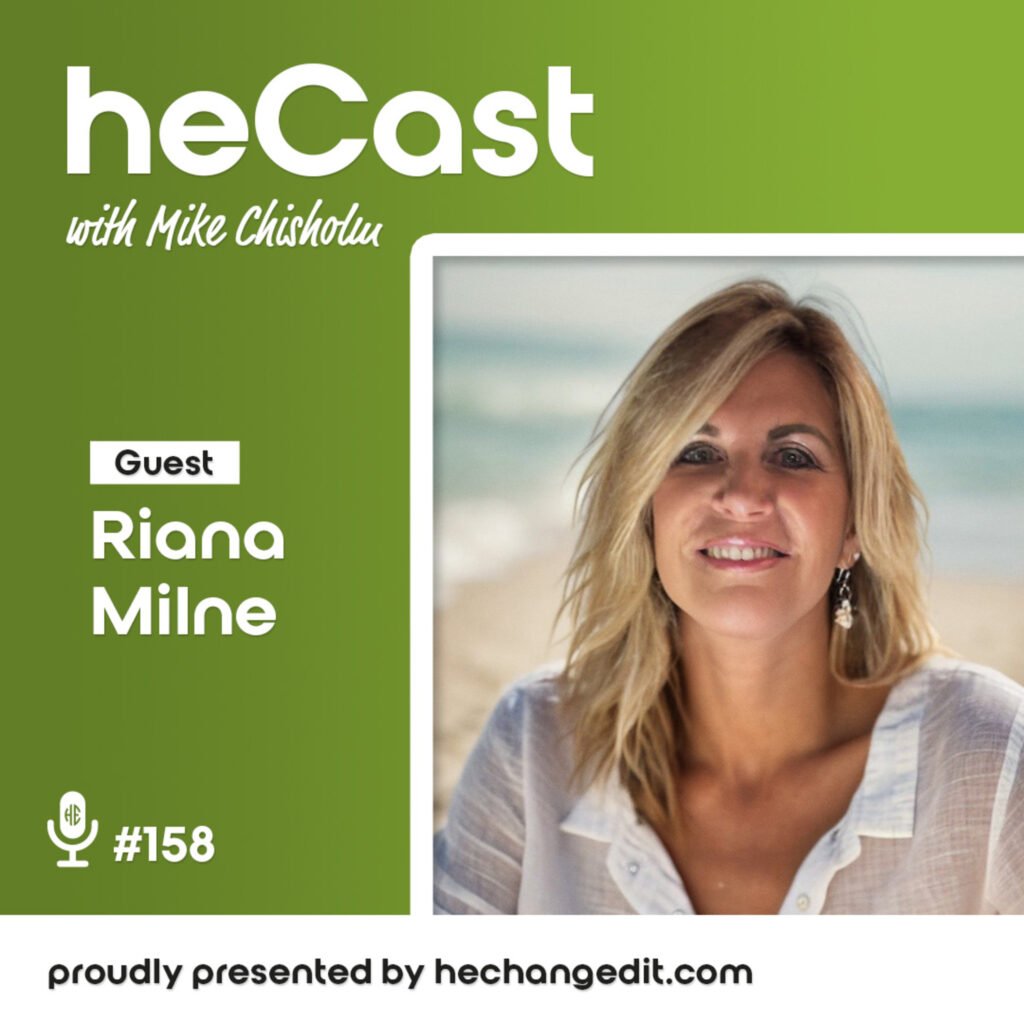
The conversation
About this episode
Episode 158 of heCast features Riana Milne in a powerful and practical conversation about childhood trauma, relationship patterns, emotional healing, and how our earliest experiences can quietly shape the way we love as adults.
Riana Milne is a Certified Life, Love Trauma Recovery & Mindset Coach, an Advanced Certified Clinical Trauma Professional, best-selling author, podcast host, and licensed mental health counselor with decades of experience helping people heal from both childhood and relationship trauma. In this episode, Mike and Riana explore how trauma is not always just the major events people typically think of, but can also come from the repeated smaller wounds, messages, and emotional experiences that influence self-worth, trust, intimacy, and connection over time.
Mike and Riana discuss the difference between “big T” and “little t” trauma, how unresolved childhood experiences show up in adult relationships, and why many people repeat painful patterns without understanding the root cause. They also talk about her childhood trauma checklist, her work helping singles and couples create healthier love, and how new tools like her 24/7 interactive AI love coach are making support more accessible for people ready to heal and grow.
This episode is for anyone who feels stuck in toxic relationship cycles, struggles with intimacy, self-worth, or emotional triggers, or wants to better understand the hidden patterns shaping their love life and personal growth.
Listen to heCast, the official podcast of HeChangedIt.
Download the HeChangedIt app for more tools, content, and support on your mental wellness journey.
Read transcript
Transcript supplied via Spotify RSS.
Welcome to He Cast, the official podcast of He Changed it.
As always, I am Mike Chisholm. As always, I am so excited to
have conversations centered around the world of men's mental
Wellness in the modern age where we are today.
We're all doing our best, right? Moving forward as best we
possibly can, you know, and in one of the, the areas that we
always get requests for people to, for, for topics to focus on,
it's around relationships. And I mean, I think that's
probably no surprise for any guy out there who's listening to
this in a relationship. They're not always the easiest
things in the world, are they? And who we have on today, She's
a, she's an expert. She really, really is.
She's been in the mental health space for 40 years, but for the
last 15 or so, she's really been focusing on the idea of
relationships and love. Rihanna Milne is her name.
You can look up her and her books, Live Beyond Your Dreams,
Love Beyond Your Dreams at rihannamilne.com.
She also has, it's crazy to say, an AI version of what it is that
she does that has just been launched as well.
We have a really good conversation today.
It's going to be the first of, of, of of many, I'm certain,
because really it gets the time gets slippery when we do these.
But but today's conversation is centered around the idea of
trauma that we have that we bring into relationships
knowingly or unknowingly many times And, and what trauma is we
go through that. It's certainly a word these days
that has many meanings for many different people.
We dissect all of that and things that may have happened
when we were a kid, whether we were aware of it.
Sometimes there's big T stuff, major events or not aware of it,
small little things, interactions that might happen
or a child that we then take on and bring into relationships and
how that can cause static in relationships.
We really focus on a lot of these things.
It's a beautiful conversation. I really appreciate her.
She's a very, very busy lady. I'm very grateful that she took
time out of her day. She appreciates the 'cause as to
what he changed. It is all about.
So without further ado, please enjoy my conversation with
Rihanna Milne. Rihanna, I cannot tell you how
excited I am to have you on he cast today.
If there's one topic that comes up over and over and over again,
that is many times the root of the other topics.
If there was one thing that men go through that that that we get
requests for, they'd say, hey, can we have some, can we get
some cover on this, please? Can we get some resources?
Can we get some help, some ideas, some it's it's
relationships and and to have you on here today, it's a real
honor for me. I appreciate it so much.
Thank you so much for taking time out of your insanely busy
schedule. Come on, he cast today.
Of course, I'm really happy to be here.
I work with a lot of men. I have for over 40 years and
really love helping them because the progression of once they
understand what childhood trauma is and then how it's showing up
in their adult life, it's just like the lights go off and we
can change everything. So giving them that extra
confidence, that ability to communicate, to feel safe, to
share their emotions, it's wonderful work.
I really enjoy working with my male clients.
I'm really glad to hear that. You know, you brought up the
word already trauma. And, and I mean, if, if there's,
if there's a word that in our time and place in 2026 that is
loaded, if there's a loaded word out there, it's probably the
word trauma. And I, the way that I always
look at it is, is, is trauma with a big T, trauma with a
little T. And, and, and I'm, I'm, I'm
excited to unpack this with you a little bit because really at
the end of the day, there are a lot of relationships out there
where there are people who are just not, they're missing
connections with each other. And it's not even necessarily
their fault of what's going on in the present moment.
It's because of patterns that have developed from a long time
ago, perhaps from an epic event like trauma.
Could you describe in your opinion, your, your take on
trauma and, and maybe perhaps what it used to mean, what it
means now? You 40 years is a long time to
understand the evolution of that word in our society.
Well, it's really interesting. I went for triple master's in
psychology and graduated year 2000.
So I've been a licensed mental health counselor for 26 years.
Then I became a certified coach for singles and couples in 2009
and 10. So I've been doing that eleven
years. But I had a couple of traumatic
relationships myself and I had a question, why am I attracting
people that hurt me? Like I'm a nice lady, I'm smart,
I'm a great mom, I'm successful in business.
Why am I successful in business but struggle and love?
And I went to seven therapist friends when I had a toxic
partner, and they were all surprised by his action.
He had a secret life and it shocked me.
And it was very devastating. And nobody had the answers.
And I'm like, well, what is it that he has?
So the word childhood trauma did not even exist.
So I went into the psychological libraries and did a whole lot of
research to help myself. And then I came up with the
slogan, you can't change what you don't know or understand
because I didn't understand it. So how could I change it?
How could I pick a better partner if I didn't know what I
was doing wrong? So I've been in the shoes of all
my clients. I get where they they've come
from. So it was interesting.
I started talking about childhood trauma by developing
the childhood trauma checklist, which we'll do today, which is
10 items, very simple to understand.
My clients can look at this and say yes or no, very simply if
they had these situations happen to them or not.
And I started talking about that because it came out in 2012, the
list. And in 2015, a fellow
psychologist said to me, you're making this up.
This is not in the DSM 4, which is our psychological manual, and
it doesn't exist. You're making it up.
I'm like, I swear to God, I'm not making it up.
So I was a rebel. I started talking about this in
2015, childhood trauma. And it's interesting now how
it's such a buzzword. I'm like, it really is at that
education to get out there. So I've been on podcasts since
2015 talking about this and trying to educate because it was
such a a HA moment. And my number 1 bestseller, Love
Beyond Your Dreams is based on the research that I found.
I got up to 400 pages. I'm like, Oh my God, I have to
stop. And then I started creating
notebooks for my clients. So for my couples, I have
relationship rescue, for the singles I have dating to mating.
So it all, it's all research based education, what I teach.
And then in 20, I think 16 or 17, I saw another chart that had
come out from Kaiser Permanente called the ACE test.
And I said, how could they miss abandonment?
How could they miss bullying? How could they miss my kids that
were in foster care? Because my list came from all my
work experience as a therapist. I worked in a mental health unit
for kids 5 through 19. I were and they were critically,
mentally upset, right? Emotionally upset kids.
I worked in the schools from kindergarten all the way through
college as what's called a student assistance counselor,
helping the emotionally upset student.
I worked in my own private practice called Therapy by the
Sea, which I still have. And I worked with women and
women and teens, two different drug and alcohol rehab centers,
'cause I'm a drug and alcohol counselor too.
So how did they develop this addiction?
So the addiction studies goes back to original childhood
trauma. And many of these women were
from the prison system. So I had found no matter their
age, their race, the culture, their upbringing, these top 10
traumas kept showing up. So as I was doing the research,
I created the checklist for my own clients, like, oh, this
makes it so easy to see what went on in my life.
And I said, now let's talk about how it's showing up for you
today as an adult. So, so, so the thing that the
thing that you talked about, you can't change what you don't
understand. What a, what a, what an aha
like, like for people who are listening to this and maybe
you're not in the place that you want to be, right?
The idea that you can't change what you don't understand.
Here's a question for you. How well do you understand where
you're at? And, and, and, and really at the
end of the day, this introspection is the type of
thing that we talked about on, on, on he cast all the time
this, you know, allowing people the opportunity to potentially
wake up and ask questions exactly like that.
You know, if I don't understand it, well, how can I change it?
That is even. Know it even know about it
because I don't know about childhood trauma.
And I'm like, childhood trauma. My childhood was normal.
That's what all my clients initially say to me.
And then I'm like, well, no, I have that one and I have that
one. It's like, oh, because my dad
wasn't home much. That's an abandonment issue for
me. So, you know, there's, it's very
interesting to know what they are, then understand them
deeper. And childhood trauma goes
through at least three generations.
So what did you have? And mom and dad and their
parents. So we have to look through the
whole family system to dissect that and and it helps for
forgiveness and understanding and that's part of the healing
process. OK, so I mean like here, let's
talk about like that T word that that word trauma.
I think that it's a very misunderstood word.
Like I said, I I I would go so far as to say it's Co opted in
our society. When I hear somebody saying that
they were traumatized because somebody put said mark instead
of Mike on their Starbucks cup. I'm sorry, it's just not, that's
not trauma, but but at the end of the day, though, I also don't
want to throw the baby out with the bathwater and minimize
because you can't judge trauma. You know what somebody's trauma
is. It doesn't matter where they
came from. If somebody said the wrong thing
at the right time when we're young, that could be something
that imprints and, and, and could be that word.
So could you describe in your mind what what what trauma
actually is and perhaps maybe what it is?
Actually, like you had said it a few minutes earlier, you said,
well, what's big T trauma and little T trauma?
And that's actually 2 terms that I want to discuss.
So a big T trauma is what most people would think trauma is.
Being in a car accident and losing your best friend, losing
your team, having a rape or molestation as a young child or
a teenager. That's a big T trauma.
Everyone gets that. The Little T traumas are more
ongoing, everyday things that happen that young children just
use to learn to adapt to in different ways.
And we'll go through the list and you'll see the difference
between Big T and Little T trauma as I go through them.
OK, and I'm grateful that you said it like that because I
think a lot of men out there certainly the stigma that that
that that we have been, you know, handed down in this time
and place in society many times is to look at what you were
talking about Your your the best friend dying in the car
accident. Well, that didn't happen to me.
I didn't have anything like that happens.
Therefore I everything else must just be something that I can
just, you know, put on my shoulders and carry on with.
When really at the end of the day, you get to a place where
you can only walk for so long with that stuff.
And and then it has to be reckoned with and it and getting
to a place where we can actually understand know that it's there.
First off, identify it and then understand it's there.
It sounds like that's exactly what what you try and get people
to do is that is that do you find that with men?
Is it? Yeah.
Together as a team. That's why why I love coaching
versus counseling because coaching is highly educational
and we work as a team. So what we do is bibliotherapy
with their notebook. It's like 150 pages.
They fill out very simple forms. From what they tell me, I know
what I have to teach them. So it's all personalized and
interactive, but we work together and I describe it like
a rainbow. You're starting at I don't know,
I don't know about this and I don't understand it.
So then I have to start educating, right?
So as they're learning, they're changing things and they're
learning the trauma recovery and the mindset tools to feel
better. Even holistic remedies for
Wellness, vitamins, meditation, the spirituality.
There's a lot of different things that I teach to help heal
as they're learning more, right? So they're learning, learning,
learning, and then they're starting to see change because
they're doing these new goals and learning these new
techniques and they feel better about themselves.
And it's doesn't happen. I mean, it happens pretty
quickly. The initial changes.
Some people say within 8 days to two weeks they're starting to
feel better. People at work say you're
smiling more, you've got more energy, what are you doing?
You look better and by the end they're actually in that pot of
gold where they just feel so amazing about themselves.
The personal transformation is so huge.
Then they look back and the last exercises we look back to Module
2 and this is where you are judging your life wheel.
Where are you with your friendships?
How many friends do you have? How are you with your finances?
How are you spiritually? How are you with a partner, if
you have one, or your confidence in dating?
So we look at all of that, the whole life interaction.
What are their goals and dreams? When they're over here at the
end, they're like, Oh my God, these are all now 90 to 100%.
They were like 10 to 25% in the beginning.
So we do a lot of work together, but it's fun and it's exciting
because they feel so much better as we get started with the
transformation. So it's really great work.
Jump jumps like that. I mean, like it just shows the
power of awareness and mindfulness.
And when you combine those two things together, how, how, how
quickly things can change for people.
You know, you brought up the idea that there there's going to
be guys who are listening to this right now, you know, talk
about the idea of being with someone who is toxic.
OK, fair enough. There are guys who are listening
to this that might be the toxic person and they don't even know.
There's also a combination like when you talk about a
relationship and when you talk about these events that happened
in childhood that may just be subtle, really, really subtle.
And there is no awareness whatsoever, doesn't even know,
you know, and and you help obviously to mine these things
out. It feels like, like when you,
when you, when you put it in that perspective, if all of us
who are in a relationship, we bring that stuff with us, They
bring that stuff with them. And now boy, oh boy, you mix
this stuff and that's where the fireworks can show up.
And, and, but there are guys who are who are listening to this,
that that might be the toxic person in their relationship
without even knowing that. Do you ever?
Find them deep down when they come to me.
Rihanna. I haven't been successful in my
relationships or the girls keep breaking up with me or I know
I'm lying to her, but I want that, you know, or I'm addicted
to porn and I hide it, you know, And if she knew, she would break
up with me. So there's The Secret Life part
of it or impulse. And you know, it's funny.
After I wrote Love Beyond Your Dreams, I sent the sample copy
to my ex. And it goes, oh, my God, I
finally know what was wrong with me.
Thank you for writing this book. And it's 400 pages.
It's called the Guidebook to Love on Amazon.
And I didn't know what was wrong with him.
And that was what sought my journey.
And he had nine out of the 10 top traumas.
So that also made me give some compassion and forgiveness and
understanding to he was really hurting emotionally.
And he acted out in these certain ways to, for a Band-Aid
or to feel happy or to feel good.
And he learned, Oh my God, I know what's wrong with me now,
you know, and I can fix this. Of course, I didn't work with
him after that point. I said, well, find yourself a
certified clinical trauma professional and, and get
started and you know, for your healing journey.
But it really did help my journey in that research to be
able to forgive him, knowing from the childhood traumas he
grew up with. So again, to put it, to put it,
you know, the, the, the idea of the listener out here who might
be an X to somebody. What a beautiful experience for
you to have that kind of, if you want to call it closure or, or
at least at least you know, a, a little bit of, of, of repair
acknowledgement between the two of you.
Because then both of you can take that repair and you can
take the healing from that and move it into wherever your life
goes next time. There's a lot of guys right now
who might be thinking, OK, I wanna hear some of this stuff.
So, so, so you say talk about some of these top traumas I with
men. And specifically, are there one
or two or three on that list that kind of bubble up to the
surface a little bit more than other ones or is it across the
board? Yes, as I go through them, I
will state the ones that I think men are mostly impacted by, but
the interesting thing about the childhood trauma checklist, and
people can get that on my website for free at
rihannamilne.com if you can't write them down right now.
So help yourself to that. But it, like I said, it's across
cultures, It's works with straight or LGBTQ individuals,
younger, older men, women, it doesn't matter.
It, it's, it was kind of blew my mind that this list, the generic
list, there's no prejudice on it.
It impacts all of us. So I'll start with #1 which is
growing up with any addiction in the family.
And most people in the ACE test just only said drugs and
alcohol. Well, I'm a drug and alcohol
addictions counselor, so I have 12 OK addictions that could
impact you as a child if they existed in your primary family.
So it's drugs, alcohol, sex, meaning you knew your parent was
a cheater and you kept the secret.
Porn use, gambling, hoarding, spending, eating, gaming, TV
watching, social media addiction and workaholism.
So if the parent is more involved in one of those
addictions and the child's just kind of off to the side while
they're on their phone constantly or on the computer,
or you know, the, the, the father that might be working all
day, come home, eat dinner, then go into his office and just kind
of ignore the child. These are samples of those types
of addiction, gaming addiction. I've had 1415 year olds with
gaming addiction that were skipping school and cursing out
their parents, refusing to eat to be on their games.
So these kind of addictions do impact the family and if you've
noticed any of those in your current family or past family,
it's something to look at. OK, there you go.
The second one, which I think is one of the most impactful for
everyone, men included, is verbal messaging.
That's trauma too. So did you hear the words?
I love you, I'm proud of you. Great job, kiddo.
You know things that are accolades that made you feel
good about yourself. Or was there messages of put
down like I'm not sending you to college, you're not smart
enough. Why should I waste my money?
Like that's a verbal put down or you know, the the parent on the
side, the football stadium screaming at his kid, you're a
moron. Get the ball.
You know these parent coaches, you know, that are constantly
yelling at their kids really bad stuff.
You're implanting these messages constantly over and over to the
point where your child's afraid of you or they don't even want
to play the sport or you know, it's they're performing for
their father or just to get some love and accolades.
So this is verbal messaging is huge.
I was going to ask you about that.
I'm glad you. I'm glad you you mentioned it
that way because earning like you think, OK, well, no, I was,
I was brought up in a house where they told me they love me
all the time and I felt I felt all that.
But was it unconditional? Well, no.
Many times I had to go and I had to earn that in some way, shape
or form. The only time I got that
positive messaging was when I earned it.
So I I love that you made that distinction because people who
grew up in that, is it possible that maybe.
I exhibit that with the people that are around me now because
that's what IA monkey see monkey do.
Like, you know, it's called normalization of the behavior
you normalize. My dad did it and I turned out
to be a good football hero. So I'm going to do it for my kid
that way. And then you're kind of like
buried down, you know, the messages that weren't very
positive. And it's funny, it's different
generations too. Like I'm part of the baby boomer
generation and I was on the beach with 9 of my cohorts and I
told them I said, you know, did you hear the words I love you?
And everyone's like no. And I said I didn't either.
And I finally asked my mother. I was fourth out of five kids
and I was pregnant with her first grandchild.
And I asked her, I was like, mom, why don't you ever tell us
kids that you love us? Well, you know I do.
It's a response back. And I said, well of course we
know you do mom, you do all these things for us.
But why don't you say the word? She goes, well, those aren't
words I ever heard. I grew up in the Great
Depression. My parents didn't tell me that
if we had food on the table, that was love.
So now people that are like my daughter's ages, which are in
their 40s, they got a lot of love and a lot of hugs because
we didn't hear it. So it's like, well, I'm when I'm
a parent, I'm going to overload that, you know?
So it's different generations have different emotional
responses to these verbal messages as well.
So I think that's an interesting part.
Absolutely. I'm glad you, I'm glad you
talked about that because again, I, I, I feel like, like I look
at my father and he had the issues that he had.
We just lost him last year and, and, and, and he grew up in
horror, absolute horror. He had to, he end up, ended up
leaving the house and living as a man when he was 15 years old.
And, and that's what he ended up having to do.
And it's funny because, you know, we grew up in a household
with anger, lots of it. And, and, and, but I'll tell you
this, he grew up like, I believe that every generation, whether
it's consciously or subconsciously, tries to patch a
hole in the bottom of the boat. I didn't.
I didn't know alcohol in my house.
There was no alcohol, not a drop of alcohol in my house.
The first time I ever saw a house with alcohol was when I
went for a sleepover when I was about 10 years old and I saw it
in somebody else's house. Why was that the case?
My dad said I will never live in a house with my family, will
never have alcohol. So while of course he had
shortcomings, there were things that he tried to bottom holes in
the bottom of the boat that he tried to patch.
And I think a lot of us do that. Alcoholic.
That's Oh yeah. The horror that he grew up in
was very much centered around alcohol and, and, and, and
things like that. And so, so, so yeah.
But not saying he was perfect, but that was the thing that he
tried to to solve. We love to like my granddaughter
again. I'm all over her.
Like she, she will never, ever, ever not know that I love that
her paw loves her, right. But what are the blind spots
that I still have? And I think that these are
really good questions. Your father is what we call
ACOA, adult child of an alcoholic.
And I also say N ever trauma 'cause once you know the 10
traumas, you'll know. But that test is also free on
rihannamilne.com. So if anyone else similar to you
had a, a father or parent that was a child of an alcoholic,
there's the three generations right there impacting you.
So they may not have the alcohol in the home, but the problem is
they still have the anger that was never healed.
So this comes out in verbal messaging as well.
And they're fighting between mom and dad, right?
Because their trauma was never healed.
So it is passed down until you finally learn this education and
then you know, you work with it with your partner, and then you
raise your children totally differently.
Yeah, I appreciate this so much. This is so great.
What's the third one? I love seeing them brought up
with this very emotional loving home because my girls understand
this work, so it's really awesome.
OK, so the third one is any emotional abuse or neglect.
So we mostly understand what that is, but the a lot of
reports also came out for the single working mom in the 70s
when we married. There was a lot of divorces
after because the women were expected to.
I mean, there was even a commercial on it.
Anjali. I can, you know, bring home the
bake and fry it up in a pan and always prove that you're a man
'cause I'm an Anjali woman. I don't know if you remember
that commercial. I I Yes I do.
Do it all or you're less than a woman, was the message.
And eventually we're like, screw this, we're out of here.
You know, we need a partner who's a teammate.
So there was a lot of divorce for your generation.
You're a little bit older than my daughter, my 2 girls.
But you know, they went through the divorce, of course.
So but they were saying the working mom, that was the
collecting their kids because they were latchkey kids.
There wasn't cell phones back then.
You know, there's only house phones and no baby cameras where
you could say, OK, my daughter's home safely or ring, you know,
none of those devices that gave them that security, my
daughter's home and everything's OK.
But we had to work to support the family.
So the childhood trauma is understanding them is not about
blaming the parent. You know, most of them did the
best they knew how. And the single mom was, well, we
have to work to support our kids.
And I had found a lot of the millennial men like my son in
law's had a lot of love and dedication to their moms because
they saw how difficult it was for her to hold that together
and still give them love. And if she could give herself
some self love, you know, it was a difficult time.
So but that fell under some neglect.
You know, if the mom had to work all the time, she was out of the
house. It's very interesting that I
find it very interesting that emotional abuse and neglect are
in the same category because you'd think that they're two
different behaviors, but at the end of the day, the net result,
it results in a similar trauma or trauma response.
So everything Mike is A1 to A10 level 10 is the worst.
One at one or two is OK. She had to work.
But I understood that we worked through it and yeah, I didn't
really like being home alone. I was aware.
I was aware. I had awareness of the of, of
things because we have awareness.
Again, it kind of takes the pressure out of the balloon,
right? Yeah, yeah, that's the mystery,
OK #4 and this is inside or outside of the home.
Any of these traumas, you could have a perfect home life but not
at school or something happened to you in the community would be
rape, molestation or physical abuse actually being hit.
You know, working in the schools, I was the one that had
a call DYFUS in New Jersey, the Division of Youth and Family
Services, if my students said they were being hit by switches,
which is a tree branch or an electrical cord.
I even had a young boy raised by the grandmother because the
mother was a drug addicted. The father was just gone and she
hit him with metal trucks on his genitals, you know.
So, you know, the things that you hear and see as a trauma
counts are quite sad. So you know, it's, it's the
degrees of 12:50. You can see why there, there's
so much. And one of the statistics too
was for men and boys. Unfortunately, 4 out of six were
molested or touched and usually by someone they knew.
So I work with a lot of men around that, that they, they
feel shamed or they would never tell anybody.
I've had men that ate so much food to just like not be
desirable. So they didn't have to be
touched, you know, So the impact on your mental health goes very
deep when, when these things are a part of your life.
And those would be a big T trauma, of course, and one
that's a big T trauma for men. OK.
Yeah, absolutely. Women as well, but men also.
You mentioned the shame earlier. I, I, I want to, I, you know, I
think it's really important to kind of throw out there.
There are a lot of guys who hide things because of, of the idea
of shame and they might not even realize that that's what it is
as well. And, and, and I think that
that's, I, I'm grateful that you mentioned that.
I just want to put an exclamation point on that
because you know, really at the end of the day, when the
flashlight shines on things, it's not, I'm not saying it's
not as hard, it's not hard. But at the end of the day, many
times it's much easier then carrying the weight of the shame
that is unknown. The known is many times easier
than the unknown. Again, you know.
Getting it out there and sharing the secret and that, that helps
take away the shame. And it's like, you know, there's
nothing I haven't heard yet from any of my clients in all these
years I've been working with men and women and couples.
So, you know, they know I'm there.
I'm on their side. It's like, you know, I give them
the compassion and the space to grieve that innocence that was
lost, right? But they do understand that
childhood trauma is not their fault.
They didn't 'cause this, you know, they were just a victim in
this household that that's all they knew.
So that's why I say just covering it up or having a
secret about it or it's my uncle.
He's touching me because he loves me, you know, and this is
what he's saying he's doing, you know, and rewriting that story.
So as a child, you can accept it and just keep on with a somewhat
normal life, Right. So.
Yeah. I'm glad you mentioned that
though, because there's a lot of shame out there.
And it's, I don't want to say it's, I don't want to minimize
it, but I do want to say there's a lot of needless shame out
there. And the needlessness is because
of, you know, this, this, this ego or stigma or, or, or
whatever it might be. And again, we're, we're
generalizing here. There's a lot of different stuff
that's out there. Obviously, you know, for, for,
for, for guys who might be, if any, if any of this is touching
a nerve of any sort, you know, go out and find out what it
might be from somebody who, who, who can help you with that.
But but if we're, if we're, I think.
It helps to normalize it a little bit, like 4 out of 6 boys
were touched inappropriately. And, you know, just that.
It's the stigma of, you know, this happens more than you
realize, you know. And in 2021, childhood trauma
research and other researchers said 100% of us have some of
these traumas. So you're not different if you
have them. We all have something, you know,
So it's just identifying what it is, how it happened.
It's like factual identification.
OK, yes, this happened. So how is this causing me grief
now in my adult life and then healing that right?
I'm going to get I'm going to get really, really, really
vulnerable. I'm going to say something I've
never said on the podcast before, OK.
And it's it's a question that's kind of related to this because
that to my knowledge, never happened to me when I was a
child. But I will say this, when I, I
was in the second grade, a gal in my neighborhood and I, we
played some doctor and it was, it was I would even now thinking
back on it, consider it to be a very I don't even want to if I'd
call it a pause. It was a playful experience.
I was led into it, but it wasn't a coercion of any sort.
There was there was that sort of a thing.
But at that point, when you talk about the idea of innocence
lost, can those types of events lead to what it is that we're
talking about? Patterns that develop all the
way into adulthood when things like that happen.
OK, so I'm glad you mentioned that too, 'cause I have young
children that have experienced that.
There's a certain age where it's just childhood curiosity.
Yes, I would put this in that that.
Category and nobody's hurt. No one's manipulated.
Nobody is forced upon. Yeah, it's kind of is childhood
play and curiosity. Of course, when the parents find
out, they blow it up. They make it a big deal.
And it's like. Oh yeah.
It was shamed about my body. OK, so.
As I was talking, I was realizing there's a good chance
my mother will listen to or watch this show, and she does
not know that this is the case. So yes, I hear that.
Even at 50 years old, I hear that.
Talk to me, Mike. It's pretty.
There it is. There it is.
Yeah, so that, but there's a certain age where it's not.
So if there's a 7 year old girl and a 13 year old boy, he's of
age now to know that's not appropriate, right, Right.
So you really have to make the distinction when I have somebody
in front of me, if this was childhood curiosity or if it's
manipulative, right? So.
Right, and but, but does the childhood curiosity part still
leave some of the lingering things that can move into
adulthood at that point? Or would you say it's they were?
Caught and how their parents handled it.
Perhaps. There you go.
There you go. OK.
You shouldn't be showing your body to anyone and right, that's
dirty, what you're doing or you know, again, verbal messaging.
And there you go. You're handled or do you educate
your child? Well, it's normal for you to be
curious. Let's read some books about boy
and girl bodies and why they're different.
That's a whole different approach.
Then you should be ashamed of yourself, right so. 100%.
Parents need to be educated on what childhood trauma is and are
they raising their children in an emotionally healthy
environment. But you're, you're, you're,
you're, you're certainly, certainly showing how I think
you're doing a really good job showing how these patterns from
then can then lead to, you know, patterns through adolescence,
patterns through young adulthood, patterns into when
you get into long term relationships as an adult.
And these things, we don't even know that they're there.
And This is why this exploration is so important.
I want to make sure we get through the whole list.
So let's let's let's keep going. OK, one other thing about the
sexual, You know, some men kind of brag.
Well, I was only 10 and a 14 year old girl came on to me and
wow, now you know, I'm a young man, you know, and they kind of
brag about that. But they're often the men that
are turned on to put pornography early.
It's like this switch in the brain that goes on and you know,
now they're always curious. It's like cocaine to a young
person or drinking alcohol when you're 12.
It's the addiction part of the brain.
The earlier you start, the worse the scenario will be as you get
older. So they kind of take it as a
bravado thing, but in a lot of ways it could be messing with
their relationship or they could be hyper sexual, oversexed,
needing sex every day. And if the woman doesn't give it
to them, they're mad or they're upset or they brag on their
first or second date. Well, you should know I'm highly
sexual. I said the women, you know, run
from that because that's something they haven't really
dealt with. It's more of a conquest or a a
bragging thing. So, you know, this goes very
deep. There's a ton of examples we
could go into, but we'll move on to the next one.
Yeah, let's yeah, yeah, let's move on to the next one.
OK, hold on, hold on. Before we do for a guy who's
listening to No, I'm just saying it because I always try and come
from the perspective of there's a guy listening to this right
now that might be that guy. So the guy who hears that and
has sort of a light bulb moment at that point, is there one or
two things that that that that that you could kind of throw
their way like a couple little Nuggets there that might show
them First off, they're not alone.
Obviously they're not alone. Hey, you're not alone if this is
you right now. I think that's very powerful
right there. But is there anything else that
you would throw at that? I have a lot of couples where
the concern is porn addiction and porn use.
And I always recommend Out of the Shadows by Patrick Carnes,
who is one of the leading mental health practitioners on
pornography addiction and his wife is Stephanie Karns and her
book is called Mending A Shattered Heart.
So I always recommend those two and I actually had a sexual
addiction expert on my podcast Lessons in Life and Love.
So they can go into my Lessons in lifeandlove.com and and
listen to a deeper dive into that whole issue there.
Thanks, Rihanna. I appreciate.
I appreciate you doing that. Thank you so much.
I just just the guy who hears that and says now what?
I like to just provide now what's if we can a little bit.
So thank you so much for that. What's the next one?
OK, so the next one, what are we up to #5?
OK, this is a big one. This is around abandonment.
So I named two types, fault and no fault abandonment.
So a no fault abandonment. An example, if a parent happens
to die early, if the parent was deployed to war or if they had
to travel quite a lot to support the family because the kids
feel, you know, I remember growing up that way, but we
didn't know where my dad was. We later find out when we get
letters from Ronald Reagan and William Casey.
He was FBI and CIA. But I remember as a kid saying,
when's where's dad, When's daddy coming home?
And my mom would be, well, I don't know where he is.
I'm like, well, why not? And that was like a normal
question in our family, where's dad or when's he coming home?
And we just didn't know. But that's a no fault
abandonment. That's how he supported the
family. Then there's a fault
abandonment. This is if you never see your
child, if they're you were together and there's a divorce
or a breakup and then you barely see your child or you promise to
see your child and don't deliver on that promise.
Or you're there in the room, but you're not interacting with the
child. Now of course working in the
schools, I have therapy with a lot of kids and I remember 1
little boy saying, well I don't want to go to my dad's.
He just sits there and watches football.
So I'm in my room just playing on my computer.
Why should I even go there when he doesn't even talk to me?
Now that's false abandonment. He feels isolated, left alone,
not played with, not going on an adventure day somewhere.
So that's one thing. I always work with my clients
when they're there. How is your parent child
relationships? Let's fix them.
Let's start talking honestly with your kids and sharing your
emotions and say, I'm proud of you kid and great job.
I saw you trying so hard out there, you know, and if he says,
well, I didn't get a basket and basketball and goes, that's OK,
You know, you tried your best. So dad's really proud of you for
that. You know, these kind of verbal
messages are king, really important.
You know, you talk about abandonment, abandonment and
neglect. Are they, are they the same
thing? Are they a little bit different
from each other? But customs?
Me, it's different. It's a it's the same category.
Yeah. And like I said, the ACE test
didn't even have abandonment in there.
And I saw so much of that everywhere that I was.
I'm like, how could they miss abandonment?
So you know, kids normalize more when you know it's a no fault
abandonment. Of course, like my right, I
would see in the schools the kids grades go down and then
they're diagnosed ADHD. I'm like that child's not ADHD.
His father's over in Iraq and scared to death he won't come
home, you know, So he's coming in traumatized, ongoing.
And the truth is in the body, when cortisol is up, memory and
focus is down. So the kids kind of just checked
out emotionally glaring out the window.
You know, I might have seen news reports the night before hearing
news stories. And it's scary for these little
ones, right? So.
You know, unfortunately they have removed what they call the
SAC counselors, which is what I did, the emotional mental health
and Wellness counselor from the schools.
This should be the first person to be hired even before a
football coach because every child needs emotional Wellness
and support to talk about these fear based issues.
And I did a lot of behavioral modification with these kids so
they weren't ADHD. You know, we did meditation, we
did music therapy, we did positive reinforcement.
You know, where there's a treasure chest that they'd had a
star that day, they could reach into the treasure chest and get
a prize. I you know, so and just talk
about, well, I miss my dad, you know, where is he going to come
home, you know, and normalizing that feeling for that child so
he can really talk to him about someone because he can't talk to
his mom about it because mom's already freaked out, right?
So there's, there's all these different things that go on in
life. Right now is a very scary time.
The time of COVID where kids couldn't even go to school.
Those children now are like, I have grandchildren in that age
range, 12 to 9 through 1213. And that age group, there's four
years, couldn't go to school, worried if mom or dad goes out
to work, are they going to come home alive or hearing all these
deaths, That's a big trauma. Absolutely.
That's for community trauma, by the way.
OK. Before before we go to the next
one, I really want to just say how grateful I am for this
conversation because you know, you guys who might be listening
to this might be in a place where, oh gosh, that was me.
But there are also a lot of fathers who listen to this.
And So what you're doing also is you're, you're, you're, you're
turning on light bulbs for fathers that are out there
again, for things they might even know exist.
And now that there's a, a potential awareness or
mindfulness that, that that's there as well.
So thank you again for that. You're welcome.
Yeah, it's really important. And I always teach as if they
are parents or will be parents one day.
And also, how did they grow up? So looking at all these
different generations. OK.
And that's number 5A round abandonment.
Number six is you're part of the foster care system, had to go
live at somebody else's house 'cause your parents couldn't
keep you or were sent away, like the foster care system.
And I worked with a lot of kids in foster care, so they deserve
their own category. And sometimes children of
adoption feel like, oh, well, my parents didn't love me.
They gave me up, even though the adoptive parents were fabulous,
you know, there's still that emptiness.
Why did my birth mother love me or want me?
Right. So that's number six.
And even going to live at someone else's house, even if
his grandma or an aunt or a family friend, you still feel
disposed from your mom or dad. Right.
Yeah. So get that out there.
Let's get it. Let's get the awareness there so
you can unpack some of that stuff.
OK #7 is personal trauma and this is a big one for men and
women. So this is if you felt different
in any way. So you could have been a chubby
child and tease for that or tall, skinny and gawking called
the nerd, which I was. You could have been, you know,
gay or lesbian coming out in school and your kids or your
family rejected you. You could have been, you know,
the only African American in all Caucasian schools.
So you felt different because of that.
So, you know, there's so many reasons you felt different.
Identified as ADHD or pulled out for special classes, you know,
and you're embarrassed about that.
And I see all these dynamics at the schools, right?
So I was really hands on working with the kids going through
these things. So anyway that you felt
different? That's basically trauma 7.
And hey, everybody who isn't in that category, right?
And you think about that, like think about your childhood who
wasn't in that category. Again, you're not alone.
And sometimes little things like that.
For me, I was told I had a big nose growing up.
You know what? I, I unpacked it.
I'm glad I unpacked it. But that was one of those things
that for about two years in elementary school, I carried
with me for a long time. It was made.
It was 2 comments that people made.
It was one one day of being made fun of by two people.
Yesterday. There it is, there it is.
So again, small T, but long, long effect.
So again, not alone. All right, let's keep going.
OK so trauma 8 is around siblings, sibling trauma.
So three ways this could show up. 1A sibling of yours was born
with a medical issue, so that commanded more of mom's and
dad's time. And you felt kind of alone
because they always said, well, you're OK, we have to help your
brother or your sister. The child understands it, but it
doesn't mean they didn't feel alone.
OK. Another one is the sibling
bullied them, beat them up the older brother.
I wouldn't teach you to be tough.
These kinds of things, you know, or the third one where a lot of
women felt this, I think more maybe than the men.
But there was always like the sibling hero or the what we call
the golden child. You know, I grew up fourth out
of five, but in between two brothers and my brothers were
all American Water polo swimmers, which is great.
You know, I love my brothers. It didn't cause rift between us,
but it was really evident that my mom favored the boys.
But why did she? These were the men of the house,
right? So I had sister, sister,
brother, me brother. So they were the, her golden
child, you know, and complimenting them.
And, you know, I was always the one that had to work harder to
get some attention or get a compliment.
My first compliment was when I was 50 when my book Love Beyond
Your Dreams went on #1 bestseller on Amazon.
My mom's there. It's a really great book.
I read the whole thing and I'm telling my ladies at the at, at
Bridge about it. I'm like, you are like, I was
shocked. I got a compliment.
So these are things I remember right?
Like, Oh my gosh, my first compliment when my mom said I
did a good job, but of course it gave me worth, worth ethics.
So he's successful entrepreneur of several businesses and you
know, so you find the good from the bad.
And this is part of rewriting the story of trauma healing.
You know this happened, but what good can we find from what
happened? That's just an example.
So that's. Fantastic.
That's OK. So sibling, what's the next one?
The only reason that we're rushing through it everybody is
because she's got a client coming up and I've been told
that we got to keep it under an hour now.
So anyway, anyway, but but what's what's the next one?
OK #9 is 2. I had to move it down #11
because it came so prevalent #11 was community trauma.
So the example is COVID, our Mother Earth events, flood,
fires, hurricanes, you know, where it wipes out entire
communities. And of course, this war, any
kind of war is a community trauma.
And it mixes with family trauma, which was always #9 so that
could be growing up in an area of poverty, struggling
financially, dad losing jobs. Medical.
Something medical. Medical and the family, yeah,
the parents being incarcerated, you know, so any kind of family
trauma. And then #10 is one of the
hardest ones as well. Mental health issues.
And mom or dad. And the two most difficult is
borderline personality, which I'm going to describe is when
they were good, they were great. When they were bad, they were
horrid. And the kid never knew what they
were going to get when they opened the door from school that
day. Is dad going to be in a good
mood or is he going to scream at me today?
You didn't know? And it keeps the child always on
edge. And most of my clients coming to
me have ongoing anxiety. And it's from these these
personality disorders. The other one is bipolar and
that's manic depressive. A lot of people think manic
phase is a high and happy phase. Well, it could be.
Let's say you're gambling and you won $2000 and you feel
great. You go back an hour later and
you lose 5000. Now you don't have the mortgage
money and you're depressed for two months, right?
So a manic phase is always followed by the depression
stage, and that's a hard one to live with, but borderline I
think is the most challenging. The ups and downs and the, and,
and I think a lot of us, I, that was something my dad, my father
had, he was, he was, he was a borderline personality disorder.
And it's exactly like you say, you know, the fight or flight
almost never turned off. You know, for us, we didn't know
what was going to happen. It is, it got to the point where
I was so astute. I think it's where my curiosity
comes from. I actually think it's why I'm a,
why I'm a good podcast host in both my shows because I'm
naturally curious. But I think it came from a dark
place. I could tell the way that Dad
would drive into the driveway. If he was in a good mood or.
What kind of mood he was in. I could tell the way, never mind
the way he would slam the door or whatever.
That was the early stuff. I could actually tell by the way
he was, he drove in at 5:00 every day.
I, I, I, I knew. And that was something that, you
know, again, the, the, the, the idea when you don't know what
you're going to have in a household, whether it's a,
whether it's a spouse, whether it's a parent, whatever it is,
you don't know what you're gonna get constantly on edge.
That's gonna lead to some stuff. The good news is, though, is
that we can, there are solves for these things.
Identifying an awareness is a huge one.
And there are exercises and things that we can do for that.
I'm gonna ask you this. You've got an AI Rihanna, which
which is so interesting to me. You've got an actual, you've
taken things technologically into the next, the next step.
Does your AI version of the of of you know all of these things
and and is this the perspective that that I guess she for lack
of a better care comes from? It's called Rihanna AI and it's
located at lovecoachonline.com. Lovecoachonline.com and there's
either a text bot where you can type in your question and it
will answer the one I love the most.
It looks like I'm on Zoom. It's a me on Zoom, actually.
And you just talk to your computer.
Hey, Rihanna, I broke up with my girlfriend.
I'm pretty depressed about it. My name's Jim and my avatar
would say, hey, Jim, nice to meet you.
I'm really sorry to hear about your breakup.
Let's talk about what you can do so it is trained on my live and
love beyond Your Dreams books, my courses, 40 years of teaching
Mindset for success. Since my 20s, I've been teaching
that my license, mental health work, my trauma recovery work,
everything. I have been feeding this and
waiting for AI to get developed enough so that I could put it
out there. And the main goal for this,
which I absolutely love, is it talks in any language.
So you can talk Japanese to my avatar, it will talk Japanese
back. And I can't do that.
So I couldn't help people around the world except if they
understood English. Now it can be anybody anywhere,
and it's 24/7. You can sign on when you want.
Especially all you know, most distress happens at night or
fights with your partner happen at night.
You just sign on. Hey, this just happened.
What should I do to calm her down?
OK, let's talk about it. Here's some things you can do.
Boom. You know, instant answers,
solution focused and all trained on my work exclusively.
Life is trippy. We live in weird times.
That is so trippy. What you just described.
Did you ever at the beginning, you've been doing this for 40
years at the beginning of your career, did you ever even fathom
the idea that you would have something that you just
described out there, an AI version of yourself that can be
there and it can kind of throw things out, be a beautiful
gateway for people to show them potentially an Ave. for
solution. Did you even think for a second
that would be? Possible.
I was talking to tech teams to say can you do this for me?
Can you? Didn't know.
No, it's not developed yet. I'm like, OK, so as soon as I
knew it was out, I went to work on it.
I brought it out Valentine's Day.
So it's about a month old and I'm so proud of it.
It's so exciting. It's love coach online.com and
there's. A free trial.
Right now and you can get the e-book have the love you deserve
for free just for trying it. The video chat is $5 for three
days because I have to pay on each usage.
Obviously the tech spot is a little bit more economic for me,
so that's just a free trial. And yeah, it's really exciting,
really good stuff. So if they can't reach me or
they speak in a different language than me, they still can
get the help that they need. And trauma.
Childhood trauma and love. Trauma recovery.
And where is it again? Love Coach
online.isthatwhatitislovecoachonline.com yes, what a what a wonderful
URL. Congratulations on getting that.
That's fantastic too. I just, you know, to close it
up. I know time is slippery when we
do these things and, and I I just appreciate your time.
I hope you come back one day. We can dive in a little bit
deeper so much. More to cover Mike.
Well, there is, I know. We didn't do how this shows up
now as an adult, so we're going to have to do a Part 2 here.
I can't wait. I and I mean that like like
let's do a Part 2. I can't wait.
As we kind of finish up and close off the first one, guys
that are out there that are feeling this, they're feeling,
they're feeling that a twig something that their
relationship isn't right. They are toxic.
They're with someone who's toxic.
Do you have any kind of overarching parting words before
we close up this episode? Yeah, I mean, my slogan is
always this. You know, life is short.
Now is the time to create the life you desire and have the
love you deserve. You can meet with me to do do
these five simple assessments for two hours for only $97.00.
You can order that at my website, rihannamilne.com, where
you can find those free tests. You can do the free test, but I
don't get a copy of it. If you do the discovery session
with me for two hours, I get the test, we dissect them and we
come up with a blueprint to help your healing journey.
So it's real simple to meet with me.
I may be international and global, but I'm a very small
town in my service. What I find is that the $97.00
for for something like that is certainly never the issue.
The issue is getting out of our own way.
The issue is, is is is many times admitting that we need the
help and then taking the step to do it.
You're not alone. This is exactly why we do the
show. Guys that are out there, you
know, keep fighting the good fight.
I just appreciate you Rihanna for taking time out of your
insane schedule. I know how busy you are.
This has been another episode of he cast the official podcast of
he changed it. My name is Mike Chisholm.
Go change something.
Transcript
Read along with this episode
A source transcript is available for this conversation.