
All heCast episodes

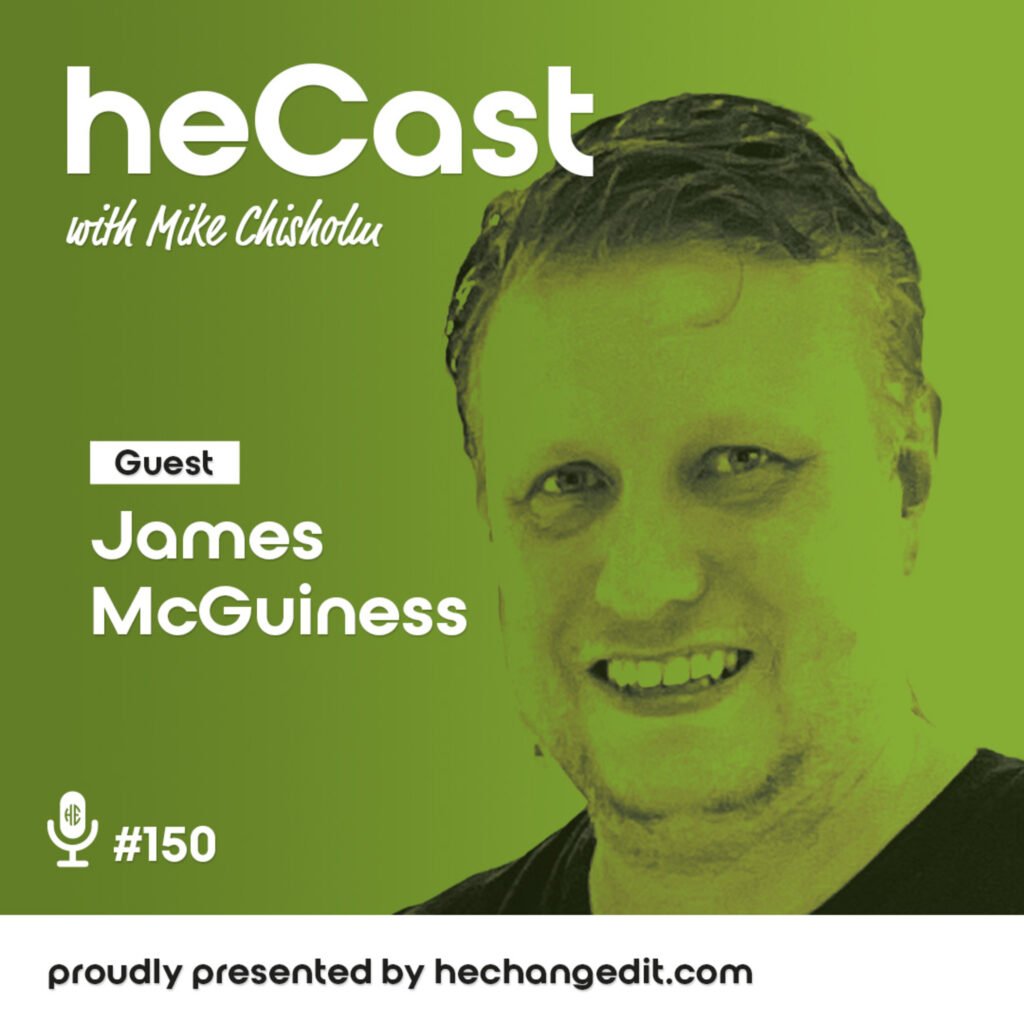
heCast Episode 150

James McGuinness on Men’s Mental Health, Vulnerability, Trauma, and Resilience

Season 3 01:13:08 March 10, 2026
Listen now 01:13:08
heCast Episode 150: James McGuinness on Men’s Mental Health, Vulnerability, Trauma, and Resilience

About this episode

Episode 150 of heCast features James McGuinness in a raw and honest conversation about men’s mental health, vulnerability, trauma, grief, resilience, and the courage it takes to keep going through life’s hardest moments.

James McGuinness is a UK-born, US-based author, consultant, husband, and father who has spent years navigating both personal and family mental health challenges while working in the fast-paced world of tech sales and startups. In this episode, he shares how adversity has shaped his perspective and why removing the stigma around men opening up is more important than ever.

James reflects on a lifetime of difficult experiences, including childhood financial instability, losing his best friend, finding his father homeless, moving to a new country, miscarriages in his family, surviving the Highland Park July 4 parade shooting, supporting his daughter through liver failure, grieving the loss of his father, and processing the emotional impact of losing his job through layoffs.

Together, Mike and James explore what men’s mental health really looks like behind the surface — the shame, the silence, the pressure, and the turning point that can come when someone chooses honesty over hiding. They also discuss practical ways to support mental wellbeing, including journaling, walking, writing, reflection, and creating space for real conversations.

This episode is for anyone navigating stress, trauma, grief, burnout, loss, or life transition — and for anyone who needs the reminder that being open about your struggles is not weakness, but strength.

Connect with James:
LinkedIn: https://www.linkedin.com/in/jamesmcguinness/
Facebook: https://www.facebook.com/share/1ZxTohFrjD/?mibextid=wwXIfr
Instagram: https://www.instagram.com/james_mcguinness_brit_in_usa

Listen to heCast, the official podcast of HeChangedIt.

Download the HeChangedIt app at https://hechangedit.com for more mental wellness tools, content, and support.

Read transcript

Transcript supplied via Spotify RSS.

Welcome to he cast, the official podcast of he changed it.

As always, I am Mike Chisholm. As always, I am so excited to

have conversations with people regarding the space of men's

mental Wellness and and and how we can sharpen each other.

That's and that's really what we had today.

James McGinnis, Brit in the USA is is, I believe his Instagram

title. Well, you can, you can look for

his socials in the description. But yeah, James is just this

really, really cool guy that's gone through a lot in his life.

He's he's gone through some adventures growing up in the UK,

going through adversity in his family and, and, and then coming

over to the US He's written three books.

He's a writer. Stars Will Guide you Home is the

one that we talked about more, but keep, keep calm and carry on

The learning is another one that he wrote.

And I just, I'm really grateful for this conversation that he

and I had. I do feel sharpened today.

I, I, I, I think he feels the same way.

And that's really what it's all about us sharing our stories or

sharing our experiences, sharing the things that we learned.

And then maybe when people, you know, receive that sharing, they

can then reflect on things that they're going through and how

they might be able to, you know, tackle life a little bit easier

or better or more successfully, like, like, you know, and move

towards whatever abundance looks like.

And James is just that guy. And, and I just appreciate him

as a dad, as a writer, as a man Really, really cool guy.

We had a phenomenal conversation.

I hope you enjoy it. If you haven't downloaded the

app yet, what the heck are you waiting for?

You can go to heatchange.com and check out all the things that

are going on. We ask that you download it,

share it, all of this stuff. Let us all sharpen each other.

Please enjoy my conversation with James McGinnis.

James, I'm so excited to have this conversation with you.

You know, one of the things about he cast and since we've

started it, I've met many brothers from other mothers and

and I certainly feel that way. It's funny you and and and I

know you live at the stateside now I want to ask you about that

actually, but but clearly from the UK, Joel's from Australia,

I'm from Canada. We're talking about how the

Commonwealth is being represented today.

James, I first, before we get going, I just want to say I

appreciate you. I appreciate your attitude

towards life and, and, and the way that you deal with

adversity. I appreciate that we're going to

get into that. Welcome, James to.

He cast yeah, thank you thank you mate and and and and

honestly the the sentiments are the same to you like what you

are doing for men's mental health is is really phenomenal.

I'm honored to be here today and talk a little bit.

But you know, if if one person listens to your podcast every

week, then you're doing something wonderful in the

world. And so there's not enough people

like you are here doing, doing good things.

I appreciate that very, very much.

You know, I think about, you know, the evolution of species

and and and and humanity in in particular and how stories are

so important and have always been so important, no matter the

culture, looking back, no matter the time frame, stories are

very, very important. And when I read some of the

things in your story, you know, we learn from these things and,

and, and the idea that every guy's got a story, every guy's

got a place. And, and many times these

stories, when we hear them, we then reflect on our own life and

how they might apply to us. I feel like you have so many

stories. I feel like I could do a podcast

series with you knowing all the things that you have done.

Like, like like it's. After today, but like, yeah,

right, it's no, it's interesting and I'll I'll perhaps for the

audience, I'll share with some of my story and my background,

but sure, I something that resonates with me is the what's

interesting when you talk about men's mental health is that

there's not one-size-fits-all, right?

Like like there's multiple different things and there's

multiple different stigmas around it, multiple different

like almost like a spectrum. And then on the other side of it

is that there are multiple different triggers or things

that happen in like, I listened to your, your show the other

week when you had the, the, the Royal Canadian Mounted Police

guy. And, and like, you know, like he

went through a lot. And there's certainly a couple

of things that triggered him onto his mental health.

And what's interesting for me is like, now I'm an like, you know,

I'm an old man in my 40s, right? Like, it's like my story.

There's been a lot of things that could have actually

impacted other people, but or could have impacted people on

depression and probably the most trivial 1 was the one that

really got me down in life, which is and that's that I think

that if we can again, bring awareness that like it's not

just one thing, it could be anything.

It could be, you know, every like No2 wires are the are

connected the same. It's not like an electrical unit

like when it comes to men's mental health.

So it's, yeah, it's, it's great that we bring this up.

I couldn't agree more. Like like if you're running it

full tilt, it only takes 1 little blemish on the ground,

one little stick, 1 little twig to completely upend everything.

But then there's the major stuff too.

And I think you're right. I think many times we pay

attention to the major stuff more because it's the big thing.

Like, like, like going through a laundry list of some of the

things that you have seen, you know, back in Britain as a boy,

you know, like some of these things that you've gone through.

I, it's, I didn't say this before we hit record here, but

as I read some of the bio, I'm like, this dude is dude is a

modern day job. I mean, my gosh, some of the

things that you've seen, like, you know, no, it's not, but,

but, but like, like, like, let's go through just a couple broad

strokes in Britain, you know, nine years old, the family going

through financial turmoil to the point where at some point you

see your dad homeless on the street, you discover.

Him homeless on the street so there is a gap there between

like of course, but so. And then at 18, losing your best

friend, like right there we're talking 3 monumental, huge,

impactful events. But yet, like you just said,

sometimes it might be the little quote UN quote trivial thing.

And it's nothing's trivial but, but, but the way when you

compare it to the broad strokes like that, sometimes it is a

much more granular thing or nuanced thing that makes yeah,

an impact on the mental health. So I I just find it interesting

that you, that, that you said that point right from the start.

But yeah, like, like you, you, you grew up in adversity.

Yeah. I mean, so, so I mean, so they

give the audience a background. So like, you know, yeah, my

daughter is 9 years old now, right.

And so, like, you don't remember.

I don't, I don't remember much of my childhood before 6 or 7,

right. You know, I remember playing

real football, like for any of the Americans, like, I remember

certain things. But the, the day that we were

made, we lost our house and we went bankrupt as a family is a

very significant day in my life. And, and, and, you know, and I

say this not because I want a sob story or a hug.

I'm British, right? I don't really want hugs.

But I'm saying this because, like, other people have probably

gone through things. Well, I went to school.

My mum walked me to school that morning, dropped me off at the

school. What I didn't know was that

essentially my dad, very interesting character, like,

loved him to bits, but had a lot of challenges himself.

Yeah, for him, like, you know, like the old emails of like,

hey, like there's a Nigerian Prince and like, hey, if you

give your bank details, my dad did that in the 1980s, nineteen

90s, before the world of emails. And he gambled essentially our

whole house on something. And my mum was naive, didn't

know about it. She was a mum, She wasn't paying

a mortgage and she, he gambled everything and then told her the

night before, hey, we've got to go to court tomorrow because

we're going to leave the house. So she didn't have any idea.

She drops me off at school. She goes to the court, they tell

her no, you've, you've had your chances.

You've, you're losing the house. She goes back, packs up the

whole house in the matter of like four or five hours.

I, I get picked up from school because from my family friend

and I get taken to McDonald's and I'm like a nine year old.

I'm like, wow, like this is so cool.

I get McDonald's tonight and and then they drive me to this place

and as opposed to my, you know, 4 bedroom house, I'm suddenly

living in a one bedroom flat apartment in, in England.

And then, you know, through very luck and because my mum was a

nice person, we then got like a kind of two-bedroom house

rented, but we didn't have a, you know, this is 1991.

We didn't have a phone for a landline for a year as a nine

year old. Like we only had one old 14 inch

TV, which you had to bang to get the three channels like that,

like, and it just in a flip of a coin changed my whole childhood.

And and then, you know, you talked about my dad, like my dad

had this struggle. I want it's almost, it was

almost like a gambling addiction, but it was with

businesses. And so I came home from

university, you know, like in my probably 2021 and I knew that he

was struggling on things and my mum was in like, at that point,

like a government housing. And he was sitting there

watching TV And I, you know, I'm like, OK, like, like, all right,

time to go. Like I'm, I'm going to bed.

And then I just went out to put the trash out and I see him

sleeping next to the trash cans. And it's kind of like, what do

you do? Like, like.

And, and that, that I suppose is just one element of things that

I've had to deal with. And I think my, my approach to

mental health has always been very much British upper lip,

like, OK, well, right now we just deal with it, right?

Like, OK, like, you know, the world's collapsing, OK, we just

deal with it, right? And I think it's only taken me

until like, like probably in the last five or six years to

realise that like again, all of those things can have a knock on

effect on your life, can trigger you how you cope with it there

and then might not be how you cope with it later on.

And it's OK for people to to have experiences and it's OK for

people to go back on history 10 years later and, and, and, and

take the help you need. And for me and and and the other

last thing I'll say, and I promise I'll be quiet like I

know this. Is no, no, no.

This is great. I I love this is.

Everyone handles mental health differently as well.

Yes, there's a there's a lot of charities out there that deal

with men's mental health. And you know, there's the TV

commercials like, hey, like you like, like talk to a friend,

talk to someone. I didn't want to talk to a

friend I didn't want anyone to know about.

I was embarrassed about. It's a shame thing at that

point, right? Right.

And, and so for me, my coping mechanisms were very different

to someone else that might have experienced homelessness or

losing our, our house as a, as a kid or like, whatever it might

be like. And it took me a long while to

realise that one, I wasn't coping and I still had demons.

And two, my coping mechanism was I would rather talk to a

stranger than I would a friend. I'm, you know, I, it was, I was

an embarrassment for me talking to my friends.

OK, I gotta, I gotta, I gotta break in here for just a second

because I, I gotta and it's a it's, it's stupid because it's a

generic question. It's the question that, that,

that you know, So at the risk of being generic, but I, I, I gotta

ask that, you know, this question.

If you could go back and if there is an area that you could

console that child or that, that, that, that version of you

growing up, would it be to, to, to say, you know what?

You don't have to be ashamed and to kind of release the yoke of

shame from you at that point is that is that, is that one of the

things that you've learned along the way?

A hundred, 100%. I think we spoke before we

started recording about my books.

Yeah. And and I'll, I'll bring this

in, in a, in a, in a, there's a reason for it.

Yeah. I was a weird kid, right?

Like I was into sports. I was like into football, rugby,

tennis. I was also into acting, but I

was a weird teenager, right? I openly admit it.

At the time, I didn't think so. I thought I was the coolest

person ever, right? But but I would, I would write

as a teenager, I would write things and I was completely

embarrassed about it. I was like, writing is not cool.

I would never talk in the same way.

I was embarrassed to talk about my family, like I was

embarrassed about my situation. I, you know, I didn't want to go

back to university after a weekend away and go Hey, like,

yeah, I found yeah. Like, you know, I watched the

game like, and oh, by the way, I saw my dad buy a trash can.

I I was just. And and I think if I were to go

back into time to answer your question, I think that you

should never be embarrassed, right?

You should embrace who you are, but you should also embrace what

struggles or what challenges you're going through in your own

way. Like, and I would have gone back

in time and said, dude, you should talk to us.

You don't want to talk to people.

Talk to talk to a therapist. Like talk to someone that you

don't have a relationship with, but you need to talk.

I would have definitely done that.

Yeah, I mean, it's funny because shame is one of those things

that, you know, with some of the struggles that I deal with now

at almost 50, shame is one of those things where if, if if you

don't get a handle on it, it can really drive your life.

And, and, and, and The thing is, I mean, I'm glad that it's

coming out now. Like you say, these stigmas, a

lot of these stigmas and, and, and I'm grateful that you said

it, how you said it. The stigmas get really nuanced

and you can zoom in and they're all very, very different and,

and the reactions to them. But, but at the end of the day,

shame is one of those things that can really drive your life.

And, and the idea that it could, it's, it's out there now that

it's OK to not be OK, right? And that that can be a, that

that concept can be a door to opening the idea of saying, OK,

why like I'm feeling shame right now.

Why am I feeling shame? Is it wrong to feel shame?

And then and then as these things will come out, do you, is

there a time in your life where because obviously, you know,

well, I mean, I'm a stranger in that regard, but clearly you

have become an incredible communicator in everything that

you do. I mean, I see some of the videos

that you're doing with your daughter.

I'm seeing, you know, there's there's one in particular that I

saw of you and it was a few years ago, you'd lost a job and

it was your reaction to losing a job.

It was the exact opposite of shame.

You like you were you were open about it.

You said, OK, this sucks. I've lost the job.

We've got the, by this point, you're stateside and and you've

got the mortgage, you've got all the stuff going on.

This kind of sucks, by the way. I've got a couple books that

would help a lot. But you didn't dwell on that.

You weren't pushing or selling people to do that.

You were like, listen, I need to regroup.

I know it's going to be OK. Like you were the opposite of

shame. You embraced it.

And I'm curious if there was a certain time in your life where

you went from that kid that's filled with his embarrassment

and shame to this man who, when adversity hits, I'm not going to

be ashamed about it. And I'm going to, you know, and

then you finish the video by going.

And by the way, if you're going through something, come and talk

to me. I'm here for you.

And I'd be happy to talk to you when you're sitting there down

and out. And, and, and so I was very,

very impressed by that. And, and so I love the idea of,

of, of clearly there's an evolution here.

I would like to kind of look at that a little bit.

There are clues in that. It's an interesting question.

What's interesting what What I'll start by saying, though, is

that social media videos and everything else are sometimes a

mirage, right? Like.

Sure. So I, I did that video, you

know, I've embraced it and like I, like I spoke from the heart,

which is, you know, what I've always done.

But we talked earlier about like that one tiny trigger, right?

The most trivial thing like, you know, in my, in my bio, I think

I told you like, you know, I went through a mass sheeting

here in America, right? You and I both have this kind of

unbelievable story. I'm getting that you were at the

July 4th. Yeah, we'll get.

We'll get to the. Chicago, Yeah, Yeah.

But I did that and then you and I like my daughter was in ICU.

Your granddaughter was in ICU. Yeah, those things I was kind of

just so focused on the like, it didn't it it almost didn't

affect me, but it it did affect me.

But it wasn't like losing my job and going back on the shame

element that video. I was genuinely trying to put a

positive energy policy for other people as well.

But I went, you know, last year was my darkest point when I was

going through my element of depression because I'd son, I'd

lost my job for like the fourth time and right.

And like I'm the, you know, we live in a house.

My wife and I both work, but like I'm suddenly not

contributing towards it at all. And I remember with my my

youngest when she was a baby, like last year, I was in the

like, she was crying through the night.

I went in there and I'm rocking her to sleep and I'm bawling my

eyes out. Going like this is the lowest

I've ever felt because of the job situation.

So I think that people mirror like try and reflect by doing

videos or doing social media like with Anna and and it's

important in men's health that like sometimes the picture

doesn't paint the whole story right and and the video doesn't

paint it. I don't think you were coming

across inauthentic. I think I the, the, the vision I

got from it was exactly what you're saying, James.

It was literally like, here's somebody that is, is, is trying

to put the most positive spin on a hard situation that they can

like, like you're being, to me, that's being proactive as

opposed to burying it, as opposed to sitting there in the

shame and not doing something about it.

To me, that was proactive. Somebody sees that video even

years later. And I mean, I'm going through

stuff right now. Like, like I watched that video

and I felt encouraged. I, I really, I really, really

did. And so to me that is being if

you could be proactive in a situation.

Where, you know, sometimes society or even our wiring

allows us or encourages us to be reactive and to and to to get

smaller. You know, it looked like you

went the other way with that, like, OK, well, I can't, I can't

do anything else right now. So I'm just going to talk a

little bit about it. And when we, we all know that

when we talk about it, we start to get it out a little bit.

You never know who's going to see it, who's going to be, you

know, so, so to me, it was a proactive thing.

But you're right, like the social media shininess that

everybody has where everybody thinks.

So I get that all the time, right?

Because I, you know, I use my Facebook as an example as a

highlight reel. I use it as a scrap.

Exactly, Yeah. I usually don't put crap in the

scrapbook, you know, so, so people think this one thing

about me, but it's like, no, no, no, no, no.

I'm going through stuff too. I, I understand.

And let's talk about it a little bit because iron sharpens iron

and maybe we can, you know, clues from that.

Yeah. And then and then go back on

your question. So you asked me like, like there

wasn't a moment. I went from like this kind of

awkward good shame like period to like like this confident

person that can do a video. Yes, there wasn't a moment like

that I distinguished like there wasn't a moment or transition.

But there became a point in my life, probably actually when I

first moved to America, where I was like, I am who I am, right?

I'm you know, like the British are great and mocking

themselves, right, Like, you know, like I'm not the skinniest

lad anymore, right. Like, you know, I look a bit a

little bit more like Boris Johnson than I do like Matt

Wayne when these days, right, like, you know, like I'm I, I am

a little bit I am a little bit awkward, right.

I you know, I sometimes say inappropriate things I like,

but. You're describing most men just

so you know, right? Right.

But like I'm also at the point where I'm like, all right, I

don't care. Well, I am who I am and I'm

actually happy on who I am and I actually embrace that.

And so I don't know whether there was a set moment, but it

was just a realization in life that like I don't need to try

and impress other people. There was just a light bulb

moment on on that. And then?

Well, they're connected. I mean, if you learn to accept

yourself, guess what, James Shame, and I'm not saying it's

going to go away completely, but if you learn to accept yourself

and, and where you're at and what's going on, it's hard for

shame to, to have a hold in that if that's how you feel about

yourself. So that that makes a lot of

sense. And I also like, so we were

talking about my, my, my dad and my mum and my dad and, and like,

it was just a few moments where I, I, I kind of look back on

history and like, you know, the history is the history, right?

I can't, I can't go back and like change my awkwardness as a

kid. Like that's who I like was.

And my dad always used to say that humans float, right?

That was his one saying, which meant that like, it's actually

harder to drown than it is to float because by default the

human body floats up. And, and that plus when I like,

you know, when I was a teenager and I was going through

everything with my mum and my dad, you don't you're a

teenager. You don't realize all of all of

what's going on. Yeah, my mom is now my best

friend. But when I had a conversation

with her and like she spoke about like her moments of real

depression and the real like she just did everything for her

kids. And, and, and so long answer is

I think that like when I moved to America, became a husband to

a wife and then became a dad, I just realized there's a lot more

than worrying. There's A and and I think my

whole family has always wanted to help others.

To me, you can't help everyone, but if you can help one person,

yeah, that's that's just the way you should be.

I actually posted on that on LinkedIn this week on, on like,

I would always rather be that kind person, that supportive

person than the someone that would stamp on someone else's

head. Like it's just, I think in my

DNA. I'm not a scientist, but.

I know, but but OK, you've you've touched on a couple

things that I mean, and, and it's, it's not a popular thing

to say these days, but, but I'm OK with that.

I'm OK with the idea of saying no, no, you know what?

Men are wired a certain way. Yeah.

And, and I'm not saying every man.

I'm not saying that there aren't exceptions to the rule.

I'm not saying, but I'm saying when I talk to people, there's a

commonality there. And, and it's, it's sad because

some guys don't even like to say this anymore because of what's

going on in society. And, and, and it's almost like

they're trying to merge men and women is the same thing.

When, when really we are very different machines.

We're very different biological machines.

But one of the commonalities is you, and you've gone over a

couple of them. The, the, the, the need that's

in us to provide that we want to provide.

It's, it's, it's something that's there, you know, I, I

joke with, with Candace all the time, who's one of the founders

with, along with Joel and Randy, if he changed it, you know, if

the byproduct of a tech company even being moderately successful

is a lot of money, OK, that's the byproduct.

And so Candy would say things like, oh, I'm going to retire

you and all that sort of stuff, right.

And don't get me wrong, there are like moments where I'm like,

Oh yeah, it'd be nice to have, you know, a month of being

retired and, and, and very comfortable that way where I

didn't have to do that. But I'll tell you, I've met many

dudes who have a few money who now have lost purpose because

the providing is sort of done, but they're not doing it on a

day-to-day thing. And they have to figure

something out that will give them something that scratches

that same itch. The other side of that coin is

you have just perfectly encapsulated what he changed.

It is men have this stigma that we don't get vulnerable, OK, but

many men, I'm not going to say all men.

Of course, there's exceptions. Again, disclaim, disclaim,

disclaim in this day and age, Oh my God.

But there are so many men that are wired to want to help

immediately. Like I, I use this example all

the time. A guy who is a professional

painter is walking down the street and he sees a guy

painting a fence and the guy is, is, is ass backwards doing it.

He's just not, he's not doing it right.

That guy many times will walk over and say, hey, if you did

this and this and this, it would take the half the time and half

the paint. Oh, OK.

Like we, we, we naturally want to help.

The act of helping is vulnerability.

It's it's not showing. And so he changed.

It is all about leave something that you know and take something

that you need. And many times like that act

alone is vulnerability and many men are wired that way and can

understand that, which is why that wraps into all everything

that he changed his doing. And it feels like you're just

making that case. Yeah, I mean, you touched on a

few points here. I mean, the I loved Friends

growing up. I think everyone in the everyone

loved Friends, loved it, right. But there was the Phoebe and

Joey and there was like, there's no selfless acts.

Like you're always doing something for a reason.

And it's like, why, why can't you to your point, like if you

know, if I'm, if I'm walking down the street and I'm not very

good at painting fences, but like if I was walking down the

street and someone was doing it badly, why wouldn't I want to

help out? Right?

Like, like, and, and we all, we all kind of like trains like,

like what's in it for me? What's in it for me?

Like sure. Like, like there's nothing in it

for me. It's just like, that's a good

thing to do in life. It's the right thing to do.

Like, like, as someone, like someone's in my daughter's

daycare came up to me this morning and was like, hey, like

you're, you're good at sales, right?

And I was like, well, not really, but like, like, you

know, like that has been my job. And he's like, I'm starting a

new business. Like, can you help me out?

And my immediate reaction was, OK, let me brainstorm some ideas

with you. Let me see what I can do.

All right? Let me be honest, like you, what

your business is is nothing to do with what I've done in my

career. But I'm more than happy to have

a conversation, have a cup of coffee with you.

Yeah. And, and I'm not interested in

like, well, I hope I get shares in that company and I hope I

he'd get payment in it. I'm just like, all right, if I

can help him, like if I can help him in a small way, great.

Like that, That should be the way of life.

It should be but but but like, and this is where it gets even

where again, things that are naturally hard hardwired into us

even get demonized. Like like the idea of this is

what we're talking about here. Other people might spin that and

going, Oh yeah, you're just mansplaining.

Like they demonize it. They like like it's a bad thing.

And don't get me wrong, we can all have tact.

We all need to learn how to actively listen so we don't

steamroll people. I'm not, I'm not saying I'm

throwing any babies out with any bathwater.

I'm not doing that. But what I'm saying is, is that

many times that mansplaining quote, UN quote comes from a

place of wanting to just help, wanting to just explain that

learn, don't be abrasive. Don't be, you know, be open

minded, be, you know, don't try and control.

OK, I get all that, I get all that.

Of course there's nuance and there's but, but again, that's

what we're talking about here. And it's really, at the end of

the day, so many men are wired to want to do that.

Right. And, and, and, you know, bring

it back. Let's bring it back to mental

health, right? Yeah, I genuinely think there

are like you know, we talk about my books, right, I genuinely

everyone, everyone is a book, right, Everyone has ones at

least one story in them of their life, their ups and downs, their

challenges. Everyone has it.

Everyone has tough days, right? Every man and wants to help out

others like not actually, I'll, I'll go back.

Not every woman, not every man, but a lot of people want to when

people are down, support them and help them out.

Like, I think the challenge, part of the challenge with

mental health though, is you have to embrace that health.

Like a lot of people came to me last year.

A lot of people come to me a few times and again, like, oh, like,

like, I'm so sorry. Like, you know, like actually a

few weeks ago, like I randomly I had two dogs and I love dogs

more than I love most human being.

Yeah, yeah. I lost my first dog in January

this year and I lost my my second dog in February this

year. And you and like, your reaction

there is like, oh man, that sucks.

Like what can it like your immediate reaction without

knowing me was how can I help? What can I do?

Yeah. And my immediate reaction is I

don't want a hug. I don't want support.

I'm OK handling this on my own. And what, you know, if one

person listens to this again, like if one person listens to

this and goes OK, you might not want help from Mike.

You didn't want that sympathy. But you need your suffering.

You need to find your output to help you.

Then you and I have done our job for the next step.

Like oh. My gosh, I, I just, one of the

things I'm working on in my life right now is, is emotionally

managing people. Yeah, when, when, when somebody

in my life is upset, I want to help that.

And, and just like, just like you said, like, like, like you

lost both your dogs. Oh my God.

Like, I think that is a universal.

I think that that most people would hear that and go, oh, that

sucks. And they want to know this story

and they want to know. And they, and the empathy is

there. They want to help.

Right. But you can go too far in that

too. You can be like, OK, well, I'm

not like if, if one of the kids is going through something is

upset is whatever. Sometimes we can take emotional

management too far where if they're not OK, we're not OK.

So if I can't help them change their attitude or change their,

their viewpoint on things, or I can't help them with that, where

I don't feel like they're OK now I'm going to be stuck in a fight

or flight kind of spot. And, and, and that's something,

that's something I'm working on right now personally, because

empathy needs to be managed to just like every other emotion

that we have. And I, I love, I, yeah, that's,

that's, I love that you brought it up in that story.

I'm sorry you lost your dogs. That sucks like that.

Yeah, man, that's, that's a, that's a, that's a brutal thing.

I want to pivot to the books for a second.

Here was Stars will guide you home.

That was your first book, right? No.

So do you know the background on that?

Because I think it will help you.

Do I very much because the book, the synopsis fascinates me.

I haven't read it. Full disclosure, I'll.

Get your address after this Mike, I'll send you 30 I.

Appreciate it, man. Yeah, yeah, yeah, yeah.

I'd love to because the synopsis fascinated me like crazy.

And, and, and some of this from Grandfather inspired this stuff.

Yeah. OK, this is where it's

interesting, right? So, so stars is actually a

really interesting project. My grand for all four of my

grandparents were in the Second World War, like, and not only

were they in the Second World War, I mean, they were really in

the middle of it. Like my granddad on my mum's

side was dropped behind the enemy lines in Burma.

Like the bridge over River Kwai was his regiment.

Like, I mean, that's crazy. You know, my granddad on my

dad's side was in the British Navy on the Atlantic Fleet

trying to hunt down EU boats. My grandma on my mum's side was

17 and and moved from like a rural countryside, Wales, to go

to like one of the busiest hospitals in London and then got

evacuated with the kids. And my other grandma on my dad's

side was in the Second World War in London.

She was working at what was in a furniture factory, and they

changed it into making aeroplanes.

Yeah. And then she was a warden on the

street. So when the sirens went off, she

was one of the people that was walking around making sure

people got underground. So that was that was a real

like, I'm really proud of all of them for, for what they did.

What was interesting as a teenager was two of my

grandparents, what would you know when you have classes and

stuff like that? They would tell me everything.

They would tell me like almost too much details for a 14 year

old. Like, you know, like, hey, I was

behind enemy lines. Like, yeah, I blew up a bridge.

I killed some enemies. Like, like, whoa, like 2 of my

grandparents didn't say a word about it at all.

Didn't want to, didn't want me to know about it.

And again, I think that mental health, that stigma of like,

they, they didn't want the medals, They didn't want the

anything like, yeah, that come came across.

Anyway, So Long story short, so when I moved to America, I

didn't have any friends. I had moved to a brand new

place. I was on my own.

And I'd always liked writing and my I only had one grandparent

left. And so I started calling her and

she just got diagnosed with dementia at the time.

So I started calling her and asking her about her experiences

in the war and started writing down.

And then I was like, and then like, you know, like I remember

Granddaddy was in Japan, like in Burma, like.

And so she would tell me all of the stories.

I started writing them down. Yeah.

And that transcends transpired into, well, then I'm going to

talk to my dad about his parents.

And then I'm actually going to do some research.

And I just started writing this down and I wrote Stars where I

then went into the fiction world and I was like, OK, I want to

tell the story of World War 2 from 4 different angles.

Yeah. And, you know, they'd never met

before the war, but of course, in this book, they did.

Like miraculously in this in my book, one of them happens to be

a Pearl Harbour. The day Pearl Harbour got

attacked, you know, like one of them met Queen Elizabeth.

Like, like I just created this fictional world of like World

War 2, but it was my, we talked about it earlier.

I was lonely and it was my way of connecting with my family

from across the world and writing down and, and building

out my story. And, and so that's how I built

stars. And that, you know, I, I love

the fact now that my 9 year old is reading it and I, and I have

to remind myself that like it's, it's a little bit like, yeah,

maybe you should read that chapter.

Like, you know, like. It's like the grandparent who

who is has no problem telling you the horrors and the

atrocities. Right.

Yeah, but. Hold on.

I'm gonna ask you about that. I'm gonna ask you about that.

Because, like, OK, there are people out there like I look at

my childhood, right? I mean, we we all this is a

universal thing. I think we Gen.

X OK, Because, because Gen. X like I'm a young grandpa and,

and grandfather as as as she calls me Paw, she's 70.

It's the best, it's the best. I see her five days a week.

She's my favorite thing on the whole planet.

That's amazing. But but I know that I lean to

what you're talking about. I'm the guy that will say things

that other parents might look at, especially parents like,

'cause it's first, especially first time parents, right,

'cause, you know, you know, once you go through it, you've got a

little bit different of a perspective of things.

And, and I will be the guy that I have to get talked to

sometimes or it's like, Hey, she's only 7.

Be careful of some of these things that you're, you're

laying on her. But I remember when I was a kid,

don't come home till the street lights.

Are on, you know, or or. Like, like, you know, and, and

when you look at when it comes to safety, in some respects, in

most respects, we have never lived in a time that's more

safe. Yet we still try and bubble wrap

the kids in a way that they haven't been.

So, so hearing you talk about this, I think there's a lot of

dudes out there that are, are trying to figure out what that

balance is, right? I mean, I mean, I haven't I

definitely have words out like, you know, I am on the OK, she's

9, She's fine. Like, you know, like the other

week, like let's get. A T-shirt.

She's 9. She's.

Fine, right, You know, but there is like, you know, with the

book, there's a proudness of it. Like like I hope that like she

starts asking me questions like, hey, was your was your granddad

was great. Granddad do actually doing this.

It's like, no, he wasn't actually in Pearl Harbor.

Yes, he did actually do this, but because I hope that they

learn the history. I hope it's not for Conan, but

like on the same side of things like I'm, and I don't know why,

but like I, I also I, I didn't grow up in a world of like

summer camps or any of that like that.

My daughter goes to night now it's like pick up at 8, gets

home at 5, like plays games all day.

Like like I summer holidays in England was like, all right,

we're going to like from probably about nine years old

was like I'm out like, like, and there was eight of us that were

like, we would walk the streets, play football together.

One of one, one of the parents worked in the bakery, so she

would always get us like like discount sandwiches.

One of the parents worked right cleaners so that we could use

the the toilet to get like in the middle of the night.

But like so I am much more of that like OK, like mindset and

and. You know, I probably shouldn't,

but I, I let my kids watch. I don't want to say grown up

movies, but like, like the other the other week my known Rd.

watched Pitch Perfect, right? Yeah, he's an actress, she's a

singer and she doesn't get some of the jokes and things.

And so I'm OK with her watching that, right?

When you were when you were a lad, did you and the boys watch

R rated movies? Yeah, right.

Like I mean I. Sure did.

I saw Revenge of the Nerds when I was grade 4.

You know that? OK, so that's a raunchy comedy.

But at that same party, the way I watched that, we also watched

the first Terminator. Like as a mom said, I terminate

A RoboCop. I feel like every one of our

generation. Yeah, Robocop's another one

again. Yeah, like, yes, exactly.

And, and so if it was OK for me, then there's a part of me that's

like, OK, well, no, she can handle this stuff.

And, and, and I'd rather get it out in the open and talk about

this stuff. I'd rather be the friend in that

regard. You know, I, I do like the idea

of, of deeper relationships between parents or grandparents

and the kids. So where there is a, there is a

friend component. I dig that a lot.

And that's an area where there can be, if there is openness to

things. Yeah.

You know, I he didn't want to hide that stuff from my parents,

but. But I did.

I think, I think I, I mean, one of the thing, I mean, there's a

million recent things that I respect about my wife.

Like, I know I'm obviously punching about flight, you know,

like, yeah, but like my wife has always had this like, let's have

open conversations with our daughter right from an early

age. Like if you like, if you're

upset, if you're like, and like right now she's she's dropping

right now. She's knowing and she's dealing

with like bullies and things. And like, I'd much rather her

have that conversation with us and train talk things through

with her helper than her hide things like going back like, you

know, to the, the, the piece and the and the other thing is, I

mean, like I actually listened to another podcast this morning.

My friend started his own podcast.

We talk about like what affects one person versus another

person, right? Like my friend has loved movies

for years. So he started his own podcast on

movies. I, I clearly remember 9 or 10

years old watching RoboCop with that guy, right?

Absolutely. It did not affect either of us.

He talked about the never ending story this morning and that film

traumatized me for years. Like, you know, and, and I think

that like goes back to the one person's one person dealing with

it in one way is is OK and another person dealing with

something in another way is OK like that.

We're it's not, it's not like, you know, when it comes to

mental health, it's not like, OK, you have a migraine.

OK, We know from years of experience of studying a

migraine these medicine works best.

Yeah, yeah. Mental health is like there are

so many different triggers and weight and things and things

that affect people and so many different ways of coming out

from it and, and that's OK. Like that's the, you know, the

more the people embrace, like actually, I'm not OK, but I need

help. But I don't like, I don't want

the help of talking to someone on the phone.

I don't want this. I'm the more you embrace that,

the more that we, we accept that not like you said earlier,

we've, we've accepted the normal mental health now.

And I kind of feel like society is accepted that mental health

is a, is a thing. It's not like made-up story,

like a never ending story, right?

It's actually real. But I think like more people

embrace that. It's not just one thing, it's a

whole whole scenario here. That's that's the key to me.

Well, for me, like, I mean, I look at it the same way that I

would look at, you know, I'm AI have a financial business and I

look at other advisors and I and I say to them, OK, hey, what do

you do? What are you doing right now

with the markets and what they're doing?

What do you do or, or, or, you know, what are some of the

things? And we bounce things off of each

other all the time. And I think I think men are very

good at that. They're very good at being, you

know, inquisitive about that. And, and, and, you know, we'll,

we'll refer people to each other when we see an opportunity to do

that, not because of any game, like you said earlier, but at so

at the end of the day, you know, you've got some widths and

breadths of experience here. What are some of the things for

James? What are some of those things

that when when, when you know, you feel like you've got twelve

holes in the dam, but only 10 fingers and stuff going on and

you know, what are what are some of the things that you have

found effective to deal with these things?

Yeah, so, so we kind of touched on two of them already, right.

So for me personally, writing, writing is my escape to the

world. So we said about the first book.

My second book was I'd done 20 years of tech sales and I I'd

seen so much BS and so many learners.

Keep calm and carry on learning. That's this is the one we carry

on. So I, I just, I wanted to write

down. I didn't want to write a

business book. I wanted to write down short

stories, but with learnings in them.

That's fantastic. And I genuinely think it like

it's, you know, my, my 4 followers or whatever it is.

But I genuinely think that like, if you read keep calm, anyone

can learn from it. You know, a shopkeeper or a

financial advisor there. There's, there's something that,

you know, it's not rocket scientist, something that's

like, hey, like, Oh yeah, I should think about tone and body

language. I think should think about

perception. Right.

And then I just did and the Animals, which was my third

book, which is my favorite one I did, which was I started with my

daughter's Addie. So I started with, OK, I'm going

to do Addie and the egg and I'm going to do a little quirky kids

story that rhymes about, you know, a talking animal, the

embracing change. And it's like, well, I've got

two kids, so I've got to do Stevie and the Spider then.

The theme is embracing change. Yeah, Addie's.

Addie's embracing change. What a beautiful, beautiful

thing to try. And yeah, right can change

because life for life is everything is temporary.

We know this, right? Yeah, great.

So so so then I did Stevie and the spot and it's Stevie and the

spot is about like scared to do something like all right, like

OK, so then I was like all right, these are fun, right?

Like, you know, like, OK, I'll do my nieces and nephew, but

like I've, I've already done S and Sky is my my nephew.

So I'm like, OK, I'll do his middle name.

So I'll do Braiden. And then and then he just grew

and grew and I did ended up with 26 short stories.

And so that was so that to me, whenever I'm feeling stressed,

like last week, I was, you know, really in a stressful spot with

the work situation and other things.

I was like, I I need to write for an hour a day, even if I do

two things, That's my that's my escape.

And, and I've also come to the conclusion like, yeah, of

course, my next one is, is called Chloe Stone and the Orbs

of destiny. And I decided that like I'm

going to take on JK Mullen that like, like, you know, that tiny

author. Yep.

And I, I genuinely, I just started to think I, I'd had this

idea for years about this, like what happens if there's an alien

school on there? And I genuinely saw an article

that annoyed me about JK Rowling.

I loved Harry Potter, loved those books.

And then my brother's an openly gay man and I just don't like

the ick around it, right? Like I don't like what?

And so I was like, all right, I'm going to write Chloe Stone

and the Orbs of destiny. It's going to be an 11 year old

American that goes to an English school and it's an alien school

and like, like, and I've much so you dream like, oh, I hope it

gets as big as like Harry Potter.

Like I'm perfectly content with the fact that I've just taken

some negative thoughts in my mind.

I've I've dealt with it in my own way.

And if five people buy the book, great, like.

The process is the outcome. Yeah, exactly, exactly.

Who knows what happens after that, but the process is the

important part, yeah? Exactly.

So you also that I have never been one to open up.

In fact, this is like, you know, if any of my friends hear this,

this is probably the most open I've been with a lot of my

friends when it comes to mental health.

Yeah, like to take him out like. You, you would never, never.

Like, I think that there are people listening to this right

now that are probably going to be flabbergasted by that.

Yeah, right. But I again like that stigma.

I'm like, I I hung out with them on the streets.

I've been, I grew up with these people like my, some of my best

friends, like my neighbors down the road, like I know that

they're everyone's dealing with their own thing.

Like, I don't want them to think of me in a certain way, which is

crazy. Yeah.

But I haven't, I haven't mastered that.

So therapy has helped, though, like last year, I last year was

probably the darkest I've been in a while.

And if not alive and depression kind of, and mental health can

affect people in different ways. I was getting really angry and I

wasn't realizing it. And it got to the point I think

it was even July 4th, we went away and my daughter, we were in

a swimming pool. And my daughter stormed off and

said she didn't want to talk to me because I was so angry.

And it like, broke my heart. Yeah.

And I realised that I'm not the person that I want to be.

And so I sought out therapists and I saw our therapist that I

see nearly every week. And I honestly do not care what

her suggestions are 99% as occasionally she does come up

something and say like, but it's a way of me being able to talk

openly about what I want, what I'm feeling, what I'm doing that

I never that I'd shut off in my life.

So that was the second And then my third hour is walking like

I'm I've again, I used to play sports and not that it's sport,

but I love going into a walk for an hour.

Yep, on my own clearing. My head.

I know that that doesn't work for certain people.

Like, I know that all three of those options, you will probably

go like, dude, I'm never going to write.

I hate walking, and the idea of talking to a stranger just

doesn't abort me. But what I found is that those

three help me. And I think it's important that

people realise everyone has some kind of out something.

Yeah, I mean like I think you are.

Universal, I really do. You, you, you, but you know it

gets customized for each person. Unique.

I thought I was unique. You are.

But we are all unique, but everybody poops.

And so there's, there's universal things too, right?

So, so, so like physical activity like is like you need

to move your body. It needs to happen.

Like, like, like, I mean, OK, guys who are in a wheelchair,

guys who are who are physically encumbered, whatever.

I'm saying the vast majority of people out there, if they create

some sort of physical movement, there will be a net result in

other areas of their life. Cardiovascular, sure, OK, but

your mental health big time, big time.

So moving your body, whatever that looks like.

And I love that you walk because walking is really at the end of

the day. I love that there's a, there's

a, there's a, a culture of 10,000 steps out there now

because a lot of people work in buildings and they're, they're,

they're, they're, they're doing 1000 steps a day.

Hey, get out for 45 minutes, get it up to 10,000 and, and, and

see how things improve. And they do improve, including

how you are equipped to deal with the pressures of this

modern society. Like like, like.

So, yeah, I think that is a universal one.

I think getting it out somehow is also universal.

I think you get it out in a one way when you're writing, when

you're using your creative, clearly you're a creative and

that creative muscle needs to be exercised.

And I love that you said that you're not trying to.

And don't get me wrong, I love the idea, like the idea of it

being an alien school in Britain.

That's really cool because then you can really talk about some

of these things that are so, you know, that kids are going

through in this modern society where they all feel different.

Well, guess what? They all are different.

Yeah. They're all different.

Exactly. Yeah.

You know, and, and, and so I, I love that.

But you know, that's the net. That's that's a great message.

But really, at the end of the day, you just writing and

getting it out of you and using some of your creativity.

That's that's the thing. That's the thing that helps you.

And then who knows what happens after that.

So that's I, I love that you're you, you, you have identified

that. And anybody who's listening to

this, if you haven't identified what it is that helps you

release the pressure valve, find out what it is, find out what it

is for you. You know.

That's what it is for James. I've got, you know, for me,

podcasting is a huge, huge thing.

Like I've, I, I chase, I chase my, I've, I've chased dreams,

ridiculous dreams. And it's led to some pretty cool

experiences when really at the end of the day, the outcome was

just chasing the dream, right? And when I podcast like this,

like I'm gonna go see a client in in an hour, I'm gonna drive

out there and see them senior seniors.

They're, they're, they're wanting to make sure they're the

retirement stuff's OK and that, that, that, that they're the

people that they want to get their money when they go get it

and they're efficient and all of that stuff.

I'm going to be charged up when I go into that meeting.

I'm going to have so much optimism and, and positive

because of this conversation, because of doing that.

That's what it is for me, for me.

And I know if I'm in a bad place, I do a podcast.

I want to go to the spot, though, where you suddenly were

given that gift of awareness that you did not like the person

you were. And, and, and I mean, that is to

me so sobering. If Alara, my granddaughter ever

came up to me and said something like that, it would be the

coldest of cold showers ever. It would be OK.

I'm, I'm listening now. And, and, and that awareness

that you were given and it was a gift because now you can

recalibrate and, and, and so many times awareness is that

silver bullet, right? That is a thank you for thank

you for sharing that. Yeah.

I mean, you know. No, no human being is perfect,

right? And so like the other day, like

2 points on this, I lost my temper the other day with my my

daughter right now, arguably she's nine years old and did not

listen to me. And I feel like every parent in

the world and grandparent in the world has gone through this of

like, I've told you this five Times Now.

I'm raising my voice conversation.

But then what? So just because I found that

pressure valve, as you called it, like doesn't mean it works

100% of the time. And you that's OK.

Like it's. OK to make mistakes on this

journey of embracing. Who you are?

The other thing that you kind of touched on is hobbies, right?

And interests and and like to me those 3 and you know I live just

north of Chicago so I'm I'm near neighbors to you guys right but

you guys are like upright by the Arctic Circle having equal.

I'm humor of Canada, right like but other side of a Big Lake and

that's where we are. Yep, yeah.

Right, but like my. Like when it's icy and snowy,

there's every reason not to go out and go for a walk, right?

I, I do it myself, I find the if I have a, if I'm having a bad

period and I don't do any one of the three, ideally I take off

all three knowing that like 1-1, maybe all of them will be that

relief for me. But if I don't do all three,

like if I don't like a few weeks ago, it's snowing, I don't go

for a walk. OK, I was busy working, didn't

write OK and my therapist cancelled on me.

I didn't have all three of them that I I know lead like luckily

my mental I was OK, but if I was having a bad period and I didn't

do all three or any of those three, that that leads me into

an even worse place. And so Howard spiral absolutely

yeah, right. And, and like, you know, hobby

could be any hobby, right? Like I think one of my favorite

job interviews I ever did with someone was I interviewed him.

I was like, so, well, tell me about yourself at college.

And like, they were like, I was part of the Quidditch team and I

and I wanted to hire him there. And then I was just, that's

amazing. But like the fact that he was

embracing the fact that he was in a Quidditch team, right?

The fact that people have hobbies and like knitting has

become cool again, right? Like, you know, like my grandma

used to knit and now like there's these 20 year olds

knitting and I'm like, that's amazing.

Like whatever it is like don't use the excuse.

Go down the route of like actually doing the hobby and

interest. That's what that would be my

take from this. Clearly we have established a

theme and it's. It's about proactivity, being

proactive and, and, and embracing some of these things

that that we have. And, and again, so many times we

put so many carts before so many horses.

I'm not going to learn that instrument because I'll never

play in the United Center for 20,000 people.

Well, no, no, no, no, it's not, that's not, that's, that's not

it. Yeah, go just learn how to play,

get Wonderwall under your belt and see how you feel when you

get those five chords or 4 chords, whatever it is and you

sing it. And that part of you that's

always wanted to be a singer, be it whatever it is, that part of

you just lights up. It lights up like a Christmas

tree and, and and and suddenly, you know, with no outcome.

So go. Yeah.

But it's very funny you bring up music, because I do.

Think music in general is an interesting topic.

So I don't, and I don't know whether you know this, but Joel

and I met. We were we, I was running my own

business. I asked for Joel for some work.

We bonded over Pearl Jam. Like my wife is obsessed.

I love Pearl Jam now. We bonded over Pearl Jam.

In fact, Joel wrote me a very clever e-mail that had like 10

like, you know, it is an all black and like we are still

alive and like, and, and music is just like music is a very

interesting topic when it comes to depression because, and

mental health, because I genuinely think most, most

people, not everyone loves some form of music.

Yeah. And, and I think that music is a

great. Like when I walk, I often will

have music on, but sometimes I will have 90s trance music on.

Sometimes we'll have classical music on.

Sometimes I will have Pearl Jam on.

Right. And and I think that.

Almost to find your jam right like it like everyone has

different music. Everyone should embrace the fact

that everyone likes other music and everyone should realise that

whatever your your your music is, if it helps you listen to it

and in and you know, don't don't overthink it, don't think like,

Oh my God, I'm listening to Pearl Jam.

So like 10 people are going to like, judge me right now.

Like, oh God, yeah. Like, like I I go back to like.

That was, that was one of the silver bullets that got me

through my youth. You know, like I, I lost my

father last year and it was, it was, it was traumatizing and it

was, it was these things. But my, my dad was an angry guy

growing up and, and, and, you know, he never beat us or

anything like that, but there was always the shadow of dad's

anger. And, and, and, you know, I could

tell the way he drove into the driveway, what was coming into

the door, you know, and, and, and, and it was just, it was

always kind of on edge. And so you're going through your

teenage stuff and a lot of that stuff.

You know, I didn't open up to my dad about anything 'cause I was

just more afraid of, of, of things many times.

I wanted everything to be copacetic.

I wanted everything to be OK, right.

That's probably where I got this.

This, this is trying to emotionally manage people.

But I was in Grade 8 and I remember I went through, you

know, teenage romance, right? You know, where, where you, you

go on two dates with a girl or something like that or you.

You. Yeah.

Well. There you go.

See. And that's just it.

And then suddenly. It's like, no, it's not going

that way and and it ends. So I mean, I'm sitting there

listening to Nothing Compares to You by Sinead O'Connor on loop

that summer and. Then and then the Bryan.

Adams song came out the, the, the Robin Hood, Bryan Adams, Oh

my God on loop. And I mean like, like they, the

teenagers who do that are right take the music and, and, and get

emotionally allow it to allow the, the, the, these emotions to

come out and what music is a huge thing, whether you're

listening or playing. That's a huge release for

people, you know, and we don't take the time to do it sometimes

and I love that. Yes, it's great to listen to

podcasts and books on tape and, and, or, you know, audiobooks

now books on tape. I just showed how old I am.

It's great to listen to that when you're going for a walk,

you're exercising or whatnot. But sometimes I need some 9 Inch

Nails, man, or sometimes I need some Radiohead or sometimes I

need some, you know, like, yeah, I'm a huge KLF fan, like 90s

trance. Sometimes.

That's just what I need is that, that, that, that driving beat

and it changes everything else that I'm going through.

And and that's a great, that's a great release.

So I get you and I are very similar to that.

And Joel and I have also certainly, certainly connected

over music as well. So that's one of the reasons why

you and I like each other so much too.

But yeah, I love that. I love that and and and.

Don't be embarrassed about it, right?

Like, you know, like I started an hour ago talking about like I

lost my friend at 18. Like I listened, I can't

remember the name of the song now, but there was a Bon Jovi

song that I listened to for probably 6 days straight.

Like like and, and that's OK. Like like it doesn't matter what

other people think. That's your release.

That's your way. I will like just sorry.

Like I, I lost my dad as a few years ago.

When you lose a parent, it's, it's a very significant loss

that you don't realise until you can go through it.

And again, like for some people listening to this, losing a

loved 1 can be a trigger that affects everything else and, and

that and that and I can't, I can't hug you.

I can't I, I don't know what your releases are, but all I

can, I think that there should be more sympathy and empathy in

the world of like, look, I'm sorry, I, I'm sorry you had to

go through that. It's tough, you know, when you

do go through. Stuff like that.

My encouragement to people, one thing that I learned is get

reflective. Yeah.

Because. Because at the end of the day,

you know, there's no sense in regret.

There's no sense in, in, in, in, in trying to change things that

are impossible to change, but you can reflect and you can

improve moving forward and you can figure out the things that

you learned that you didn't learn.

It's like, it's like your daughter saying to you, you

know, suddenly waking up and making you aware of something.

When you get reflective, when things like that happen, I find

that there's a lot of gold that can be mined in that reflection.

And then that goal will usually lead to to improve it moving

forward if you choose to go in that direction.

But again, that's the proactive touch, right?

So I appreciate you saying that. And and, and you know, the same

thing for you. I mean, what I learned, one of

the things that I learned going through that is we all have

people in our lives who talk about the parent that they lost

1520 years ago and they talk about it like it happened

yesterday. Suddenly, I completely related

to those people in a way that I never related before.

And it's, it's, it's, it's something that it's the way it's

supposed to be. Our parents are supposed to go

before we do. That's the way it's supposed to

be. Sure.

Unfortunately, sadly, tragically, that isn't always

the case, but that's the way it's supposed to be.

Every generation has gone through it.

Heroes, cowards, you know, good people, villains, they go

through it when they lose the parent, right?

Something that is universal and that's that's an area where,

like you say, it can trigger things and it's good to connect

so we can go through that Better Together.

The interesting thing and and it was kind of talking about.

Death and I don't want it to sound more, but like my favorite

quote ever. And if I wasn't scared of

needles, I would actually have this tattoo is dream as if you

live forever, live as if you die today by James.

There you go. Like that's a fantastic quote

and it is a fantastic quote and it is a quote that has stood the

test of time for thousands of years, right?

Humans have been on this planet for 5000 years, if not longer.

Death happens like it should happen in the circle of life

that like you lose your parent, you lose your grandparents, you

lose your parents, you have your kids and so on.

But it doesn't. And like, you know, we have, you

know, again, my best friend dying at 18, he was an only

child. And these parents like like that

was just horrible for them. But I'm not I'm not actually

scared of death. I'm not actually anything

doesn't depress me like what I and what it does depress many

others absolutely And whenever I.

Talk to someone. Else about it or someone that's

lost a parent or someone that's lost a loved one, I always go

back to the, you know, let's reflect on their life and what

you learn more than let's reflect on the fact of death.

It's happened because death does happen, right?

I could go pick up my daughter today and you know, like, no, I

have a good day. Everything is not getting.

Nothing is guaranteed. Nothing is guaranteed you use

universe but like yeah. No, no, no.

We're not manifesting that. That's that's.

That's an example though it's true.

Like like. I'm not afraid of it either.

And, and I know how it evolved for me.

And many times it does evolve out of experience, right?

That, that, that idea, because I used to get depressed thinking

about death. I used to look at, you know,

seniors when I was in my 20s and 30s and how they would always be

talking about death. They'd be talking about looking

at the obituaries and they'd be talking about all these things.

And I couldn't connect to it. Now I feel like I am connected

to it. It's it's, it's, it's one of

those things that I'm very comfortable with it right now,

like like extremely comfortable. But it took an evolution to get

to that place. But there's and there's two

other things, I'll tell you that.

Like so. Yeah.

Well, first is your point on like some people talk about it

like 10-15 years later, right? Like that's all kept like there,

there, there was a moment last year like I lost my dad in 2019,

like completely like randomly, like almost like I lost him to

COVID before COVID was caught, right.

Yeah. It was like lost him to like

something very similar. Yeah.

But I saw to someone last year and they were like, yeah, but

that was like 5-6 years ago. Like aren't you like.

And it's like, well, no, like that's like everyone like loses

people. And they can have those

thoughts. Like I lost my best friend at

18. That was 25 years ago, right?

Like that's, that's OK. Like it takes however much time

it does. And then the other thing is, is

if you start overthinking things, and I don't want to, and

I never talk about religion or politics too much.

I mean, sure, politics in the world right now is like very

scary, like bonkers, man. Yeah, right.

Like that. That's the.

Polite way of. Saying it like, but my grandma

is 101, OK, Yeah, right. Like now, now she's she's

actually not living a great life.

Like she doesn't remember much anymore, but she's 101.

And then you like, you talk to people and they lost their

parents and they're like their parents were in their 30s or

their 40s or like tragically you lose kids, right?

And and and it's like, well, the world isn't fair.

And like God, it's like, first of all, remove religion like it

happens. And second of all, you can't

control that. You can only control your

connection and your relationship and how you move it.

And and once you have that realization, I think it changes

your way of coping with tragedy. Like death.

Yeah. Well, and and and death is 1.

But also like the the, the trials of life, like that advice

or that, that, that, that pondering can apply to the to

the, to the, the big things, but also it, it can apply to the

little things too. I think that's that's, I hate to

say that we're going to we're going to call it, but we're

going to call it because the, the powers that be, one being my

wife, say that they want they want the podcast at a certain

length. I'm the guy that loves the long

form and they've, they've they've with a whip and a chair.

They have tempered me. There's so much that we could

have talked about more. I knew that this was going to be

the case. I said at the beginning, like

you and I, I know if we wanted to do a series, would you please

come back at some point and we can talk about some of the other

things. Like I said, I think what you're

doing. Is phenomenal to the world if

one person if one person listens to this podcast and goes Oh

yeah, I can relate to that fella that like looks like like Boris

Jobson. Why you know I can deal I like

I've I've had to deal with these things I've had to deal with

job. That's that's what the universe

is all about. I would love to come back at any

point you want me. I appreciate it for people who

want to. Connect with you.

What are your socials do you have?

Do you have any? Like is there still websites for

the books and things like that or so?

All three books are on Amazon. You can go on Amazon and buy all

three. I'm on

linkedinjamesis.linkedin.com/james Guinness.

You can find me there. I'm Brit in the USA on LinkedIn,

the gram, I think I can't remember it.

James Britton, the USA Joe Joe has my Instagram.

Oh yeah, we'll put it. We'll put them up too.

So yeah, that's they. Want to come up with me?

Feel free. And, and, and you know, we

started by saying this like, I believe in karma in the world,

like the offer is there to win. Like if anyone listens to this

and resonates in any shape or form and just goes, hey, you

know, I actually want to talk to a stranger.

I want, I don't want to talk to a friend.

I want to talk to a crazy British guy.

Like, you know, hit me up, reach out.

I'm not, I'm not 100% good on like great on social media, but

hit me up. This is what they're more all

about, man. I appreciate it so much.

And and and. You are a light in this world,

man, and, and thank you for being that despite the times of

darkness, you know, still striving for that and, and, and

sharing what you've learned. It's it's amazing.

I'm grateful that there are going to be people in your life

that are going to be shocked by you doing this and being open

and what not. That's that's super, super cool

because they're going to see another dimension of you.

And it's the dimension that I saw immediately when we did our

intro. So thank you so much for coming

on to heat cast today. This is why we do the show

everybody. This is this is exactly it.

It's it's not advice in the in the regard.

What we're trying to do is share stories and throw it out there

for people so they can maybe reflect and see how they can

improve their lives. This is been another episode of

he cast the official podcast of He Changed it.

My name is Mike Chisholm. Go change something.

Read along with this episode

A source transcript is available for this conversation.

Open transcript

Meet the guest

James McGuinness

James McGuinness moved from the UK to the US in 2011 and has worked in tech sales and startups for over 20 years. He currently works as a consultant and fractional sales professional, while also writing and self-publishing books. Above all, he is a dedicated husband, father of two girls, and advocate for mental health awareness and stigma reduction.

Read transcript

Transcript supplied via Spotify RSS.

Welcome to he cast, the official podcast of he changed it.

As always, I am Mike Chisholm. As always, I am so excited to

have conversations with people regarding the space of men's

mental Wellness and and and how we can sharpen each other.

That's and that's really what we had today.

James McGinnis, Brit in the USA is is, I believe his Instagram

title. Well, you can, you can look for

his socials in the description. But yeah, James is just this

really, really cool guy that's gone through a lot in his life.

He's he's gone through some adventures growing up in the UK,

going through adversity in his family and, and, and then coming

over to the US He's written three books.

He's a writer. Stars Will Guide you Home is the

one that we talked about more, but keep, keep calm and carry on

The learning is another one that he wrote.

And I just, I'm really grateful for this conversation that he

and I had. I do feel sharpened today.

I, I, I, I think he feels the same way.

And that's really what it's all about us sharing our stories or

sharing our experiences, sharing the things that we learned.

And then maybe when people, you know, receive that sharing, they

can then reflect on things that they're going through and how

they might be able to, you know, tackle life a little bit easier

or better or more successfully, like, like, you know, and move

towards whatever abundance looks like.

And James is just that guy. And, and I just appreciate him

as a dad, as a writer, as a man Really, really cool guy.

We had a phenomenal conversation.

I hope you enjoy it. If you haven't downloaded the

app yet, what the heck are you waiting for?

You can go to heatchange.com and check out all the things that

are going on. We ask that you download it,

share it, all of this stuff. Let us all sharpen each other.

Please enjoy my conversation with James McGinnis.

James, I'm so excited to have this conversation with you.

You know, one of the things about he cast and since we've

started it, I've met many brothers from other mothers and

and I certainly feel that way. It's funny you and and and I

know you live at the stateside now I want to ask you about that

actually, but but clearly from the UK, Joel's from Australia,

I'm from Canada. We're talking about how the

Commonwealth is being represented today.

James, I first, before we get going, I just want to say I

appreciate you. I appreciate your attitude

towards life and, and, and the way that you deal with

adversity. I appreciate that we're going to

get into that. Welcome, James to.

He cast yeah, thank you thank you mate and and and and

honestly the the sentiments are the same to you like what you

are doing for men's mental health is is really phenomenal.

I'm honored to be here today and talk a little bit.

But you know, if if one person listens to your podcast every

week, then you're doing something wonderful in the

world. And so there's not enough people

like you are here doing, doing good things.

I appreciate that very, very much.

You know, I think about, you know, the evolution of species

and and and and humanity in in particular and how stories are

so important and have always been so important, no matter the

culture, looking back, no matter the time frame, stories are

very, very important. And when I read some of the

things in your story, you know, we learn from these things and,

and, and the idea that every guy's got a story, every guy's

got a place. And, and many times these

stories, when we hear them, we then reflect on our own life and

how they might apply to us. I feel like you have so many

stories. I feel like I could do a podcast

series with you knowing all the things that you have done.

Like, like like it's. After today, but like, yeah,

right, it's no, it's interesting and I'll I'll perhaps for the

audience, I'll share with some of my story and my background,

but sure, I something that resonates with me is the what's

interesting when you talk about men's mental health is that

there's not one-size-fits-all, right?

Like like there's multiple different things and there's

multiple different stigmas around it, multiple different

like almost like a spectrum. And then on the other side of it

is that there are multiple different triggers or things

that happen in like, I listened to your, your show the other

week when you had the, the, the Royal Canadian Mounted Police

guy. And, and like, you know, like he

went through a lot. And there's certainly a couple

of things that triggered him onto his mental health.

And what's interesting for me is like, now I'm an like, you know,

I'm an old man in my 40s, right? Like, it's like my story.

There's been a lot of things that could have actually

impacted other people, but or could have impacted people on

depression and probably the most trivial 1 was the one that

really got me down in life, which is and that's that I think

that if we can again, bring awareness that like it's not

just one thing, it could be anything.

It could be, you know, every like No2 wires are the are

connected the same. It's not like an electrical unit

like when it comes to men's mental health.

So it's, yeah, it's, it's great that we bring this up.

I couldn't agree more. Like like if you're running it

full tilt, it only takes 1 little blemish on the ground,

one little stick, 1 little twig to completely upend everything.

But then there's the major stuff too.

And I think you're right. I think many times we pay

attention to the major stuff more because it's the big thing.

Like, like, like going through a laundry list of some of the

things that you have seen, you know, back in Britain as a boy,

you know, like some of these things that you've gone through.

I, it's, I didn't say this before we hit record here, but

as I read some of the bio, I'm like, this dude is dude is a

modern day job. I mean, my gosh, some of the

things that you've seen, like, you know, no, it's not, but,

but, but like, like, like, let's go through just a couple broad

strokes in Britain, you know, nine years old, the family going

through financial turmoil to the point where at some point you

see your dad homeless on the street, you discover.

Him homeless on the street so there is a gap there between

like of course, but so. And then at 18, losing your best

friend, like right there we're talking 3 monumental, huge,

impactful events. But yet, like you just said,

sometimes it might be the little quote UN quote trivial thing.

And it's nothing's trivial but, but, but the way when you

compare it to the broad strokes like that, sometimes it is a

much more granular thing or nuanced thing that makes yeah,

an impact on the mental health. So I I just find it interesting

that you, that, that you said that point right from the start.

But yeah, like, like you, you, you grew up in adversity.

Yeah. I mean, so, so I mean, so they

give the audience a background. So like, you know, yeah, my

daughter is 9 years old now, right.

And so, like, you don't remember.

I don't, I don't remember much of my childhood before 6 or 7,

right. You know, I remember playing

real football, like for any of the Americans, like, I remember

certain things. But the, the day that we were

made, we lost our house and we went bankrupt as a family is a

very significant day in my life. And, and, and, you know, and I

say this not because I want a sob story or a hug.

I'm British, right? I don't really want hugs.

But I'm saying this because, like, other people have probably

gone through things. Well, I went to school.

My mum walked me to school that morning, dropped me off at the

school. What I didn't know was that

essentially my dad, very interesting character, like,

loved him to bits, but had a lot of challenges himself.

Yeah, for him, like, you know, like the old emails of like,

hey, like there's a Nigerian Prince and like, hey, if you

give your bank details, my dad did that in the 1980s, nineteen

90s, before the world of emails. And he gambled essentially our

whole house on something. And my mum was naive, didn't

know about it. She was a mum, She wasn't paying

a mortgage and she, he gambled everything and then told her the

night before, hey, we've got to go to court tomorrow because

we're going to leave the house. So she didn't have any idea.

She drops me off at school. She goes to the court, they tell

her no, you've, you've had your chances.

You've, you're losing the house. She goes back, packs up the

whole house in the matter of like four or five hours.

I, I get picked up from school because from my family friend

and I get taken to McDonald's and I'm like a nine year old.

I'm like, wow, like this is so cool.

I get McDonald's tonight and and then they drive me to this place

and as opposed to my, you know, 4 bedroom house, I'm suddenly

living in a one bedroom flat apartment in, in England.

And then, you know, through very luck and because my mum was a

nice person, we then got like a kind of two-bedroom house

rented, but we didn't have a, you know, this is 1991.

We didn't have a phone for a landline for a year as a nine

year old. Like we only had one old 14 inch

TV, which you had to bang to get the three channels like that,

like, and it just in a flip of a coin changed my whole childhood.

And and then, you know, you talked about my dad, like my dad

had this struggle. I want it's almost, it was

almost like a gambling addiction, but it was with

businesses. And so I came home from

university, you know, like in my probably 2021 and I knew that he

was struggling on things and my mum was in like, at that point,

like a government housing. And he was sitting there

watching TV And I, you know, I'm like, OK, like, like, all right,

time to go. Like I'm, I'm going to bed.

And then I just went out to put the trash out and I see him

sleeping next to the trash cans. And it's kind of like, what do

you do? Like, like.

And, and that, that I suppose is just one element of things that

I've had to deal with. And I think my, my approach to

mental health has always been very much British upper lip,

like, OK, well, right now we just deal with it, right?

Like, OK, like, you know, the world's collapsing, OK, we just

deal with it, right? And I think it's only taken me

until like, like probably in the last five or six years to

realise that like again, all of those things can have a knock on

effect on your life, can trigger you how you cope with it there

and then might not be how you cope with it later on.

And it's OK for people to to have experiences and it's OK for

people to go back on history 10 years later and, and, and, and

take the help you need. And for me and and and the other

last thing I'll say, and I promise I'll be quiet like I

know this. Is no, no, no.

This is great. I I love this is.

Everyone handles mental health differently as well.

Yes, there's a there's a lot of charities out there that deal

with men's mental health. And you know, there's the TV

commercials like, hey, like you like, like talk to a friend,

talk to someone. I didn't want to talk to a

friend I didn't want anyone to know about.

I was embarrassed about. It's a shame thing at that

point, right? Right.

And, and so for me, my coping mechanisms were very different

to someone else that might have experienced homelessness or

losing our, our house as a, as a kid or like, whatever it might

be like. And it took me a long while to

realise that one, I wasn't coping and I still had demons.

And two, my coping mechanism was I would rather talk to a

stranger than I would a friend. I'm, you know, I, it was, I was

an embarrassment for me talking to my friends.

OK, I gotta, I gotta, I gotta break in here for just a second

because I, I gotta and it's a it's, it's stupid because it's a

generic question. It's the question that, that,

that you know, So at the risk of being generic, but I, I, I gotta

ask that, you know, this question.

If you could go back and if there is an area that you could

console that child or that, that, that, that version of you

growing up, would it be to, to, to say, you know what?

You don't have to be ashamed and to kind of release the yoke of

shame from you at that point is that is that, is that one of the

things that you've learned along the way?

A hundred, 100%. I think we spoke before we

started recording about my books.

Yeah. And and I'll, I'll bring this

in, in a, in a, in a, there's a reason for it.

Yeah. I was a weird kid, right?

Like I was into sports. I was like into football, rugby,

tennis. I was also into acting, but I

was a weird teenager, right? I openly admit it.

At the time, I didn't think so. I thought I was the coolest

person ever, right? But but I would, I would write

as a teenager, I would write things and I was completely

embarrassed about it. I was like, writing is not cool.

I would never talk in the same way.

I was embarrassed to talk about my family, like I was

embarrassed about my situation. I, you know, I didn't want to go

back to university after a weekend away and go Hey, like,

yeah, I found yeah. Like, you know, I watched the

game like, and oh, by the way, I saw my dad buy a trash can.

I I was just. And and I think if I were to go

back into time to answer your question, I think that you

should never be embarrassed, right?

You should embrace who you are, but you should also embrace what

struggles or what challenges you're going through in your own

way. Like, and I would have gone back

in time and said, dude, you should talk to us.

You don't want to talk to people.

Talk to talk to a therapist. Like talk to someone that you

don't have a relationship with, but you need to talk.

I would have definitely done that.

Yeah, I mean, it's funny because shame is one of those things

that, you know, with some of the struggles that I deal with now

at almost 50, shame is one of those things where if, if if you

don't get a handle on it, it can really drive your life.

And, and, and, and The thing is, I mean, I'm glad that it's

coming out now. Like you say, these stigmas, a

lot of these stigmas and, and, and I'm grateful that you said

it, how you said it. The stigmas get really nuanced

and you can zoom in and they're all very, very different and,

and the reactions to them. But, but at the end of the day,

shame is one of those things that can really drive your life.

And, and the idea that it could, it's, it's out there now that

it's OK to not be OK, right? And that that can be a, that

that concept can be a door to opening the idea of saying, OK,

why like I'm feeling shame right now.

Why am I feeling shame? Is it wrong to feel shame?

And then and then as these things will come out, do you, is

there a time in your life where because obviously, you know,

well, I mean, I'm a stranger in that regard, but clearly you

have become an incredible communicator in everything that

you do. I mean, I see some of the videos

that you're doing with your daughter.

I'm seeing, you know, there's there's one in particular that I

saw of you and it was a few years ago, you'd lost a job and

it was your reaction to losing a job.

It was the exact opposite of shame.

You like you were you were open about it.

You said, OK, this sucks. I've lost the job.

We've got the, by this point, you're stateside and and you've

got the mortgage, you've got all the stuff going on.

This kind of sucks, by the way. I've got a couple books that

would help a lot. But you didn't dwell on that.

You weren't pushing or selling people to do that.

You were like, listen, I need to regroup.

I know it's going to be OK. Like you were the opposite of

shame. You embraced it.

And I'm curious if there was a certain time in your life where

you went from that kid that's filled with his embarrassment

and shame to this man who, when adversity hits, I'm not going to

be ashamed about it. And I'm going to, you know, and

then you finish the video by going.

And by the way, if you're going through something, come and talk

to me. I'm here for you.

And I'd be happy to talk to you when you're sitting there down

and out. And, and, and so I was very,

very impressed by that. And, and so I love the idea of,

of, of clearly there's an evolution here.

I would like to kind of look at that a little bit.

There are clues in that. It's an interesting question.

What's interesting what What I'll start by saying, though, is

that social media videos and everything else are sometimes a

mirage, right? Like.

Sure. So I, I did that video, you

know, I've embraced it and like I, like I spoke from the heart,

which is, you know, what I've always done.

But we talked earlier about like that one tiny trigger, right?

The most trivial thing like, you know, in my, in my bio, I think

I told you like, you know, I went through a mass sheeting

here in America, right? You and I both have this kind of

unbelievable story. I'm getting that you were at the

July 4th. Yeah, we'll get.

We'll get to the. Chicago, Yeah, Yeah.

But I did that and then you and I like my daughter was in ICU.

Your granddaughter was in ICU. Yeah, those things I was kind of

just so focused on the like, it didn't it it almost didn't

affect me, but it it did affect me.

But it wasn't like losing my job and going back on the shame

element that video. I was genuinely trying to put a

positive energy policy for other people as well.

But I went, you know, last year was my darkest point when I was

going through my element of depression because I'd son, I'd

lost my job for like the fourth time and right.

And like I'm the, you know, we live in a house.

My wife and I both work, but like I'm suddenly not

contributing towards it at all. And I remember with my my

youngest when she was a baby, like last year, I was in the

like, she was crying through the night.

I went in there and I'm rocking her to sleep and I'm bawling my

eyes out. Going like this is the lowest

I've ever felt because of the job situation.

So I think that people mirror like try and reflect by doing

videos or doing social media like with Anna and and it's

important in men's health that like sometimes the picture

doesn't paint the whole story right and and the video doesn't

paint it. I don't think you were coming

across inauthentic. I think I the, the, the vision I

got from it was exactly what you're saying, James.

It was literally like, here's somebody that is, is, is trying

to put the most positive spin on a hard situation that they can

like, like you're being, to me, that's being proactive as

opposed to burying it, as opposed to sitting there in the

shame and not doing something about it.

To me, that was proactive. Somebody sees that video even

years later. And I mean, I'm going through

stuff right now. Like, like I watched that video

and I felt encouraged. I, I really, I really, really

did. And so to me that is being if

you could be proactive in a situation.

Where, you know, sometimes society or even our wiring

allows us or encourages us to be reactive and to and to to get

smaller. You know, it looked like you

went the other way with that, like, OK, well, I can't, I can't

do anything else right now. So I'm just going to talk a

little bit about it. And when we, we all know that

when we talk about it, we start to get it out a little bit.

You never know who's going to see it, who's going to be, you

know, so, so to me, it was a proactive thing.

But you're right, like the social media shininess that

everybody has where everybody thinks.

So I get that all the time, right?

Because I, you know, I use my Facebook as an example as a

highlight reel. I use it as a scrap.

Exactly, Yeah. I usually don't put crap in the

scrapbook, you know, so, so people think this one thing

about me, but it's like, no, no, no, no, no.

I'm going through stuff too. I, I understand.

And let's talk about it a little bit because iron sharpens iron

and maybe we can, you know, clues from that.

Yeah. And then and then go back on

your question. So you asked me like, like there

wasn't a moment. I went from like this kind of

awkward good shame like period to like like this confident

person that can do a video. Yes, there wasn't a moment like

that I distinguished like there wasn't a moment or transition.

But there became a point in my life, probably actually when I

first moved to America, where I was like, I am who I am, right?

I'm you know, like the British are great and mocking

themselves, right, Like, you know, like I'm not the skinniest

lad anymore, right. Like, you know, I look a bit a

little bit more like Boris Johnson than I do like Matt

Wayne when these days, right, like, you know, like I'm I, I am

a little bit I am a little bit awkward, right.

I you know, I sometimes say inappropriate things I like,

but. You're describing most men just

so you know, right? Right.

But like I'm also at the point where I'm like, all right, I

don't care. Well, I am who I am and I'm

actually happy on who I am and I actually embrace that.

And so I don't know whether there was a set moment, but it

was just a realization in life that like I don't need to try

and impress other people. There was just a light bulb

moment on on that. And then?

Well, they're connected. I mean, if you learn to accept

yourself, guess what, James Shame, and I'm not saying it's

going to go away completely, but if you learn to accept yourself

and, and where you're at and what's going on, it's hard for

shame to, to have a hold in that if that's how you feel about

yourself. So that that makes a lot of

sense. And I also like, so we were

talking about my, my, my dad and my mum and my dad and, and like,

it was just a few moments where I, I, I kind of look back on

history and like, you know, the history is the history, right?

I can't, I can't go back and like change my awkwardness as a

kid. Like that's who I like was.

And my dad always used to say that humans float, right?

That was his one saying, which meant that like, it's actually

harder to drown than it is to float because by default the

human body floats up. And, and that plus when I like,

you know, when I was a teenager and I was going through

everything with my mum and my dad, you don't you're a

teenager. You don't realize all of all of

what's going on. Yeah, my mom is now my best

friend. But when I had a conversation

with her and like she spoke about like her moments of real

depression and the real like she just did everything for her

kids. And, and, and so long answer is

I think that like when I moved to America, became a husband to

a wife and then became a dad, I just realized there's a lot more

than worrying. There's A and and I think my

whole family has always wanted to help others.

To me, you can't help everyone, but if you can help one person,

yeah, that's that's just the way you should be.

I actually posted on that on LinkedIn this week on, on like,

I would always rather be that kind person, that supportive

person than the someone that would stamp on someone else's

head. Like it's just, I think in my

DNA. I'm not a scientist, but.

I know, but but OK, you've you've touched on a couple

things that I mean, and, and it's, it's not a popular thing

to say these days, but, but I'm OK with that.

I'm OK with the idea of saying no, no, you know what?

Men are wired a certain way. Yeah.

And, and I'm not saying every man.

I'm not saying that there aren't exceptions to the rule.

I'm not saying, but I'm saying when I talk to people, there's a

commonality there. And, and it's, it's sad because

some guys don't even like to say this anymore because of what's

going on in society. And, and, and it's almost like

they're trying to merge men and women is the same thing.

When, when really we are very different machines.

We're very different biological machines.

But one of the commonalities is you, and you've gone over a

couple of them. The, the, the, the need that's

in us to provide that we want to provide.

It's, it's, it's something that's there, you know, I, I

joke with, with Candace all the time, who's one of the founders

with, along with Joel and Randy, if he changed it, you know, if

the byproduct of a tech company even being moderately successful

is a lot of money, OK, that's the byproduct.

And so Candy would say things like, oh, I'm going to retire

you and all that sort of stuff, right.

And don't get me wrong, there are like moments where I'm like,

Oh yeah, it'd be nice to have, you know, a month of being

retired and, and, and very comfortable that way where I

didn't have to do that. But I'll tell you, I've met many

dudes who have a few money who now have lost purpose because

the providing is sort of done, but they're not doing it on a

day-to-day thing. And they have to figure

something out that will give them something that scratches

that same itch. The other side of that coin is

you have just perfectly encapsulated what he changed.

It is men have this stigma that we don't get vulnerable, OK, but

many men, I'm not going to say all men.

Of course, there's exceptions. Again, disclaim, disclaim,

disclaim in this day and age, Oh my God.

But there are so many men that are wired to want to help

immediately. Like I, I use this example all

the time. A guy who is a professional

painter is walking down the street and he sees a guy

painting a fence and the guy is, is, is ass backwards doing it.

He's just not, he's not doing it right.

That guy many times will walk over and say, hey, if you did

this and this and this, it would take the half the time and half

the paint. Oh, OK.

Like we, we, we naturally want to help.

The act of helping is vulnerability.

It's it's not showing. And so he changed.

It is all about leave something that you know and take something

that you need. And many times like that act

alone is vulnerability and many men are wired that way and can

understand that, which is why that wraps into all everything

that he changed his doing. And it feels like you're just

making that case. Yeah, I mean, you touched on a

few points here. I mean, the I loved Friends

growing up. I think everyone in the everyone

loved Friends, loved it, right. But there was the Phoebe and

Joey and there was like, there's no selfless acts.

Like you're always doing something for a reason.

And it's like, why, why can't you to your point, like if you

know, if I'm, if I'm walking down the street and I'm not very

good at painting fences, but like if I was walking down the

street and someone was doing it badly, why wouldn't I want to

help out? Right?

Like, like, and, and we all, we all kind of like trains like,

like what's in it for me? What's in it for me?

Like sure. Like, like there's nothing in it

for me. It's just like, that's a good

thing to do in life. It's the right thing to do.

Like, like, as someone, like someone's in my daughter's

daycare came up to me this morning and was like, hey, like

you're, you're good at sales, right?

And I was like, well, not really, but like, like, you

know, like that has been my job. And he's like, I'm starting a

new business. Like, can you help me out?

And my immediate reaction was, OK, let me brainstorm some ideas

with you. Let me see what I can do.

All right? Let me be honest, like you, what

your business is is nothing to do with what I've done in my

career. But I'm more than happy to have

a conversation, have a cup of coffee with you.

Yeah. And, and I'm not interested in

like, well, I hope I get shares in that company and I hope I

he'd get payment in it. I'm just like, all right, if I

can help him, like if I can help him in a small way, great.

Like that, That should be the way of life.

It should be but but but like, and this is where it gets even

where again, things that are naturally hard hardwired into us

even get demonized. Like like the idea of this is

what we're talking about here. Other people might spin that and

going, Oh yeah, you're just mansplaining.

Like they demonize it. They like like it's a bad thing.

And don't get me wrong, we can all have tact.

We all need to learn how to actively listen so we don't

steamroll people. I'm not, I'm not saying I'm

throwing any babies out with any bathwater.

I'm not doing that. But what I'm saying is, is that

many times that mansplaining quote, UN quote comes from a

place of wanting to just help, wanting to just explain that

learn, don't be abrasive. Don't be, you know, be open

minded, be, you know, don't try and control.

OK, I get all that, I get all that.

Of course there's nuance and there's but, but again, that's

what we're talking about here. And it's really, at the end of

the day, so many men are wired to want to do that.

Right. And, and, and, you know, bring

it back. Let's bring it back to mental

health, right? Yeah, I genuinely think there

are like you know, we talk about my books, right, I genuinely

everyone, everyone is a book, right, Everyone has ones at

least one story in them of their life, their ups and downs, their

challenges. Everyone has it.

Everyone has tough days, right? Every man and wants to help out

others like not actually, I'll, I'll go back.

Not every woman, not every man, but a lot of people want to when

people are down, support them and help them out.

Like, I think the challenge, part of the challenge with

mental health though, is you have to embrace that health.

Like a lot of people came to me last year.

A lot of people come to me a few times and again, like, oh, like,

like, I'm so sorry. Like, you know, like actually a

few weeks ago, like I randomly I had two dogs and I love dogs

more than I love most human being.

Yeah, yeah. I lost my first dog in January

this year and I lost my my second dog in February this

year. And you and like, your reaction

there is like, oh man, that sucks.

Like what can it like your immediate reaction without

knowing me was how can I help? What can I do?

Yeah. And my immediate reaction is I

don't want a hug. I don't want support.

I'm OK handling this on my own. And what, you know, if one

person listens to this again, like if one person listens to

this and goes OK, you might not want help from Mike.

You didn't want that sympathy. But you need your suffering.

You need to find your output to help you.

Then you and I have done our job for the next step.

Like oh. My gosh, I, I just, one of the

things I'm working on in my life right now is, is emotionally

managing people. Yeah, when, when, when somebody

in my life is upset, I want to help that.

And, and just like, just like you said, like, like, like you

lost both your dogs. Oh my God.

Like, I think that is a universal.

I think that that most people would hear that and go, oh, that

sucks. And they want to know this story

and they want to know. And they, and the empathy is

there. They want to help.

Right. But you can go too far in that

too. You can be like, OK, well, I'm

not like if, if one of the kids is going through something is

upset is whatever. Sometimes we can take emotional

management too far where if they're not OK, we're not OK.

So if I can't help them change their attitude or change their,

their viewpoint on things, or I can't help them with that, where

I don't feel like they're OK now I'm going to be stuck in a fight

or flight kind of spot. And, and, and that's something,

that's something I'm working on right now personally, because

empathy needs to be managed to just like every other emotion

that we have. And I, I love, I, yeah, that's,

that's, I love that you brought it up in that story.

I'm sorry you lost your dogs. That sucks like that.

Yeah, man, that's, that's a, that's a, that's a brutal thing.

I want to pivot to the books for a second.

Here was Stars will guide you home.

That was your first book, right? No.

So do you know the background on that?

Because I think it will help you.

Do I very much because the book, the synopsis fascinates me.

I haven't read it. Full disclosure, I'll.

Get your address after this Mike, I'll send you 30 I.

Appreciate it, man. Yeah, yeah, yeah, yeah.

I'd love to because the synopsis fascinated me like crazy.

And, and, and some of this from Grandfather inspired this stuff.

Yeah. OK, this is where it's

interesting, right? So, so stars is actually a

really interesting project. My grand for all four of my

grandparents were in the Second World War, like, and not only

were they in the Second World War, I mean, they were really in

the middle of it. Like my granddad on my mum's

side was dropped behind the enemy lines in Burma.

Like the bridge over River Kwai was his regiment.

Like, I mean, that's crazy. You know, my granddad on my

dad's side was in the British Navy on the Atlantic Fleet

trying to hunt down EU boats. My grandma on my mum's side was

17 and and moved from like a rural countryside, Wales, to go

to like one of the busiest hospitals in London and then got

evacuated with the kids. And my other grandma on my dad's

side was in the Second World War in London.

She was working at what was in a furniture factory, and they

changed it into making aeroplanes.

Yeah. And then she was a warden on the

street. So when the sirens went off, she

was one of the people that was walking around making sure

people got underground. So that was that was a real

like, I'm really proud of all of them for, for what they did.

What was interesting as a teenager was two of my

grandparents, what would you know when you have classes and

stuff like that? They would tell me everything.

They would tell me like almost too much details for a 14 year

old. Like, you know, like, hey, I was

behind enemy lines. Like, yeah, I blew up a bridge.

I killed some enemies. Like, like, whoa, like 2 of my

grandparents didn't say a word about it at all.

Didn't want to, didn't want me to know about it.

And again, I think that mental health, that stigma of like,

they, they didn't want the medals, They didn't want the

anything like, yeah, that come came across.

Anyway, So Long story short, so when I moved to America, I

didn't have any friends. I had moved to a brand new

place. I was on my own.

And I'd always liked writing and my I only had one grandparent

left. And so I started calling her and

she just got diagnosed with dementia at the time.

So I started calling her and asking her about her experiences

in the war and started writing down.

And then I was like, and then like, you know, like I remember

Granddaddy was in Japan, like in Burma, like.

And so she would tell me all of the stories.

I started writing them down. Yeah.

And that transcends transpired into, well, then I'm going to

talk to my dad about his parents.

And then I'm actually going to do some research.

And I just started writing this down and I wrote Stars where I

then went into the fiction world and I was like, OK, I want to

tell the story of World War 2 from 4 different angles.

Yeah. And, you know, they'd never met

before the war, but of course, in this book, they did.

Like miraculously in this in my book, one of them happens to be

a Pearl Harbour. The day Pearl Harbour got

attacked, you know, like one of them met Queen Elizabeth.

Like, like I just created this fictional world of like World

War 2, but it was my, we talked about it earlier.

I was lonely and it was my way of connecting with my family

from across the world and writing down and, and building

out my story. And, and so that's how I built

stars. And that, you know, I, I love

the fact now that my 9 year old is reading it and I, and I have

to remind myself that like it's, it's a little bit like, yeah,

maybe you should read that chapter.

Like, you know, like. It's like the grandparent who

who is has no problem telling you the horrors and the

atrocities. Right.

Yeah, but. Hold on.

I'm gonna ask you about that. I'm gonna ask you about that.

Because, like, OK, there are people out there like I look at

my childhood, right? I mean, we we all this is a

universal thing. I think we Gen.

X OK, Because, because Gen. X like I'm a young grandpa and,

and grandfather as as as she calls me Paw, she's 70.

It's the best, it's the best. I see her five days a week.

She's my favorite thing on the whole planet.

That's amazing. But but I know that I lean to

what you're talking about. I'm the guy that will say things

that other parents might look at, especially parents like,

'cause it's first, especially first time parents, right,

'cause, you know, you know, once you go through it, you've got a

little bit different of a perspective of things.

And, and I will be the guy that I have to get talked to

sometimes or it's like, Hey, she's only 7.

Be careful of some of these things that you're, you're

laying on her. But I remember when I was a kid,

don't come home till the street lights.

Are on, you know, or or. Like, like, you know, and, and

when you look at when it comes to safety, in some respects, in

most respects, we have never lived in a time that's more

safe. Yet we still try and bubble wrap

the kids in a way that they haven't been.

So, so hearing you talk about this, I think there's a lot of

dudes out there that are, are trying to figure out what that

balance is, right? I mean, I mean, I haven't I

definitely have words out like, you know, I am on the OK, she's

9, She's fine. Like, you know, like the other

week, like let's get. A T-shirt.

She's 9. She's.

Fine, right, You know, but there is like, you know, with the

book, there's a proudness of it. Like like I hope that like she

starts asking me questions like, hey, was your was your granddad

was great. Granddad do actually doing this.

It's like, no, he wasn't actually in Pearl Harbor.

Yes, he did actually do this, but because I hope that they

learn the history. I hope it's not for Conan, but

like on the same side of things like I'm, and I don't know why,

but like I, I also I, I didn't grow up in a world of like

summer camps or any of that like that.

My daughter goes to night now it's like pick up at 8, gets

home at 5, like plays games all day.

Like like I summer holidays in England was like, all right,

we're going to like from probably about nine years old

was like I'm out like, like, and there was eight of us that were

like, we would walk the streets, play football together.

One of one, one of the parents worked in the bakery, so she

would always get us like like discount sandwiches.

One of the parents worked right cleaners so that we could use

the the toilet to get like in the middle of the night.

But like so I am much more of that like OK, like mindset and

and. You know, I probably shouldn't,

but I, I let my kids watch. I don't want to say grown up

movies, but like, like the other the other week my known Rd.

watched Pitch Perfect, right? Yeah, he's an actress, she's a

singer and she doesn't get some of the jokes and things.

And so I'm OK with her watching that, right?

When you were when you were a lad, did you and the boys watch

R rated movies? Yeah, right.

Like I mean I. Sure did.

I saw Revenge of the Nerds when I was grade 4.

You know that? OK, so that's a raunchy comedy.

But at that same party, the way I watched that, we also watched

the first Terminator. Like as a mom said, I terminate

A RoboCop. I feel like every one of our

generation. Yeah, Robocop's another one

again. Yeah, like, yes, exactly.

And, and so if it was OK for me, then there's a part of me that's

like, OK, well, no, she can handle this stuff.

And, and, and I'd rather get it out in the open and talk about

this stuff. I'd rather be the friend in that

regard. You know, I, I do like the idea

of, of deeper relationships between parents or grandparents

and the kids. So where there is a, there is a

friend component. I dig that a lot.

And that's an area where there can be, if there is openness to

things. Yeah.

You know, I he didn't want to hide that stuff from my parents,

but. But I did.

I think, I think I, I mean, one of the thing, I mean, there's a

million recent things that I respect about my wife.

Like, I know I'm obviously punching about flight, you know,

like, yeah, but like my wife has always had this like, let's have

open conversations with our daughter right from an early

age. Like if you like, if you're

upset, if you're like, and like right now she's she's dropping

right now. She's knowing and she's dealing

with like bullies and things. And like, I'd much rather her

have that conversation with us and train talk things through

with her helper than her hide things like going back like, you

know, to the, the, the piece and the and the other thing is, I

mean, like I actually listened to another podcast this morning.

My friend started his own podcast.

We talk about like what affects one person versus another

person, right? Like my friend has loved movies

for years. So he started his own podcast on

movies. I, I clearly remember 9 or 10

years old watching RoboCop with that guy, right?

Absolutely. It did not affect either of us.

He talked about the never ending story this morning and that film

traumatized me for years. Like, you know, and, and I think

that like goes back to the one person's one person dealing with

it in one way is is OK and another person dealing with

something in another way is OK like that.

We're it's not, it's not like, you know, when it comes to

mental health, it's not like, OK, you have a migraine.

OK, We know from years of experience of studying a

migraine these medicine works best.

Yeah, yeah. Mental health is like there are

so many different triggers and weight and things and things

that affect people and so many different ways of coming out

from it and, and that's OK. Like that's the, you know, the

more the people embrace, like actually, I'm not OK, but I need

help. But I don't like, I don't want

the help of talking to someone on the phone.

I don't want this. I'm the more you embrace that,

the more that we, we accept that not like you said earlier,

we've, we've accepted the normal mental health now.

And I kind of feel like society is accepted that mental health

is a, is a thing. It's not like made-up story,

like a never ending story, right?

It's actually real. But I think like more people

embrace that. It's not just one thing, it's a

whole whole scenario here. That's that's the key to me.

Well, for me, like, I mean, I look at it the same way that I

would look at, you know, I'm AI have a financial business and I

look at other advisors and I and I say to them, OK, hey, what do

you do? What are you doing right now

with the markets and what they're doing?

What do you do or, or, or, you know, what are some of the

things? And we bounce things off of each

other all the time. And I think I think men are very

good at that. They're very good at being, you

know, inquisitive about that. And, and, and, you know, we'll,

we'll refer people to each other when we see an opportunity to do

that, not because of any game, like you said earlier, but at so

at the end of the day, you know, you've got some widths and

breadths of experience here. What are some of the things for

James? What are some of those things

that when when, when you know, you feel like you've got twelve

holes in the dam, but only 10 fingers and stuff going on and

you know, what are what are some of the things that you have

found effective to deal with these things?

Yeah, so, so we kind of touched on two of them already, right.

So for me personally, writing, writing is my escape to the

world. So we said about the first book.

My second book was I'd done 20 years of tech sales and I I'd

seen so much BS and so many learners.

Keep calm and carry on learning. That's this is the one we carry

on. So I, I just, I wanted to write

down. I didn't want to write a

business book. I wanted to write down short

stories, but with learnings in them.

That's fantastic. And I genuinely think it like

it's, you know, my, my 4 followers or whatever it is.

But I genuinely think that like, if you read keep calm, anyone

can learn from it. You know, a shopkeeper or a

financial advisor there. There's, there's something that,

you know, it's not rocket scientist, something that's

like, hey, like, Oh yeah, I should think about tone and body

language. I think should think about

perception. Right.

And then I just did and the Animals, which was my third

book, which is my favorite one I did, which was I started with my

daughter's Addie. So I started with, OK, I'm going

to do Addie and the egg and I'm going to do a little quirky kids

story that rhymes about, you know, a talking animal, the

embracing change. And it's like, well, I've got

two kids, so I've got to do Stevie and the Spider then.

The theme is embracing change. Yeah, Addie's.

Addie's embracing change. What a beautiful, beautiful

thing to try. And yeah, right can change

because life for life is everything is temporary.

We know this, right? Yeah, great.

So so so then I did Stevie and the spot and it's Stevie and the

spot is about like scared to do something like all right, like

OK, so then I was like all right, these are fun, right?

Like, you know, like, OK, I'll do my nieces and nephew, but

like I've, I've already done S and Sky is my my nephew.

So I'm like, OK, I'll do his middle name.

So I'll do Braiden. And then and then he just grew

and grew and I did ended up with 26 short stories.

And so that was so that to me, whenever I'm feeling stressed,

like last week, I was, you know, really in a stressful spot with

the work situation and other things.

I was like, I I need to write for an hour a day, even if I do

two things, That's my that's my escape.

And, and I've also come to the conclusion like, yeah, of

course, my next one is, is called Chloe Stone and the Orbs

of destiny. And I decided that like I'm

going to take on JK Mullen that like, like, you know, that tiny

author. Yep.

And I, I genuinely, I just started to think I, I'd had this

idea for years about this, like what happens if there's an alien

school on there? And I genuinely saw an article

that annoyed me about JK Rowling.

I loved Harry Potter, loved those books.

And then my brother's an openly gay man and I just don't like

the ick around it, right? Like I don't like what?

And so I was like, all right, I'm going to write Chloe Stone

and the Orbs of destiny. It's going to be an 11 year old

American that goes to an English school and it's an alien school

and like, like, and I've much so you dream like, oh, I hope it

gets as big as like Harry Potter.

Like I'm perfectly content with the fact that I've just taken

some negative thoughts in my mind.

I've I've dealt with it in my own way.

And if five people buy the book, great, like.

The process is the outcome. Yeah, exactly, exactly.

Who knows what happens after that, but the process is the

important part, yeah? Exactly.

So you also that I have never been one to open up.

In fact, this is like, you know, if any of my friends hear this,

this is probably the most open I've been with a lot of my

friends when it comes to mental health.

Yeah, like to take him out like. You, you would never, never.

Like, I think that there are people listening to this right

now that are probably going to be flabbergasted by that.

Yeah, right. But I again like that stigma.

I'm like, I I hung out with them on the streets.

I've been, I grew up with these people like my, some of my best

friends, like my neighbors down the road, like I know that

they're everyone's dealing with their own thing.

Like, I don't want them to think of me in a certain way, which is

crazy. Yeah.

But I haven't, I haven't mastered that.

So therapy has helped, though, like last year, I last year was

probably the darkest I've been in a while.

And if not alive and depression kind of, and mental health can

affect people in different ways. I was getting really angry and I

wasn't realizing it. And it got to the point I think

it was even July 4th, we went away and my daughter, we were in

a swimming pool. And my daughter stormed off and

said she didn't want to talk to me because I was so angry.

And it like, broke my heart. Yeah.

And I realised that I'm not the person that I want to be.

And so I sought out therapists and I saw our therapist that I

see nearly every week. And I honestly do not care what

her suggestions are 99% as occasionally she does come up

something and say like, but it's a way of me being able to talk

openly about what I want, what I'm feeling, what I'm doing that

I never that I'd shut off in my life.

So that was the second And then my third hour is walking like

I'm I've again, I used to play sports and not that it's sport,

but I love going into a walk for an hour.

Yep, on my own clearing. My head.

I know that that doesn't work for certain people.

Like, I know that all three of those options, you will probably

go like, dude, I'm never going to write.

I hate walking, and the idea of talking to a stranger just

doesn't abort me. But what I found is that those

three help me. And I think it's important that

people realise everyone has some kind of out something.

Yeah, I mean like I think you are.

Universal, I really do. You, you, you, but you know it

gets customized for each person. Unique.

I thought I was unique. You are.

But we are all unique, but everybody poops.

And so there's, there's universal things too, right?

So, so, so like physical activity like is like you need

to move your body. It needs to happen.

Like, like, like, I mean, OK, guys who are in a wheelchair,

guys who are who are physically encumbered, whatever.

I'm saying the vast majority of people out there, if they create

some sort of physical movement, there will be a net result in

other areas of their life. Cardiovascular, sure, OK, but

your mental health big time, big time.

So moving your body, whatever that looks like.

And I love that you walk because walking is really at the end of

the day. I love that there's a, there's

a, there's a, a culture of 10,000 steps out there now

because a lot of people work in buildings and they're, they're,

they're, they're, they're doing 1000 steps a day.

Hey, get out for 45 minutes, get it up to 10,000 and, and, and

see how things improve. And they do improve, including

how you are equipped to deal with the pressures of this

modern society. Like like, like.

So, yeah, I think that is a universal one.

I think getting it out somehow is also universal.

I think you get it out in a one way when you're writing, when

you're using your creative, clearly you're a creative and

that creative muscle needs to be exercised.

And I love that you said that you're not trying to.

And don't get me wrong, I love the idea, like the idea of it

being an alien school in Britain.

That's really cool because then you can really talk about some

of these things that are so, you know, that kids are going

through in this modern society where they all feel different.

Well, guess what? They all are different.

Yeah. They're all different.

Exactly. Yeah.

You know, and, and, and so I, I love that.

But you know, that's the net. That's that's a great message.

But really, at the end of the day, you just writing and

getting it out of you and using some of your creativity.

That's that's the thing. That's the thing that helps you.

And then who knows what happens after that.

So that's I, I love that you're you, you, you have identified

that. And anybody who's listening to

this, if you haven't identified what it is that helps you

release the pressure valve, find out what it is, find out what it

is for you. You know.

That's what it is for James. I've got, you know, for me,

podcasting is a huge, huge thing.

Like I've, I, I chase, I chase my, I've, I've chased dreams,

ridiculous dreams. And it's led to some pretty cool

experiences when really at the end of the day, the outcome was

just chasing the dream, right? And when I podcast like this,

like I'm gonna go see a client in in an hour, I'm gonna drive

out there and see them senior seniors.

They're, they're, they're wanting to make sure they're the

retirement stuff's OK and that, that, that, that they're the

people that they want to get their money when they go get it

and they're efficient and all of that stuff.

I'm going to be charged up when I go into that meeting.

I'm going to have so much optimism and, and positive

because of this conversation, because of doing that.

That's what it is for me, for me.

And I know if I'm in a bad place, I do a podcast.

I want to go to the spot, though, where you suddenly were

given that gift of awareness that you did not like the person

you were. And, and, and I mean, that is to

me so sobering. If Alara, my granddaughter ever

came up to me and said something like that, it would be the

coldest of cold showers ever. It would be OK.

I'm, I'm listening now. And, and, and that awareness

that you were given and it was a gift because now you can

recalibrate and, and, and so many times awareness is that

silver bullet, right? That is a thank you for thank

you for sharing that. Yeah.

I mean, you know. No, no human being is perfect,

right? And so like the other day, like

2 points on this, I lost my temper the other day with my my

daughter right now, arguably she's nine years old and did not

listen to me. And I feel like every parent in

the world and grandparent in the world has gone through this of

like, I've told you this five Times Now.

I'm raising my voice conversation.

But then what? So just because I found that

pressure valve, as you called it, like doesn't mean it works

100% of the time. And you that's OK.

Like it's. OK to make mistakes on this

journey of embracing. Who you are?

The other thing that you kind of touched on is hobbies, right?

And interests and and like to me those 3 and you know I live just

north of Chicago so I'm I'm near neighbors to you guys right but

you guys are like upright by the Arctic Circle having equal.

I'm humor of Canada, right like but other side of a Big Lake and

that's where we are. Yep, yeah.

Right, but like my. Like when it's icy and snowy,

there's every reason not to go out and go for a walk, right?

I, I do it myself, I find the if I have a, if I'm having a bad

period and I don't do any one of the three, ideally I take off

all three knowing that like 1-1, maybe all of them will be that

relief for me. But if I don't do all three,

like if I don't like a few weeks ago, it's snowing, I don't go

for a walk. OK, I was busy working, didn't

write OK and my therapist cancelled on me.

I didn't have all three of them that I I know lead like luckily

my mental I was OK, but if I was having a bad period and I didn't

do all three or any of those three, that that leads me into

an even worse place. And so Howard spiral absolutely

yeah, right. And, and like, you know, hobby

could be any hobby, right? Like I think one of my favorite

job interviews I ever did with someone was I interviewed him.

I was like, so, well, tell me about yourself at college.

And like, they were like, I was part of the Quidditch team and I

and I wanted to hire him there. And then I was just, that's

amazing. But like the fact that he was

embracing the fact that he was in a Quidditch team, right?

The fact that people have hobbies and like knitting has

become cool again, right? Like, you know, like my grandma

used to knit and now like there's these 20 year olds

knitting and I'm like, that's amazing.

Like whatever it is like don't use the excuse.

Go down the route of like actually doing the hobby and

interest. That's what that would be my

take from this. Clearly we have established a

theme and it's. It's about proactivity, being

proactive and, and, and embracing some of these things

that that we have. And, and again, so many times we

put so many carts before so many horses.

I'm not going to learn that instrument because I'll never

play in the United Center for 20,000 people.

Well, no, no, no, no, it's not, that's not, that's, that's not

it. Yeah, go just learn how to play,

get Wonderwall under your belt and see how you feel when you

get those five chords or 4 chords, whatever it is and you

sing it. And that part of you that's

always wanted to be a singer, be it whatever it is, that part of

you just lights up. It lights up like a Christmas

tree and, and and and suddenly, you know, with no outcome.

So go. Yeah.

But it's very funny you bring up music, because I do.

Think music in general is an interesting topic.

So I don't, and I don't know whether you know this, but Joel

and I met. We were we, I was running my own

business. I asked for Joel for some work.

We bonded over Pearl Jam. Like my wife is obsessed.

I love Pearl Jam now. We bonded over Pearl Jam.

In fact, Joel wrote me a very clever e-mail that had like 10

like, you know, it is an all black and like we are still

alive and like, and, and music is just like music is a very

interesting topic when it comes to depression because, and

mental health, because I genuinely think most, most

people, not everyone loves some form of music.

Yeah. And, and I think that music is a

great. Like when I walk, I often will

have music on, but sometimes I will have 90s trance music on.

Sometimes we'll have classical music on.

Sometimes I will have Pearl Jam on.

Right. And and I think that.

Almost to find your jam right like it like everyone has

different music. Everyone should embrace the fact

that everyone likes other music and everyone should realise that

whatever your your your music is, if it helps you listen to it

and in and you know, don't don't overthink it, don't think like,

Oh my God, I'm listening to Pearl Jam.

So like 10 people are going to like, judge me right now.

Like, oh God, yeah. Like, like I I go back to like.

That was, that was one of the silver bullets that got me

through my youth. You know, like I, I lost my

father last year and it was, it was, it was traumatizing and it

was, it was these things. But my, my dad was an angry guy

growing up and, and, and, you know, he never beat us or

anything like that, but there was always the shadow of dad's

anger. And, and, and, you know, I could

tell the way he drove into the driveway, what was coming into

the door, you know, and, and, and, and it was just, it was

always kind of on edge. And so you're going through your

teenage stuff and a lot of that stuff.

You know, I didn't open up to my dad about anything 'cause I was

just more afraid of, of, of things many times.

I wanted everything to be copacetic.

I wanted everything to be OK, right.

That's probably where I got this.

This, this is trying to emotionally manage people.

But I was in Grade 8 and I remember I went through, you

know, teenage romance, right? You know, where, where you, you

go on two dates with a girl or something like that or you.

You. Yeah.

Well. There you go.

See. And that's just it.

And then suddenly. It's like, no, it's not going

that way and and it ends. So I mean, I'm sitting there

listening to Nothing Compares to You by Sinead O'Connor on loop

that summer and. Then and then the Bryan.

Adams song came out the, the, the Robin Hood, Bryan Adams, Oh

my God on loop. And I mean like, like they, the

teenagers who do that are right take the music and, and, and get

emotionally allow it to allow the, the, the, these emotions to

come out and what music is a huge thing, whether you're

listening or playing. That's a huge release for

people, you know, and we don't take the time to do it sometimes

and I love that. Yes, it's great to listen to

podcasts and books on tape and, and, or, you know, audiobooks

now books on tape. I just showed how old I am.

It's great to listen to that when you're going for a walk,

you're exercising or whatnot. But sometimes I need some 9 Inch

Nails, man, or sometimes I need some Radiohead or sometimes I

need some, you know, like, yeah, I'm a huge KLF fan, like 90s

trance. Sometimes.

That's just what I need is that, that, that, that driving beat

and it changes everything else that I'm going through.

And and that's a great, that's a great release.

So I get you and I are very similar to that.

And Joel and I have also certainly, certainly connected

over music as well. So that's one of the reasons why

you and I like each other so much too.

But yeah, I love that. I love that and and and.

Don't be embarrassed about it, right?

Like, you know, like I started an hour ago talking about like I

lost my friend at 18. Like I listened, I can't

remember the name of the song now, but there was a Bon Jovi

song that I listened to for probably 6 days straight.

Like like and, and that's OK. Like like it doesn't matter what

other people think. That's your release.

That's your way. I will like just sorry.

Like I, I lost my dad as a few years ago.

When you lose a parent, it's, it's a very significant loss

that you don't realise until you can go through it.

And again, like for some people listening to this, losing a

loved 1 can be a trigger that affects everything else and, and

that and that and I can't, I can't hug you.

I can't I, I don't know what your releases are, but all I

can, I think that there should be more sympathy and empathy in

the world of like, look, I'm sorry, I, I'm sorry you had to

go through that. It's tough, you know, when you

do go through. Stuff like that.

My encouragement to people, one thing that I learned is get

reflective. Yeah.

Because. Because at the end of the day,

you know, there's no sense in regret.

There's no sense in, in, in, in, in trying to change things that

are impossible to change, but you can reflect and you can

improve moving forward and you can figure out the things that

you learned that you didn't learn.

It's like, it's like your daughter saying to you, you

know, suddenly waking up and making you aware of something.

When you get reflective, when things like that happen, I find

that there's a lot of gold that can be mined in that reflection.

And then that goal will usually lead to to improve it moving

forward if you choose to go in that direction.

But again, that's the proactive touch, right?

So I appreciate you saying that. And and, and you know, the same

thing for you. I mean, what I learned, one of

the things that I learned going through that is we all have

people in our lives who talk about the parent that they lost

1520 years ago and they talk about it like it happened

yesterday. Suddenly, I completely related

to those people in a way that I never related before.

And it's, it's, it's, it's something that it's the way it's

supposed to be. Our parents are supposed to go

before we do. That's the way it's supposed to

be. Sure.

Unfortunately, sadly, tragically, that isn't always

the case, but that's the way it's supposed to be.

Every generation has gone through it.

Heroes, cowards, you know, good people, villains, they go

through it when they lose the parent, right?

Something that is universal and that's that's an area where,

like you say, it can trigger things and it's good to connect

so we can go through that Better Together.

The interesting thing and and it was kind of talking about.

Death and I don't want it to sound more, but like my favorite

quote ever. And if I wasn't scared of

needles, I would actually have this tattoo is dream as if you

live forever, live as if you die today by James.

There you go. Like that's a fantastic quote

and it is a fantastic quote and it is a quote that has stood the

test of time for thousands of years, right?

Humans have been on this planet for 5000 years, if not longer.

Death happens like it should happen in the circle of life

that like you lose your parent, you lose your grandparents, you

lose your parents, you have your kids and so on.

But it doesn't. And like, you know, we have, you

know, again, my best friend dying at 18, he was an only

child. And these parents like like that

was just horrible for them. But I'm not I'm not actually

scared of death. I'm not actually anything

doesn't depress me like what I and what it does depress many

others absolutely And whenever I.

Talk to someone. Else about it or someone that's

lost a parent or someone that's lost a loved one, I always go

back to the, you know, let's reflect on their life and what

you learn more than let's reflect on the fact of death.

It's happened because death does happen, right?

I could go pick up my daughter today and you know, like, no, I

have a good day. Everything is not getting.

Nothing is guaranteed. Nothing is guaranteed you use

universe but like yeah. No, no, no.

We're not manifesting that. That's that's.

That's an example though it's true.

Like like. I'm not afraid of it either.

And, and I know how it evolved for me.

And many times it does evolve out of experience, right?

That, that, that idea, because I used to get depressed thinking

about death. I used to look at, you know,

seniors when I was in my 20s and 30s and how they would always be

talking about death. They'd be talking about looking

at the obituaries and they'd be talking about all these things.

And I couldn't connect to it. Now I feel like I am connected

to it. It's it's, it's, it's one of

those things that I'm very comfortable with it right now,

like like extremely comfortable. But it took an evolution to get

to that place. But there's and there's two

other things, I'll tell you that.

Like so. Yeah.

Well, first is your point on like some people talk about it

like 10-15 years later, right? Like that's all kept like there,

there, there was a moment last year like I lost my dad in 2019,

like completely like randomly, like almost like I lost him to

COVID before COVID was caught, right.

Yeah. It was like lost him to like

something very similar. Yeah.

But I saw to someone last year and they were like, yeah, but

that was like 5-6 years ago. Like aren't you like.

And it's like, well, no, like that's like everyone like loses

people. And they can have those

thoughts. Like I lost my best friend at

18. That was 25 years ago, right?

Like that's, that's OK. Like it takes however much time

it does. And then the other thing is, is

if you start overthinking things, and I don't want to, and

I never talk about religion or politics too much.

I mean, sure, politics in the world right now is like very

scary, like bonkers, man. Yeah, right.

Like that. That's the.

Polite way of. Saying it like, but my grandma

is 101, OK, Yeah, right. Like now, now she's she's

actually not living a great life.

Like she doesn't remember much anymore, but she's 101.

And then you like, you talk to people and they lost their

parents and they're like their parents were in their 30s or

their 40s or like tragically you lose kids, right?

And and and it's like, well, the world isn't fair.

And like God, it's like, first of all, remove religion like it

happens. And second of all, you can't

control that. You can only control your

connection and your relationship and how you move it.

And and once you have that realization, I think it changes

your way of coping with tragedy. Like death.

Yeah. Well, and and and death is 1.

But also like the the, the trials of life, like that advice

or that, that, that, that pondering can apply to the to

the, to the, the big things, but also it, it can apply to the

little things too. I think that's that's, I hate to

say that we're going to we're going to call it, but we're

going to call it because the, the powers that be, one being my

wife, say that they want they want the podcast at a certain

length. I'm the guy that loves the long

form and they've, they've they've with a whip and a chair.

They have tempered me. There's so much that we could

have talked about more. I knew that this was going to be

the case. I said at the beginning, like

you and I, I know if we wanted to do a series, would you please

come back at some point and we can talk about some of the other

things. Like I said, I think what you're

doing. Is phenomenal to the world if

one person if one person listens to this podcast and goes Oh

yeah, I can relate to that fella that like looks like like Boris

Jobson. Why you know I can deal I like

I've I've had to deal with these things I've had to deal with

job. That's that's what the universe

is all about. I would love to come back at any

point you want me. I appreciate it for people who

want to. Connect with you.

What are your socials do you have?

Do you have any? Like is there still websites for

the books and things like that or so?

All three books are on Amazon. You can go on Amazon and buy all

three. I'm on

linkedinjamesis.linkedin.com/james Guinness.

You can find me there. I'm Brit in the USA on LinkedIn,

the gram, I think I can't remember it.

James Britton, the USA Joe Joe has my Instagram.

Oh yeah, we'll put it. We'll put them up too.

So yeah, that's they. Want to come up with me?

Feel free. And, and, and you know, we

started by saying this like, I believe in karma in the world,

like the offer is there to win. Like if anyone listens to this

and resonates in any shape or form and just goes, hey, you

know, I actually want to talk to a stranger.

I want, I don't want to talk to a friend.

I want to talk to a crazy British guy.

Like, you know, hit me up, reach out.

I'm not, I'm not 100% good on like great on social media, but

hit me up. This is what they're more all

about, man. I appreciate it so much.

And and and. You are a light in this world,

man, and, and thank you for being that despite the times of

darkness, you know, still striving for that and, and, and

sharing what you've learned. It's it's amazing.

I'm grateful that there are going to be people in your life

that are going to be shocked by you doing this and being open

and what not. That's that's super, super cool

because they're going to see another dimension of you.

And it's the dimension that I saw immediately when we did our

intro. So thank you so much for coming

on to heat cast today. This is why we do the show

everybody. This is this is exactly it.

It's it's not advice in the in the regard.

What we're trying to do is share stories and throw it out there

for people so they can maybe reflect and see how they can

improve their lives. This is been another episode of

he cast the official podcast of He Changed it.

My name is Mike Chisholm. Go change something.

Keep the conversation going.

Daily check-ins, practical tools, real conversations, and support built around men's mental wellness.