
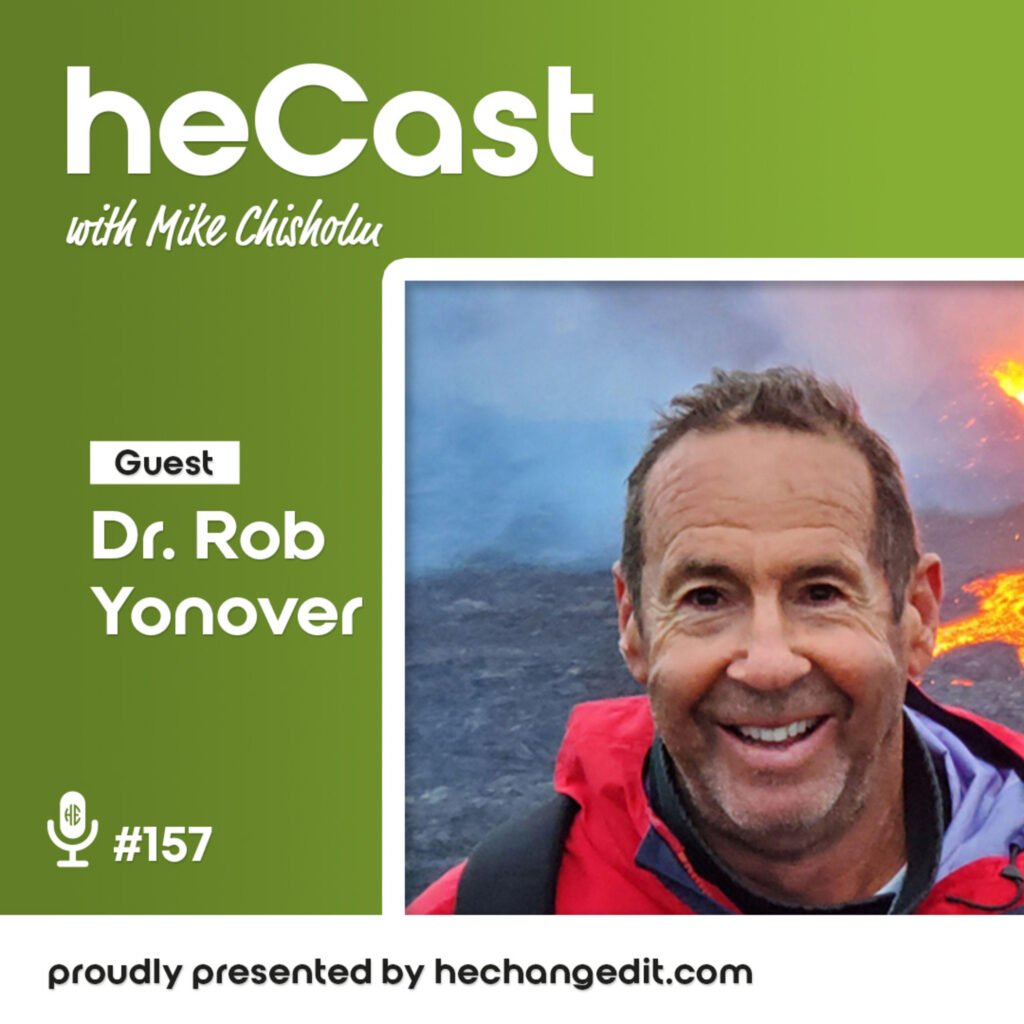
The conversation
About this episode
Episode 157 of heCast features Dr. Rob Yonover in an inspiring and deeply human conversation about resilience, caregiving, innovation, entrepreneurship, and the attitude required to keep moving forward through life’s hardest moments.
Dr. Rob Yonover is a scientist, inventor, adventurer, and longtime caregiver whose life has taken him from big wave surfing and deep-sea exploration to developing life-saving technologies used by the military, SpaceX, and rescue teams around the world. In this episode, Mike and Rob explore why attitude is not just a personality trait — it is a survival tool, a leadership skill, and a mindset that can shape how we respond to adversity, uncertainty, and loss.
Rob shares his journey of caring for his paralyzed wife for 19 years while raising children, building inventions, and continuing to pursue purpose-driven work in science, survival technology, and entrepreneurship. Mike and Rob talk about caregiver burnout, asking for help, discipline, patience, purpose, and the challenge of maintaining hope and action when life becomes overwhelming. They also discuss Rob’s innovations, his scientific work, his time on Shark Tank, and how some of the toughest seasons of life can become the foundation for meaningful impact.
This episode is for caregivers, entrepreneurs, inventors, parents, and anyone facing adversity who needs a reminder that resilience, purpose, and attitude can change the course of a life.
Listen to heCast, the official podcast of HeChangedIt.
Download the HeChangedIt app for more tools, content, and support on your mental wellness journey.
Read transcript
Transcript supplied via Spotify RSS.
Welcome to heat cast, the official podcast of heat changed
it. As always, I am Mike Chisholm as
always, I'm excited to have a conversation surrounding the
world of men's mental Wellness and, and, and we have guests on
here all the time who really at the end of the day, many times
are just telling their story and, and our guest today is is
no exception to that. Our guest today is a guy by the
name of Doctor Rob Yanover. Rob is a very, very cool guy.
He's, he's had a lot of life. He's lived a lot of life in the
67 years he's been on this planet.
He's lived a couple of lives. You know, he's got a PhD.
He was in the Galapagos Islands measuring all sorts of, you
know, at the end of the day, the current creation of our planet,
measuring magma at the, at the bottom of the ocean has been in
submersibles and all sorts of stuff.
That's where he did his PhD. But at the end of the day, his
whole goal was to get to the thing that he loves.
And that's he's a surfer. He wanted to go to Hawaii and,
and, and be there and, and, and he did that and he became an
inventor and an entrepreneur and has invented all sorts of
things. And we talk about some of those
inventions here. And, and he was featured on
Shark Tank. We talk about that on the show
as well. But at the end of the day,
there's also another side of him.
He had his, his wife tragically passed away about 10 years ago,
but he was a caregiver for her for 19 years and balancing the
idea of, you know, who he was and wanting to chase dreams and
these big goals, but at the same time be there for his family.
He sure learned a lot. Very charismatic guy and, and,
and, and he really talks about a lot of the things that helped
him get through the things that he he got through and, and where
he's at and why he has the attitude that he does.
And really, if there's like there's a a through line for
this episode, it's the attitude that we have as we're going
through stuff and and I hope that there are people who listen
to this or watch this episode who can take food, good food for
good thought with what Doctor Rob says.
So without further ado, I'd like to you to I hope you enjoy my
conversation with Doctor Rob Yonover.
Rob, I'm so excited to have you on he cast today and and with
the with the variety of adventures that you have have
have been on in your life, it is a really tough place to figure
out where to start with you. So I'm just going to start with
this doctor Rob Yanover. Thank you for coming on he cast.
What is your doctorate in? Thanks Mike.
I appreciate that. I have a doctor that PhD in
geochemistry volcanology. I worked on ocean floor lavas
off Galapagos and got to go down the Alvin submersible and worked
on my sample with MIT, NASA and here at University of Hawaii.
Wow, I don't. Know there's a lot.
How did you? OK but was this like a red at a
high school thing? I want to be as a like.
I mean it's so much more. I don't even know how to
classify. Well, I was, I was a surfer in
Miami, which is a terrible place to be a surfer.
The waves were an inch high and the women were mean.
So I dreamed about Hawaii my whole life.
And I just, I just, I learned early on I can hang out with
derelict friends, which I still have.
But if I got A's in school, I kept advancing and my parents
would give me more. They were big on respect,
responsibility, responsibility, resourcefulness.
And I went off to chart on all of them.
So I got straight A's and my friends were criminals.
But surfing was always the thing.
I became a pool boy and worked in Miami Beach as a pool boy.
It's very cliche. Went to college, didn't know
what to want to do. Had a great geology professor
and, you know, it studied geology, compensates gold,
minerals, diamonds, oil. OK, this is a good thing 'cause
I can get one off my back telling me how much money I have
to make. And then geologically, volcanoes
are in the coolest places and there's always surf around them.
So that led to my master's and, and then ultimately I got to
University of Hawaii, got a full ride to get my PhD because
again, I got straight As and I did, I did the work.
You know, it wasn't easy, but I I did the work, got the offer
and came out here 4042 years ago. 42 years and I never left.
So the PhD like like, you know, I know that many times there's
like a thesis or a like a, like a big project that's involved.
What was your? What was the project?
That got you your PhD. It's a dissertation.
But PhD stands were piled higher and deeper.
You know that. So I can talk a lot of shit.
No, I worked on the submarine volcanoes of Galapagos.
So there's the ocean floor is splitting apart there.
And we went down the submersible and we dredged rocks.
And we wanted to categorize how a spreading system dies on the
ocean floor. And as it dies, we wanted to
know what what the magma was doing as it came up.
And we thought it was going to do one thing and evolve to very
youthful. It's hard to explain evolved
compositions, but what really happened was the last pulses
before it died, deep pulses from deep in the mantle came up and
we discovered some of the most primitive lavas.
And what I looked at were melt inclusions.
When the lavas form, like when you make a tray of ice cubes,
there's a bubble gets stuck. Same thing happens with
minerals. So we'd I could analyze those
individual minerals. We had lasers at NASA and MITI
could blast the little tiny bubble and it gave us indication
of what was really happening in the Mansell before it got all
mixed up in the ocean floor and the water column.
So my PhD was working on, first of all, kind of perfecting that
method of looking at the technology, at the problem, but
also that field area, the Galapagos failing rift at 95.5°
W. But, but early on I also learned
that no one really cares about this except maybe 200 other
geologists. And that always kind of bugged
me because, you know, I, I felt like applied science would be
more useful and more rewarding. And I came from an inventor
entrepreneurial background, so I always had my eye on doing
something else. Also, when you get your PhD
somewhere, they encourage you to leave.
And I got to Hawaii. It took me to, I was 25 when I
got here, but it took me 25 years to get here.
I wasn't leaving just to become a professor in Nebraska or
somewhere. So I started a little side
business side side that invention that the streamer
behind you is what I invented when I first got here.
The idea when you're lost at sea, your head's a little speck,
your head's a coconut or your head's a rock on the mountain or
coconut in the water. Either way, smoke flares, sea
die. All what they had goes away
right away. And even E perms or now cell
phones tell you the general area you you still need a visual.
So I invented that. And the smart thing was I never
quit my day job because to build the technology and the company,
you got to keep money flowing and you never know how long it's
going to take. So I got into invention and
technology and just kept working it and working it hard and, you
know, got it all the way. It's on SpaceX, it's on some F
sixteens now. I got it on Shark Tank.
So it's a great, great success story.
But people don't see all the work, the 42, you know, the 40
years of work on it. So.
Well, that's, that's kind of like he changed it, you know,
like, like, like my wife and her team, you know, for the last six
years we've been building this thing and, and, and, and, and if
and when it it does what it's going to do, you know, people
are going to be like, oh, where'd this company come from?
Well, no, it ain't an overnight success exactly.
I found that there are very few overnight successes out there.
You know, it's just when the public view sees it, it's it's
usually had been incubating for quite some time.
Exactly, that's why it takes so much longer, takes so much more
money. And if you don't have an, an
alternative source of income, it's never going to make it.
And even this whole idea of taking on investors, something
that I've kind of flirted with, even the Shark Tank thing, it's
not always a good thing. And for me, it's not because
I'm, I'm playing the long game always, you know, I'm going to
outlast everyone, I'm going to outwork everyone.
But when you talk to investors, they want returns right away.
So if things don't go quickly, they start cutting your leg off
and selling it. And I, there's no way and, and I
have kids and I have grandkids now, but this is one of my kids,
my invention. And I didn't want some investor
to say, oh, you should do this. You should do that, you know,
and, and maybe jeopardize the longevity of it, 'cause like I
say, I'm in for, I'm in it for the long haul.
You know, my wife is a non tech tech founder and, and boy has
she learned a lot. And the one of the things that
one of her mentors told her right away is be very careful
with VC money. Be very careful with when it
comes to getting in. And so, you know, it's a longer,
harder Rd., but, but being able to kind of do this without any
major investment and get it to that place, Boy, does it ever
pay off in, in dividends, both figuratively and and and
literally and, and. It's really your baby, you know
there. There's always a struggle.
The human nature is who did what, who owns what, you know
and and one of my philosophies is you can never, never have
more fun than your partner. That's ended many marriages and
and many partnerships, especially like in Hawaii, my
late wife used to say, man, stop playing, playing with that piece
of plastic, get a job, stop surfing.
I mean, she knew who I was, but still, when the going gets
tough, if you're having more fun than your partner, if they're,
if they perceive that you're doing less, there's always that
tug of war on on who's doing more and who created what.
You know, people rewrite the past.
So there there's all sorts of minefields that you can
encounter when, when things are rushed or especially when you
need money. That's why the idea of doing it
as a side job, whatever it is, you know, I always say don't
quit your day job so you can quit your day job.
You see, you can't quit till you're ready to quit because you
know, everyone thinks it's just so quick and, and it's not.
And it really, it's really a good lesson I learned a long
time ago. We talked about this on, on, on
on a recent episode. I forget who it was with, but,
but it was a, it was a Jim Rohn. If it wasn't a Jim Rohn quote,
it was a, it was a, it was certainly the spirit of it.
It's, it's feed your family during the day and work on your
fortune at night. And, and I, I mean, there are so
many, like, again, there's a lot of guys out there who are
grinding it out. They're, you know, not blessed
enough to come from an entrepreneurial background and
understand the, the benefits and pitfalls of, of, of that
particular particular thing. But, but at the end of the day,
I mean, if you find something that you're passionate about,
right, it makes the day job better.
Like, like when you know that you're working on something and
towards something, the process is the outcome.
And, and, and, and if you're working towards something that
could potentially take you out of that day job, Oh my gosh,
that puts you leagues ahead of the person that you're working
beside or working with, because they're just, you know, tunnels
and moving forward. And that's right.
Now it's so true. So many guys need to find that.
Plus the, the, the simplest thing is to start with math 172
seven days a week, 24 hours a day, that's 128 hours a week.
Only 40 hours a week is a job that leaves 88, another 40 to
sleep. That still leaves 48.
So I used to help him put your phone down and do the work
nights, weekends and all that. And, and, and again, you're
right, if you have a passion to it.
And for me, becoming self-sufficient entrepreneur is
one thing, but to I, to me, the highest levels of is our, if you
save lives, that's my thing. So I'm not building bombs, I'm
not building an app, no offense to any app builders, that's
cool, But I want to build something that might save
someone's ass one day. And it has.
And, and I, and I felt the joy of that when when a guy, a
military guy, came up to me and another local skin diver came up
to me and said, Hey, man, that thing works.
It saved my life. And that, that was the best gift
of all. So I, I still want to do more of
that. And that's why I'm going all the
way. I'm not, I'm, you know, I'm, I'm
not, I'm, you know, you know, the tortoise and the hare.
Of course, you know, the, I am the ultimate tortoise.
I am plugging away. You know, people can't believe
it, but this idea was thought of in 85 before you were probably
born. And I'm not going all the, I'm,
I'm not quitting. And, and, and once those
military guys saw that because they dismissed me early on, like
who's this idiot from Hawaii, this surfer with a piece of
plastic? They will.
I'm not going away. I'm going to save your house one
day or save some of your troops asses so that that's where where
it stands. I appreciate you're a charmer.
I'm actually a 76 baby. I remember 85 very, very well.
So but I gotta you said you came from an entrepreneurial family
inventing invention type family. It's like you're in the family
business a little bit. No, no, no, you're not the
family, the family sector. OK.
Yes, yes, my father started a mail order business 80 say 70
years ago, 60 something. He passed away at 95, still
working into his 90s. He started a mail order company
in his part time. He was a salesman out of
Chicago, then Miami, and he did exactly the on the side.
And I saw him. In fact, the book, one of the
books I wrote, Hardcore Inventing the working title was
Inventing in Your Underwear as an homage to him because the guy
used to work at home in his underwear before it was
fashionable. Everyone knows about it now.
But. He had a phone.
He had two phones in the house, one that rang his office a few
miles away and he had two in the bathroom.
He loved toilet time. Don't ask me about that one was
red and we used to kid that our friend, that's the white that's
the house aligned to the president in his toilet.
He had two phones, but, and we had a, we had a sign in the, in
the house that said just say no to real jobs.
And it was you, if you got a real job, not, not one to make
money while you're doing your passion, that was kind of like a
disappointment. So he started this, you know, he
started this mail order company and it kind of moderately took
off and it funded him for 50-60 years.
Yeah, more so. And my mom was kind of an
artist. He was a, he was World War 2,
Battle of the Bulge, Purple Heart guy.
And he didn't he, he lived in Chicago.
It was snowy and, and I, you know, I was born there.
We left when I was one. I still was thanking him for
that forever. Nothing wrong with Chicago, but
as a surfer? Little sunnier, little sunny in
Florida. So yeah, entrepreneur.
Spirit was always in us and we always, his thing was always we
can fix it and we didn't have any money.
He was part of the Depression and so his whole thing was
making things out of nothing, out of junk piles.
So when I go to stores, I don't really look at the products
offered as much as what can I break away from that and build
something else with? And so we were tinkerers and our
house looked very homemade growing up.
And even now I have friends with a lot of money.
They come over here and they're like, I have AI have a little
boat that I used to commercial fish.
I still fish and dive off at surf.
My friend said, haven't you bought one thing from a boat
store for your boat? And I go, no, I took that as a
badge of honor. He was saying that as a put down
so that that's a different perspective.
So it's function over form. I, I don't care how it looks.
If it works, it's great. And if you made it even greater.
So I think that's that's the key for creativity, you know, be
creative with the materials you haven't had.
Creativity I, I, I'm going to date us again.
You're, you're, you're a MacGyver, a, a guy who can
fashion one thing into another and, and, and make things.
It's it's amazing to have a brain like that doesn't shut
off. Do you have a hard time shutting
it off? No, that's, that's the problem.
But I, I've learned how to shut it off.
I, you know, when I I'm in the ocean, when I'm in the ocean,
you know, paddling, I, I couple miles a day, I paddle for lunch
break or, or surfing waves. It doesn't shut off.
It actually go our our fishing in rough water.
It goes on in the survival mode and and even at sleep, it's hard
to shut it down. The the truth is, and I laugh
about this, the only time I can really shut it down is when I'm
watching a movie, especially like foreign movies.
Yeah, because I'm so into it. I'm so into movies my whole
life. And now with the streaming, I'm
watching movies from all over the world and I'm my girlfriend
gives me shit. And she's like, you got to, you
got to get every line. And I start making up scenarios.
She's going, you're overthinking it.
I go, yeah, yeah, but I'm in there.
I'm I'm in that world. My world's off when I decide to
go into someone else's world of a movie or a television show.
So, but other than that, it's never off my mind.
I I'm so antsy. But the common, the common trait
in both of those things, of course, is imagination.
And, and and you said it earlier, the creativity and, and
we live in a world right now where, I mean, the norm is to
distract ourselves so much that creativity gets, gets, gets
completely stifled. I know, you know, even.
Yeah. Like, like like like.
I can't. I can't overemphasize the need
for some boredom every once in a while.
Absolutely. Where you could just sit and
just let your brain start to do its thing and let the creativity
start to spin a little bit because you never know what it
what ideas is going to put there.
Right I, I, I got these grandkids now and I, I'm, I
decided I don't even want them at my house.
I got this crazy dog who might kill them just by accident by
wagon's tail. But more importantly, I want
them to be bored and I want them to be in nature.
So my, I used to be uncle punishment.
I don't really like kids, but they like me.
And I, my, my new moniker is no electricity grandpa.
So when I pick them up, I don't go anywhere where there's
electricity. It's always nature, except for
restaurants where I'm training them how to eat, be burritos or,
or whatever you have. So I, I don't really, I think
it's critical because what they're about to face is the
scourge of this world, which most everyone loves, which I was
the, I think the only guy in 2007 to say the iPhone is full
of shit. And I still say that I, I am so
against smartphones. I'm and now AI is even worse.
You know, when I grew up, there was a kid in our neighborhood,
we'd go knock on the kids door and the mother would say, oh,
he's watching TV, can't play now.
And he became TV Kevy. That was became his nickname.
It was it was horrible. So now why is it okay to have
everyone has a color TV in their pocket, a cell phone, a
smartphone, smartphone and why? And the other thing, the two
points of data that I'll pull up is Steve Jobs didn't let his
kids have one number one #2 they have Apple commercials showing
you how creative and useful you are with with apps and and the
iPhone. No way.
Because it's too much stimulation.
You can't think. And like, back to your point
about boredom, I totally agree. Being bored in nature and making
stuff, you know, it's so I want to think like a child.
And that's how my little grandkids are like that.
You, you don't have to give them toys.
You go out in nature. They're going to make toys with
a stick. They're going to make a game
with the grass, whatever it is. They're creative.
And we're losing that. And just to back up my, my
thumb, this is my phone. OK, So it's it's like a souped
up BlackBerry. It has buttons and if I send you
a text I went ABBCC. There's build T1, the T1
language 1 so. I have an iPad and I do use tech
and I'm old so I'm now I'm already a lost cause.
I'm old already, but I am worried about the youth of today
and forget about reading books that they're just and and even
and I just read something where movies and TV shows are still
way better 'cause they tell the whole story, a story that's
storytelling instead of this, you know, scan, scan, scroll. 8
seconds doom scrolling. Yep.
Yep, right, exactly. And then and and even the dating
thing, forget about that. It's horrible.
You know, guys and women, they can't even talk to each other
when I, I do a lot of outreach education.
These kids are real. It's really bad.
I mean, they, they have no social skills and it's really
tough. It's tough to compete with a
color TV in your pocket. I mean, and I love color TV's.
I'm not saying I don't love them.
They have a place though. And that place shouldn't be in
your pocket. And you know, there's a big,
there's a big, you know, OK, 2007 now, 2026 now everyone's
caught on. There's a big movement they're
trying to ban kids 1600. I'm totally behind all of that.
And even this iPad's in school and the argument used to be all
but they'll they'll need to know how to use use it.
You could figure it out in like a a day or an hour.
It's not that hard. They they designed it for that.
They designed it so a three-year old can learn how to swipe and
do the things that like they make it so simple to do that.
And I mean, yeah, you're right. The priority needs to be on
these connective things. Like this is what he changed and
is all about is connecting right?
And, and, and connection is, is such a a valuable tool.
But then, like, you talk about like, I mean, I was gonna ask
you if you meditate, but it feels like you meditate when
you're on the water. It feels like, it feels like
that's kind of your that's that's the thing that you can do
to kind of tune out. You know, you've been surfing
for 40 something years now. Yes.
Yeah. Do you surf every day?
Pretty much I, I come down when I'm a little older.
I, I either do the two mile, I do a two mile lunch paddle on a
thing called the prone paddle board.
It's a lay down paddle board. So, and it's very Zen about
meditating. It's one hand in front of the
other, you know, wax on, wax off.
I mean, and the other thing is if you're going to be a surfer,
99.9% of surfing is paddling. You only catch a 10 or 22nd ride
at most, So and you only catch 10 or 15 of those on a great
day. So it's under a minute or two up
for three, two or three hours in the water.
And then I free dive and then freestyle medley swim while I'm
out a mile just to train. So I, if those are days I don't
surf, but now that I'm older, I realized I used to work and do
other things all day. So if I'm a big physical project
or even mental, I have to rest. I can't do everything because I
want to be on for the things I need to do.
So, but I do, I typically surf or paddle every day.
And that's the goal. I mean that that's really, and
again, that's the easiest way to disconnect and the easiest way
to get in your head. And my best ideas are out in the
water. And years later, my father said,
you know, he's not, he swam, but he grew up in Chicago, so he
learned to swim with his head above the water.
So he said to me, he goes, you're no, you're right about
the water giving your ideas. But for me it was the shower,
you know, and, and, and OK, that's getting wet.
And that's, you know, something, something about being wet.
So I do, I constantly come in from surfing or paddling and run
to get a piece of paper to write all these crazy ideas I have,
write them down. I'm still into pieces of paper
and pens. And the other thing is it it's a
numbers game. I have 100 inventions.
If only two or three are successful, that's good.
So there's a lot of crazy that comes out of me, but you just
have to be able to kind of mine and discern what the good ones
are. And that's where you know your
time will tell if it's a good one or not really.
But I mean, you only have so much time.
Well, that's, well, is that the truth?
Isn't that the truth? I, I, I want to get into some of
the inventions and Shark Tank and all of that stuff.
But before we do that, I, I also want to talk about there's
another side of you that that is, is, is really, in my
opinion, very, very important. I had a my my my wife went
through a pretty severe 18 months in 2016, 2017.
Thank you that she's on the other side of it.
Up in Canada, Lyme disease isn't something that gets diagnosed as
easily as it does in other places in the world.
And when you have something like that, your body short circuits
and they can't really tell why. And we've got a wonderful
healthcare system up here, but it just doesn't diagnose the
same. So it took us about 18 months,
including times where she was in the hospital paralyzed.
One of the things that they kept testing her for was multiple
sclerosis and, and, and, and, and, you know, because it
mimicked it. And Yep, no, exactly.
Thank goodness. Thank goodness it didn't turn
out to be that. And we sent her blood off to
Germany and they they, they test for Lyme more extensively there.
And she hadn't driven in six months.
And within about two or three weeks after we realized what it
was, she was back to driving again and back to normal life.
But we certainly saw a reality, a potential timeline where
things were going to get different.
And then? Things were going to progress
and they were going to go down. You were a caregiver, right?
Well, I I lived that whole story to the maximum.
My wife was training for a marathon, started her foot
started dragging. You know, she's a great athlete,
37 years old. From that day she went from foot
dragging Kane Walker wheelchair within a year, and that was in a
wheelchair for 19 years. So she passed away paralyzed
from her neck down. And ironically, she kept hoping
it was Lyme disease, which is kind of a weird twist.
Really. Yeah, because that was, she
didn't want to acknowledge and accept that it was Ms. and they
only saw one lesion on her brain stem.
And you know, multiple sclerosis and by its name multiple, you
have to have multiple lesions. So she kept holding out that it
wasn't multiple sclerosis, but it was.
And she had the bad kind, which is primary progressive.
It just kept getting worse. So for a macho guy, you've heard
of what I'm like regular. So I had to convert from being
this macho guy to and, and I was a good parent, good father
figure, but my, our kids were seven and four when she got the
illness. So all of a sudden I had to be a
caregiver and you know, she would kick me if she could, when
I would say I had to be mother too, a little.
I mean, I'm not a mother, but I also would fight her and say you
got to stay alive because she wanted to give up all along the
way. Like you need to stay here to so
the kids have a mother, even if you're just paralyzed.
We just had to modify our lives and have it was just different.
Our kids learned how to pop wheelies in a wheelchair.
That's different than most kids. We had bedroom parties, we would
get asked to go out. We got asked to go to a club one
night and I we're like what the hell, why would they invite us?
Screw it. So we go.
And her deal was always and she was beautiful till the end.
You couldn't tell anything was wrong with her until you saw me
start feeding her all the time. But if you just saw her.
So we would get to a place early and stash the wheelchair and
then I'd put her in the best seat in the house.
So we were at the club. Everyone starts dancing and she
goes, hey, you want to just make out because that's what
everyone's trying to do anyway. I go, OK, so, you know, you
just, we had to just be flexible and you know, it, it got me into
these crazy situations. And we just kind of tried to
make light of it and kind of stick it out and, and make it
through. And, and we did, you know, she
probably they probably thought she was going to live five years
or 10 and she lived 19. She made it to 55, which wasn't
bad for being diagnosed that young.
And we just, you know, the, the beauty of it, not the beauty,
but the challenge was how does this macho guy who's never been
a caregiver never been a nurse? I mean, I knew how to cook and
clean and that stuff. But because my mother, we were
very luckily, I came from a family who was very progressive
about gender roles. You know, we, we did everything.
We all, my sister did everything a guy did and my, me and my
brother did everything a woman did.
So I was kind of, I was ready for it sort of, but not for
that. So, you know, and I, I had to
become her arms and legs. So I'm the most feminized
masculine man maybe in the world because, you know, I, I had to
wipe her. I changed tampons.
I did everything. I had to take her to the
bathroom in public places. And she would never want to go
to the men's room. We had to go to the women's room
and kind of sneak into the stall.
And I couldn't say anything because I didn't want to freak
out the women in the other stalls.
And, you know, that's when she would dig into me because she
knew I would shut up because I didn't want to freak everyone
out. And then we'd come out and we
were like, what are you doing in the bathroom, You know, and
pushing in a wheelchair. It was just an endless.
Yeah. But it was also beautiful in
many ways. We were very, very tight.
And because I became her arms and legs, you know, we were like
one person. We were like, 1 Organism.
And we fought a lot, of course. And that was the way we both
vented. And she did some crazy stuff and
some of it directed at me. But you know, it's just you had,
you know, I gave, I cut her a lot of slack because of what she
was going through. And I think that's where the
more fun than your partner thing originated because that was off
the hook off the, I mean, how could it be?
She's paralyzed and I'm surfing beautiful ways on the North
Shore. How can it be equal?
It's never going to be equal. So I think that that was a
difficult thing. But I, I, I got to ask you
though, like, like, I mean, one of the natural questions, of
course is I mean, you got guys who are listening to this that,
that, that potentially are caregivers of some sort.
And, and, and, or, or maybe facing that.
The first question, of course, is, you know, what are some,
what are some advice? But it seems to me the number
one thing is attitude. Like what, you know, one of the
things that we have control of, we have control of our attitude,
we have control of our activity. Those are two things we have
control of whether we, whether we know it or not.
And for the guys who are listening to this that don't
realize, hey, you guys have control of your attitude.
You do, you do. I'm not saying it's going to be
instant or easy, but you have control over it.
The other thing that's right, that's right.
The things that we do, we have control over the activity that
we put out there. It seems to me like from from
from listening to your right attitude is number one.
That's the number one thing if you're going to be a caregiver.
That's true. And the thing I got some great
advice early on, one of my buddies, a psychologist, and he
said, look, you got to lose self.
And that was so profound. And it was only two words, you
know, you lose self. And I didn't even know what he
meant at first, but then I realized, and it is true, I had
to give away. I mean, when you get married,
you give away half yourself and you get there half.
Ideally. In this case, I had to give away
so much and I was proud to do it and glad to do it.
And I was also challenged to do it.
One of the things that's different about me is I'm
really, really competitive. And I just thought, you know, my
wife and I, we had, we were both star students and really heroes
in our little families. But this was our shit.
This is what we had to deal with.
And I'm like, OK, this is another thing put on my
shoulders. I'm going to embrace it with the
right attitude and I'm going to power through it.
I'm not letting the kids down. And she would tell me, you know,
you should just leave me or you should just get a girlfriend or
my friends would say, this is your chance.
You know, when she was giving me shit, just let her go and put
her in a home. I'm like, no, I'm not doing
that. I'm stepping up for the kids
because I, the kids were the main thing.
You know, her and I were fine. Really.
We had, we were together like, I don't know, 10 years before
this, 12 years before this even happened.
So we had this whole life before we, we were together in Hawaii
for five years and traveled the world before we even had kids.
We had all these great segments of life and then we got this and
it was just the attitude was critical.
And I, I had to just knuckle down and just say, look, I, I
just embraced it. And I, and again, carving out
time and time management was critical.
And fortunately in Hawaii, where the weather's nice and being a
surfer and really the paddle board saved me because surfing
is two or three hours. And if it's out here in the
South Shore, it's close. But if it's on the North Shore,
it's an hour each way. So it's like a 5 hour event
those and I got those, but those were more the exception than the
rule. The rule was I could jump off.
And we, we luckily scored this townhouse on the water 40 years
or 35 years ago when she first got sick before that.
And I'm able to roll out of my house and go paddle a couple
miles, come back and just readjust my whole attitude.
That saved me because it was a reset and no matter how shitty
the day was going, I could reconvene and, you know, talking
about, you know, meditation, I could meditate with nature,
which is what I was doing. I wouldn't call it that per SE,
but that's really what was happening.
And I still do it. It's still is a great source of
recharging for me. And and that's, you know, and,
and even I had a boat and I take her diving and boating.
She loved it And and even at one point she wanted to move to San
Diego or somewhere where it was colder.
Some of the doctors said it would be better and I I was just
beside myself, but I couldn't. The one of the hardest thing is
you can't take away a person's ability to chase their rainbows,
right? And for her, she's paralyzed, so
she's going to chase every cockamamie solution, potential
solution. Ultimately, she was going to
Israel to meet with a Russian acupuncture that was giving her
relief. She was saying he was curing her
and he was taking all our money. That was just one of many
situations where I can't block what she thinks is helping her.
That's why. And the other thing was I lost,
we lost so much privacy, not not when we were together, but for
me to knock out a portion of the day, we had to get some help.
I couldn't do 24 hours a day. I did 16 hours a day.
So I would get 6 or 8 hours a day.
And I did the math and, and estimated we had 183 people
through the 19 years in my house.
That's unbelievable. Every day waking up with some.
And these weren't like, we didn't have any money.
I, we almost went bankrupt. I was so far in debt.
This whole, it was a, it was a nightmare.
But that, that part with the people in your face, it was just
talk about losing self. I was losing so much self all on
every, every front I could look at.
And then, but then I'd look at the kids and I'd look at her and
you know, we got to stick, you know, we got to stick it out.
And that was really, really tough, but.
But really rewarding. So again, I'm hearing attitude.
I want to get into loose self for a second because I, I would
really like to know your definition of that.
But but the other thing that I'm hearing is, is in part, perhaps
part of it is losing self. It might be an ego thing or
whatever. Don't be afraid to ask for help.
I mean, 183 people over that 19 years, like you weren't afraid
to ask for help. I don't know if that was if that
was instinctual or if that was the advice you got at the very
beginning, but the idea of us who are going through this stuff
here, you know, the you're not alone idea.
It's a really powerful one, but many times we think we are and
we won't go and ask for that help.
So asking for help, that's another clue right there.
I want you to talk about losing self for a second because that's
something that I don't think is part of most men's everyday
vernacular. I, I know losing self.
What does that, what does that mean to you?
Well. Like I said when he first told
me that, I didn't know what he meant, but what he told me was
you just got, you know, like a death sentence on your own
personal time and interest. So basically saying you, you
have to give up. And, and before that, we all, we
both had our lives. I would surf, she would run, we
would be together, we'd party, we'd have friends.
But this put a big strain on what I was able to do in my
life. And I had to give away myself
and, and it was open-ended. And it was open-ended in a good
way. I didn't want it to end.
I didn't want her to die. And even a few times she was
suicidal. And I'm like, no, no way.
And she'd asked me to do it for her.
I'm like, no, get your sisters or family.
I'm not doing it and I don't want you to do this.
I don't want any part of this because this is important for
the kids and for me. And so losing self meant I had
to give up a lot of my time and my interests and my dreams to
make sure she was functional And, and just it's I, I, you
know, it's really hard to do that when you're.
So we're all consumed in what we, you know, our lives get so
wired into what we like. And fortunately we like doing a
lot of the same stuff. That's why we were a great
couple to start with. But I still had the change.
But, but I, but when you lose self, that's when you get into
the math of it and start carving out, OK, I'm losing self for 23
out of 24 hours, but that one hour a day, I'm going to go
paddle or, you know, and, and the six hours I have help, I'm
either going to surf or I'm going to work.
I'm going to do my invention, whatever it is.
Yeah. All of a sudden an hour a day is
so much different, especially when you're paying people 20 or
30 an hour cash out of your pocket that you don't have to,
to enable you to get the six hours free a day.
So it was, it was redefining the my whole world of how I grew up.
I mean, it was never, I mean we, I was not selfish, but I was
definitely self motivated and, and I was doing self-care.
You, you exercise self-care, so you'd have the energy to be
selfless in other areas. But you gotta like, again, we
talk about this, the airplane masks come down.
You put yours on first before you put somebody else's on.
Exactly. You still did that.
You still did that even though. Actually, even more the other
thing I realized early on is, yeah, if I get sick, we're all
screwed, you know, cuz. And that's where I got.
I was always healthy, but it was, it's easier to be healthy
when you're younger. So as I've gotten older, I've
become just an like an incredible animal on health and
fitness and nutrition. And part of it is I don't want
to die in the North Shore. I was surfing 30 foot face
waves. I'm still surfing 20 foot face
waves and I'm in, I'm going to be 67 in a couple of weeks.
I'm on, I'm on. Oh my.
Gosh. Yeah, I'm not old.
That's why I asked you. You, you, you were born the the
year before I graduated high school.
So you know, well, that's, that's OK.
But the only thing is it it's it empowers me.
It's like, OK, and I see people fall off from aging and not
taking care of themselves, and I'm just like, OK, I'm not doing
that for two reasons. First of all, I, I couldn't, I
had to be around even if I got a cold.
It was bad for everyone. I couldn't afford to get sick at
all, let alone a real illness. And in parallel, I didn't want
I'm I'm still selfish surfer. I don't want to miss a good
swell when there waves. I want to be on it.
That's why when I paddle, I had mental health, physical health
and I just, I'm an eating freak, you know, I eat beans, greens
and protein. I mean that I'm just, I'm an
animal and I and I'm at my, I'm at the same weight.
I've been since college really. So it's like, it's a lot of
discipline though, and I and I think that's hard.
It's easy to say it. It's hard for people to do it.
Maybe because I had the waves that might kill me and
bankruptcy and the family that falls apart, though those were
good incentives to stay in shape.
Not everyone has those incentives.
And you know, it was easier for me to do it and I'm still trying
to do it, but you know, you never.
Have a clue, you just have another clue.
You find something to live for something find something to work
for something find something to work toward.
You know that's that's what this is and that's what you've you've
done. Did she get a chance to see So
let's the Shark Tank thing when we get to it, when we get to it,
But did she get a chance to see some of your big achievements?
Absolutely. Chance to see someone not that
she didn't see Shark Tank, okay, seven or eight years ago.
She died like 10 years ago. It was right after.
But the thing about it is early on with the streamer, she was
like one of her lines when I was building it on my patio.
She was stop playing with that piece of plastic and get a real
job. And I just looked at her and go,
you asshole, this is my job, this is my calling, this is what
I'm doing. And then, you know, years later,
I got, there were a lot of success.
I had a 15 actually, I got a 15 year license agreement that paid
guaranteed royalties. And that actually saved us
because it enabled me to be flexible enough to care for her
in the middle of the 19 year period and then also invent
other things and take care of the family.
So that was 1 success, but it had gotten a lot of success.
I got media all over the world. I was in all the magazines.
I'm kind of a media whore. I'm not even kind of, I'm
definitely a media whore. And I built the, I built the
whole business through the media.
My brother PR yeah, PR advertising got my brother and
he taught me they're guys, editors sitting on their ass
right now wondering what to write about.
It's your it's your job to contact them and tell them about
the streamer and write. So he he turned me on to this
thing again. This is old, old timesy.
You know, like black and white movie.
There's a thing called Bacon's Publicity Checker.
Before the Internet, there were these big fat books in
libraries. Thompson Register was one of
them where you can find out where to get a piece of plastic.
The other was Pete A Bacon's Publicity Checker, Big fat book
that had all the names, numbers, and here's the key fax numbers
of editors of all the magazines. And I don't know if your viewers
know what a fax machine is, but there used to be this thing
called a fax where you can it connects to your phone line.
And here in Hawaii after 11:00, it was cheaper to make phone
calls. So again, maximizing my time, I
would write a one page press release and at 11:00 at night, I
sent it 100 times to all these names.
It's like a fishing expedition. I put out 100 lines, got one,
The first article is Miami Herald put that out 100 times.
The my book was one article. And now it's like it's huge.
I can't even carry it to meetings anymore.
People don't care. But I got an outside magazine,
Men's Journal, Playboy every I I got it on CBSNBCI and even, and
the culmination is CBS Innovation Nation and then Shark
Tank. And then now someone lifted my
Shark Tank pitch and put it on YouTube.
It's got 58,000,000 hits. So that was unheard of back
then. So the ability to work the
media, because what my brother showed me was if you get someone
to write about it, it's third party endorsement.
I didn't have, I didn't have any money to advertise anyway.
But if they wrote about it, it was kind of an endorsement.
I got into military magazines. Anyone, anyone that would talk,
I mean anyone, anyone, anywhere I would, I would pitch and it
was like that. And the other thing was trade
shows where I could wear a suit and tie and shave and go to a
trade show and I could chase some CEO into the urinal just to
talk to them, of course. And but that was the only place
I could get, I could get uneven keel with them.
So I. Oh, yeah, Yeah, yeah.
You talk about a vulnerable moment Exactly.
No. But no, it's true and I love and
hate trade shows, but trade shows were trade shows and work
in the media I did forever and it was the lowest cost thing you
could do and trade show you could go and just walk the floor
and the streamers small. I could fit it in my pocket.
So no one even knew I had I'd tell them about this great thing
and then say here and I learned early on, if you put something
in someone's hand and then take it away from them, they they
really want it back. So there was very psychology of
that. So, but the media was great
because first of all, I believe in this.
I have a passion for this and I have a passion for saving lives.
So for me, that's enough juice to keep driving me forward in
this 40 year effort that I've been undertaking because the end
game is some military guy or some skin diver thanking me for
saving his life. So that that was worth it.
You know, forget Mark Cuban. Mark Cuban didn't invest, but I,
you know, I got to talk shit to him.
We'll get to him in a second. How many patents, How many
patents do you have out there? I've I have like 6 or 8 of
individual technologies, but like more like 20 if you count
all the world patents, the streamer for years I had patents
all over the world on it and but that that only represents the
inventions that I went all the way with and.
Yeah, Oh yeah. A lot of dead ends along the way
I assume. Well, a couple of my greatest
inventions never made it to market, but the first thing I do
for an invention is ask this question, do I want one?
And if I want one and and that and the two I still use to this
day that they're not really commercial is 1 Was I used to go
surfing? I wear like a rash guard now,
but in the old days I never wore a shirt and I can't reach the
middle of my back. And I got something lifted off
from my dermatologist. Then I usually get cancer on
your back. You got to get sunscreen in the
middle of your back. So I asked my friend when we
were surfing, You know, I don't have beautiful women in bikinis
surrounding me, putting sunscreen on me all the time.
What? So I ask.
Why the wine? The wine Tropic girls aren't
there. If they're a perfect girl in a
perfect world, that can happen. But surfing is, occurs more
often than that. So I asked my friend and he did
it, which, and I'm a little homophobic.
Not really, but I, you know, a guy putting lotion on my back.
It was just weird. Then here was the kicker.
He goes here, can you put it on my back?
And he had this kind of nasty hairy back.
I'm like, shit, I, I got to invent something.
So I, I, I used a, a little paint roller and I roll
sunscreen on my back now. So that was, I still do that.
I but I didn't, I mean, there, there's, there's some
applications to make money, but I didn't do that.
And the other thing is I drive around with shorts a lot and my
car, my knees were getting burned all the time.
It's an hour drive to the North Shore.
So I, I, I didn't invent. I use these little white Terry
cloth. They're like large.
What do they call it? I don't even use it.
The ones in the shower. When you take a a a bath, you
use the cloth, the little cloth. Not like a loofah like.
A It's a washcloth, like a washcloth, like a white
washcloth. When it comes, they're bigger.
They're Terry washcloths. They cover my knees and I call
them kneebrella. So it's like an umbrella for
your knees. So as stupid as that idea is,
I've been, I've been using that for 40 years.
So some of my inventions. And then I invented a sex toy
too, that never went anywhere also.
But that was a lot of it. A lot of this stuff's a joke.
Those two weren't a. Joke, but that's the creative.
But that's the creative part is that you get it out there.
The creativity is the. So, but I did.
But but I found my niche, which is survival.
I invented this sea rescue streamer you see behind me
approved. It's on SpaceX, it's on all the
manned flights. It's under the ass.
Every astronaut. I invented the portable pocket
flotation device, portable desalinator video search and
rescue device, water bicycle that that looks like a fish when
you ride it. Also that was a weird one.
But the most of them are survival based and the one I'm
still the the one and they all got military grants.
Not not the streamer, but the desalinator pocket flow.
No, the inflatable rescue board. I invented that.
Grew crazy when people started paddle boarding all those
inflatable paddle boards. I had a whole patent battle with
all these 50 companies that make those, but they were all for
rescue and they all got military funded for their development.
After I got the patent, I didn't.
That was a smart thing I did. And there, you know, there are
various forms of maturity, but the desalinator is one of my
best ones. But I'm still working on that.
I'm trying to perfect that. It doesn't make enough water yet
but I figured out a way to make convert salt water to freshwater
which is using the sun so I'm hoping to have that out in the
next few years. I had that once but the military
wants a pint a day of water and it only makes like 1/4 cup so I
have to optimize it and I know how to do it in my mind but I
haven't met the heat sealing expert yet that help would help
me help me do it. So, but, and this AI company
that I met with a startup effort I had years ago, they contacted
me and said, you got any ideas you want to, you know, give to
us and we'll put into AI maybe a good use for AI.
So and and they're writing back to me.
They're trying to change it too much.
I said ask your AI and I call it Hal.
They have a name for it, but I thought Hal was appropriate.
I don't know if you know, if you know the reference.
Of course. Yeah, Well, that's excellent to
tell us how to make it and who will make it.
I don't give a shit about what material, you know, you're going
to tell me. I'll fancy that's the way to
make it. And now I don't know if you can
tell by now, but my whole thing is simple simplicity.
Simpler is better. That is one of my mantras.
If you can solve this problem in a simple fashion, that's way
better. And even the streamer, I'm not a
great business person. And case in point is I invented
something that never wears out. How stupid is that?
I make a sale that goes on your boat or in your backpack.
You never have to buy another one.
I don't give a shit. To me that's an honor.
I solved the problem and you want to buy it once.
Now it has chem lights. So you can either not have the
chem lights, it still has retro reflectors, but you every four
years you can get a new one or replace the chem lights.
And the fighter pilot version has flashing lights.
But other than that it never wears out.
So it's going to outlive us. So so your wife got to see some
of these some of these successes come to see mission, which is
cool. She got to see that, which is
which is fantastic, you know, because, because at the end of
the day, she's going through what you're she's going through,
but at the same time she also gets to see you BU which is
great. Exactly.
No, I mean, she gave me shit, but she respected what I did and
she was happy for me and and it was, it was a joint celebration.
I mean, it's too bad she didn't see Shark Tank, but my parents
got to see that before they passed away.
And you know, she knew. She knew it was a great thing
and she knew it was. I think she knew about the lives
saved so. And she knew about all that
press, too. It was just the big, huge press
at the end, like Shark Tank. She missed out by a couple
years, but. So, so with the Shark Tank thing
and in Canada, we've, we've had Dragons den for a long time and
then Shark Tank shows up in the US and, and what not.
I have a friend, I have a friend who got a chance to be on Shark
Tank and, and, and he they didn't make a deal, but he built
this crazy complex and, and, and a whole bunch of different
things for his business. And he calls that the Shark Tank
complex because the exposure that it gave him just being on
the show fueled everything that he wanted and more.
Like you said earlier, no, no, no, no capitalist coming in to
take a big chunk. Of it, well, first of all that.
Place so. Right.
But they don't if they know you're going just for the
publicity, you can't get on the show.
No, he wanted an ideal. He wanted to know but but it
didn't happen and and it led to some really cool things
happening. I want to know about your
experience and and tell everybody about that.
OK, sure. I mean, I, I, there was no
connection there. I didn't know someone that was a
producer. I got in line with the other 400
people in Waikiki at a hotel, just like everyone else.
I was older. This was only 7 or 8 years ago.
Yeah. And you know, I, I had all these
achievements already. The streamer already saved some
lives. We sold a bunch.
We had, you know, I had my licensee, we did 15,000,000 in
15 years, which blew them away. But I had my rap and it's a
visual product, so it was perfect for TV.
And I just kept jumping through the hoops till I finally made it
to LA. And then they said, you know, we
got to pitch to the producers first and then we'll decide if
you're even going to get on the show.
So I pitched and my producer said, you know, they give you a
producer and she said you got to memorize your pitch.
I think they're afraid because people don't know how to pitch.
I've been giving talks my whole life in academia.
I mean, I was pretty shy as a kid, but I busted out of it.
And now having faced really tough audience with the military
in academia, I could face a bunch of investor types or money
types or producers. But they made me memorize this
talk. It was my talk, but I'm not good
at that. I'd like to read the persons
reaction, even if it's on the phone.
Me talking to you. I can tell when you're getting
bored, I can tell when you're excited.
Even in the intonation of your voice.
If it's phone only and what we talked about earlier, I've never
met you, You've never met me. Same thing with sharks.
So when I gave my pitch to the producers there and then I gave
the the question and answer period, you know, we loved your
question and answer. You were a little stiff on the
your pitch. I go, yeah, that's because they
made me memorize it. No kidding.
And I looked right as a producer when I said that.
And they looked at her and she looked at me and said, oh, you
don't have to memorize. You do whatever you want.
And they said, OK, go, you're going.
So I got on there and and you walk out there and, you know,
I've been watching the show for years.
They want you to watch all the episodes.
Yeah. Mark Cuban, Mr. Wonderful, all
these people. And, you know, and it's a lot, a
lot of pressure. And I went out alone, right?
Just me, those five sharks. And it's real, that show.
It's not bullshit. They they didn't know me.
I walked down that aisle. All these cameras all miked up
and then they, the hardest thing to do is they make you do a
stare down at the beginning. They make you delay like 40
seconds or so before you start talking because they want your
reaction. Each shark sizing you up and
you're looking at them. I'm looking at Mark Cuban.
And even beforehand, like an hour before that, they let you
go. That morning.
We got to go in and check out our displays to make sure
they're right. And that's the first time I got
to go out on the set and I see Mark Huby's got like a bib on.
They're doing his makeup and they're checking e-mail.
I'm like, and it's really cold in there.
They told us it's going to be cold there because they didn't
want everyone to fall asleep. I go in there and I'm like, OK.
And I was kind of like, I play a lot of basketball as a kid.
And I'm like just trying to Rev myself out.
Like, OK, I'm going to kick your ass.
You know, I'm getting revved up. I'm going to, I'm going to nail
this. I get out there.
And then they got this music's blasting in between, and it was
like the song I like Big Butts was on, which I loved.
It's just a jugger. That was they.
Got back yeah, yeah, just a mix a lot shout out exactly the Sir
there he. Is exactly so I'm like, I'm
going to kick their ass. So I got out there, but then I
had to wait 40 seconds. Then I started talking and then
right when I started talking, I could realize, OK, these guys
aren't that smart. Mark Cuban was smart.
And but these others, they barely are figuring out what I'm
saying. And I I did a couple really
smart things. One is they asked me, you know,
who do you want to demo this? They go, well, you know, we'd
like you to use Damon. And I'm like, yeah, but I'd
really like to use Mr. Wonderful.
I got a couple things that I think might happen.
So I said, OK, he doesn't do the demos as much.
So I had him unfurl the streamer.
First of all, if you ever watch the show, he's mean as shit to
people. And he drew and it's part, it's
a show. He's like.
Of course. Yeah, so that he's a nice guy,
but he's. Playing the character while he's
on there. Right, so.
And I knew he was short and I knew he was drilling people.
This woman from Hawaii, he, he called her a deer in the
headlights or about to be splattered on national TV.
And I'm like, sure, that's not cool.
She's 20 something years old. You can call me that.
You can't call her that. So I knew when he took the
streamer, I could look down on his bald head.
Not there's anything wrong with being bald or short, but I just
thought that would be a good power move.
And I thought when they, when he started unfurling that they were
going to make jokes. And sure enough, they said keep
going, get lost. So it really it worked out.
And then Mark Cuban was just, he, I think, was so bored out of
his gourd that once he heard I was a volcanologist, all he
wanted to do was talk about my PhD and submersible dives and
lava. Finally, Mr. Wonderful said,
man, stop talking to him about volcanoes.
And he goes, I could talk to this guy all day.
And then on the way out, I go give me a call.
And I winked at him. And I've never winked in my
life. And I just thought that was
appropriate. But, you know, that it, it was
kind of, you know, it was it was a bummer, really.
I was good. And then all of a sudden it got
bad as they went out. And then afterward, they're
like, you know, were you disappointed?
I go, yeah, I was disappointed. They'd rather invest in cupcakes
than saving lives. Yeah, it's a great line, but
there's no way. Yeah, they, they didn't use
that. I, you know, I was, I was in
there like an hour. What you see on TV is 7 minutes.
Yeah. It's a great experience.
And they reran it. It's been on over 100 times on
CNBC in the last seven or eight years.
So it like your friend, it's a, they call it the gift that keeps
giving. And we, we started a group, all
the people that have been on the show or on this little private
Facebook group and we get together and learn from each
other. It's pretty cool.
What's your friends? A man met your friend.
I don't. I don't.
Know I'll tell you, I'll tell you.
I'll tell you off camera. Yeah, OK.
Anyway, I'll tell you, it was a great experience.
It was a risk. My brother was saying don't do
it. They're going to make me look
like an idiot. My son's like, you better not
cry, you know, all this shit. And I'm like, Nah, don't worry
about it. I got this.
And. And the other thing is I wanted
to, I wanted to work in two things quickly without them
editing it out. Yeah.
So, and I knew how to do that. When they asked me if I had any
sales, I knew that if I said something right then they
couldn't edit it out. And that's when I, I said I, Oh
yeah. I said I'm, it's like surfing
big waves and when you get held out, you can't give up.
You got to fight even harder or something.
I said that right after and I said something about my wife
getting sick. I wanted to get those.
I wanted them national TV to know I surfed big waves just
because I'm from Miami and I was a big, that's a big status point
for me. And then I took care of my wife.
So I got those in without them getting cut to the editing
floor. But it was a great experience
and you know, it didn't lead to money, but it led to a lot of
great things. And you know, but in retrospect,
if I did make a deal, Mark Cuban wasn't going to be calling me.
It was going to be some 30 year old aide of his hassling me
saying why are you still in Hawaii?
Why is your factory there? Why don't you go to this trade
show, that trade show. Back to our original point, I
don't, I can't, especially at this age, I can't be getting
managed by other people and I don't really want to manage
people. That's to me, the home run is
never having an employee and never being an employee.
So here's there's a clue right there as well, like never having
an employee, being an employee. That's a fantastic way of
looking at it because then it streamlines things for you.
But at the end of the day also, you know, could you be more
profitable? The answer to that is yes,
absolutely. But at what cost?
And, and, and that's where, you know, the idea of the priorities
of things. It it ain't about the money.
No, exactly. The the lifestyle that you're
looking for, if you have that already, again, there are guys
who are listening to this that that may not understand
gratitude. They may not understand the
things that they do have because they're always thinking or
chasing about something else. The idea you could have made
more money at this but. Absolutely.
I still could, even back to my father inventing in her in your
underwear. He was my model and he they had
friends that were rich and they all respected him.
He was flexible. If he wanted to take us boating
or somewhere on a Tuesday, he could.
To me that he was the richest man alive and he didn't have to
wear pants. He walked around with no pants
on. Time is everything, isn't it?
It really is. And that's lifestyle is
everything. And I have a bunch of wealthy
friends now, and it's cool. I mean, not just among my other
friends, but that, you know, when you start having a lot of
money, you have a lot of worries.
My friend with a lot of money has seven employees at his
house. What a nightmare.
You know, I don't care if they're clean cleaning or
managing or security or lawn, whatever they're doing.
That is a hassle. I had my 183 employees when they
were caring for my wife. That was enough.
I don't want to have another one.
You know, I get contracting people when I need it or I bring
my family and when we get big orders.
But the the point is, I totally agree.
Lifestyle is the king of all of it and and moderate amount of
money. That's why the sharks, I
couldn't understand when I told them.
It saved money. It was the best feeling I ever
had. Don't you want to do that 1000
times over and have them? Thank you.
Also, they didn't give a shit. They didn't think it would make
enough money quickly. I'm like, are you kidding?
You guys have enough money? When is enough enough?
You know, I don't. I still don't understand that.
And especially what's going on today with all the billionaires.
What? Richard, you know the old saying
was richest man in the cemetery. What the hell is?
What are you doing? I don't understand it.
I really don't. And I.
You know it's. Good.
It's good to make money and be comfortable.
I agree with all that, but I I don't understand where the
world's gone with money. When it becomes the priority
over the stuff that's really important.
And, and I mean, if there's anything in this, in this, I, I
well, as you know, you've done a million of these things.
Time gets slippery when we do these things.
And and I mean, we're already, you know, at this place.
But, but really the priority, I mean, what you know, what your
priorities are, how many guys out there are just trying to
connect dots that somebody else laid out for them, you know, you
know, go to go to school, get the right job there that, you
know, get the, get the house and, and all that.
And they don't even know. They haven't even looked at into
inward as to what's important for them.
Like Rob, if, if if anything, I, I, I'm so inspired.
I'm inspired by a bunch of things that you talked about
here today. But number one is, is, is really
at the end of the day, you're living your heart, your what
your heart, your heart's desire is.
You figured out a way to make that happen.
And, and you had the courage to do that.
You had the courage to say, no, you know what?
I'm going to have PhD. I'm going to stay in Hawaii, you
know, because you, you run so hard to get there.
You saw it, you recognized it, and you had that introspective
time to know what was important to you.
And you've gotten to focus on that for a long time through the
UPS and the downs, through the good and the bad.
And you've certainly certainly gone through a lot of
challenges. But again, the attitude is
everything. And I just want to say thank you
so much for for taking time to come on He cast today.
Is there anything else that you want to say to guys who might be
listening to this right now? Yeah, turn turn off your God
damn phone and live man. The phone.
The phone is the enemy. The phone gets you to compare
yourself to others, to see people rich and it's half of its
fake anyway. That's comparison is the thief
of joy. Comparison is the thief of joy.
And that's how phones are you just it's so horrible.
And look, I know tech people, they designed them to be
addictive and they are. I scroll.
I love doing that. They throw you in the shit you
like. It's horrible.
And do it only a little time, just for a little time.
Don't base your life on that. And that's why you see, when the
electricity goes down in the neighborhood, people come out of
their house like zombies. Oh, you live there?
I didn't know anyone lived there.
It's so sad. Anyway, that's my one.
My one. Messy.
Then no one wants to hear that. I I don't really care.
I was right in 2007. I'm more right in 2026.
The phones are the scourge of the earth and AI is even worse
now. We don't have to think at all.
Let this box think for us. Yeah, no way.
I'd rather be 1/2 assed moron than an AI bullshitter that just
has AI do everything for me. I want to think.
Well, then the creativity part is we had somebody on not too
long ago. He's the host of the Radical Joy
podcast and, and, and he talked about and he talked about AI in
a different way. He's like, our creativity is
what makes IAI effective. But if we stop being creative,
AI stops too, because it's our creativity that's going to drive
AI to that next level, whatever it is.
If we don't if we don't come up with the new stuff, we don't
come up with the new ideas. If we don't come up with the new
vantage point of looking at things, AI will never be able to
advance anyway, because it's the human creativity that drives it.
And and I love that. And you are you embody that.
You embody taking this creativity 67 years old and
you're still killing it trying to, you know, come up with that
next great thing. You are what you're doing, the
innovation that that is coming out of you out of your pores,
your instincts. It's really cool to hear it,
man. And I I just thanks.
Mike, I appreciate. That it went by so fast, I
appreciate it. I'll do a real quick outro here.
I'll do a real quick out, then we'll say goodbye, probably.
Just stay on here. Gosh, I say it every time,
everybody. This is why we do the show.
It's, it's, it's listening to these stories.
It's listening to these vantage points from people who have have
gone through stuff and, and, and, and this stuff leads clues,
these experiences, leaves clues. Where's your attitude at?
You know, where's your creativity at?
Where are things going for you right now?
If you haven't downloaded the heat changed it app, I mean,
ironically talk about this, but the whole goal of the heat
changed it app is to create connection so we can actually
wake up and be awake in the real world and we can have these
things. That's what this show is all
about. For those of you who who, who
you know, I hope there are people out there today who have
listened to this or watch this and, and, and, and maybe it has
sparked something in you. What are your priorities?
What are the things that make you tick inside and are you
working towards whatever it is? Are you, are you, are you
working on your fortune at night, whatever that looks like
for you. This has been another episode of
He Cast the official podcast of He Changed it.
My name is Mike Chisholm. Go change something.
Transcript
Read along with this episode
A source transcript is available for this conversation.