
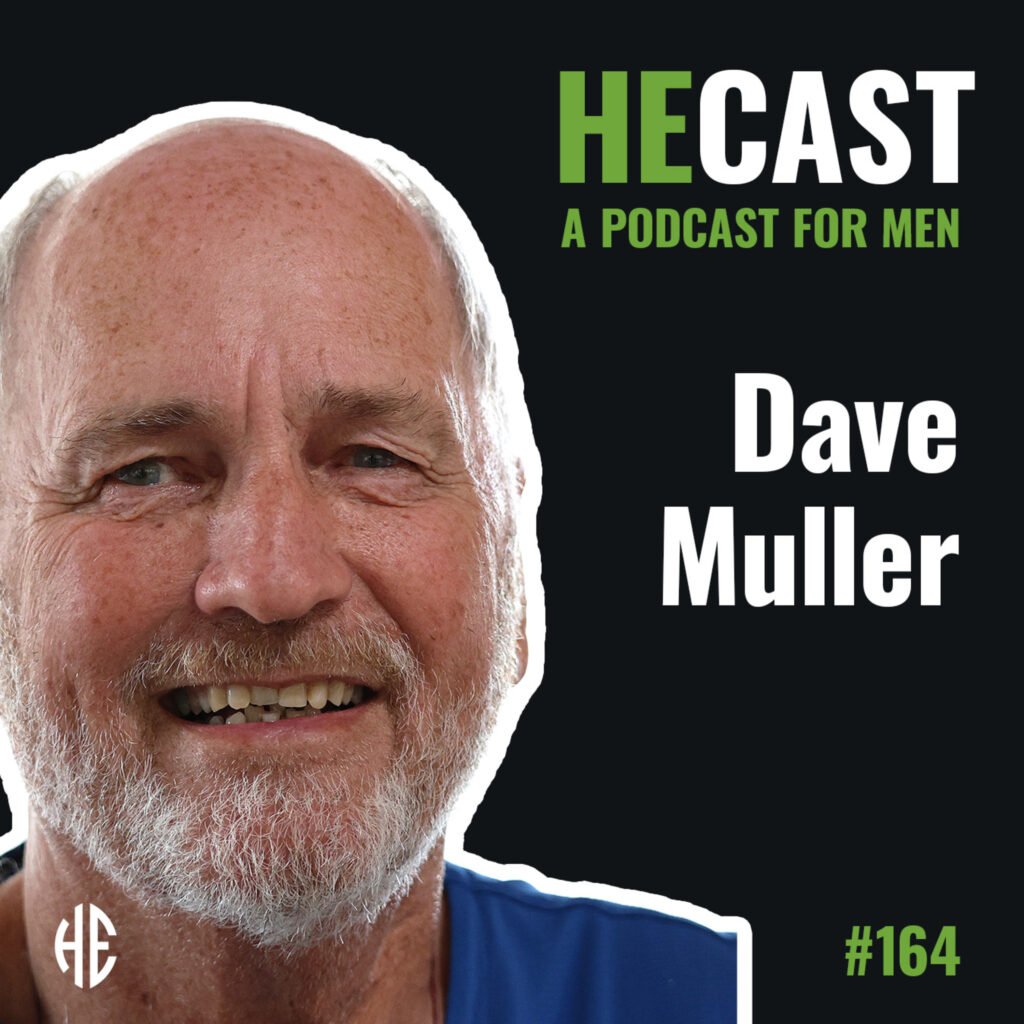
The conversation
About this episode
Episode 164 of heCast features Dave Muller in one of the most powerful and unforgettable conversations we have ever had on the show. This episode explores survival, trauma, faith, family, PTSD, hostage recovery, healing, and the incredible true story behind Dave’s book Not Child’s Play.
Dave Muller was born in South Africa, became an architect, and spent ten years building a steel-hulled yacht named Arwen with the dream of sailing around the world. In 1990, Dave, his wife Sandy, and their two young children set sail for the Bazaruto Islands in Mozambique. After running aground on the mainland, the family was captured by child soldiers from the Renamo group and forced into a terrifying ordeal that would last seven weeks.
In this episode, Mike and Dave talk through the astonishing story of how a family sailing adventure became a hostage situation inside the Mozambican Civil War. Dave shares what it was like to protect his children emotionally while he and Sandy were carrying fear, uncertainty, and responsibility beyond anything most people can imagine. He also reflects on hope, despair, faith, survival, and the strange reality of being rescued while still carrying deep emotional wounds.
This conversation is not only about what happened during those seven weeks. It is about what happened after. Dave opens up about PTSD, the long process of healing, returning to Mozambique, writing Not Child’s Play, and discovering years later how close his family had come to being killed. He also shares how the story eventually connected his family to Hostage International, with proceeds from the book being donated to support former hostages and their families.
One of the most moving moments in this episode comes through Dave’s reflection on the bowline knot. No matter how tightly it has been pulled, a bowline can still be loosened. For Dave, that became a powerful metaphor for trauma, healing, faith, relationships, addiction, and the things men often believe can never be undone.
This episode is for anyone carrying something heavy, anyone trying to heal from a chapter they did not choose, and anyone who needs the reminder that even the tightest knots in life can sometimes be loosened.
Listen to heCast, the official podcast of HeChangedIt.
Download the HeChangedIt app for more tools, content, and support on your mental wellness journey.
Read transcript
Transcript supplied via Spotify RSS.
Welcome to Hecast, the official podcast of He Changed it.
As always, I am Mike Chisholm. As always, I am so excited to
have conversations around the world of men's mental Wellness.
We have all sorts of different types of guests on this show.
And, and, and, and some of my favorite are the ones where, you
know, yes, there are clinical people that come on the show and
we, we, we talk about clinical things when it comes to mental
health and, and, and the perspective from the, the, the
man side of things. But sometimes we have people on
here where they come and they tell their story.
Now this is one of the most special episodes that we've ever
done. 2 hours. Holy cow, Mike, what's going on?
Yeah, I love the long form, but I understand we try and shoot
for 45 to an hour. I get it.
This one here, everybody who is watching and listening, this is
a tale. I got to tell you the story
here, there is no embellishment. I mean, we go watch movies that
are based on true events and things like that.
And the idea that the writers, the talented writers out there
will embellish stories and, and, and make the story that much
better. This one here needs no
embellishment whatsoever. Dave Muller is my guest of
wonderful South African man and, and, and we really scratch the
surface of a story that is so vibrant and rich that that that
I don't believe a writer could necessarily even even I I don't
think you could write this. And he wrote a book based on
what happened to him and his family.
I'm going to tell you this. Everybody's happy.
Everybody has made it through. It's a happy ending.
OK, I'm going to tell you that straight up because as you're
listening to the story of what happened when his family found
themselves marooned on Mozambique and they were
approached by a small regiment of an army of, of child
soldiers. What happened?
And seven weeks they were they were there and, and, and
captured and, and, and being held.
And there's some horrific stuff in this, but we keep it talking
about some horrific things. We do keep it PG13.
It's not a it's not a radar. We don't go into it.
We don't, we don't, we don't, we certainly don't, you know, take
some of the hard things that, that, that, that Dave and his
family saw and, and, and make it a focal point.
We don't. It is a story of resilience.
It is an unbelievable story of, of, of there are no coincidences
in life and the perspective that it will bring all of us who hear
this about the things that we have going on in our lives, it
will give pause because my word, some of the things that somebody
can survive. He wrote a book called not
Child's Play. And I mean, you know, when
you're held by an army of children, you know, where the,
the oldest one there, you know, might be 20/21/22.
There might be a 30 year old there, but the vast majority our
our children with AK-40 sevens and what not.
And again, I'm not, I'm not trying to sensationalize this.
It is a heck of a story and I'm going to stop the intro right
now. Dave, Dave Muller, thank you
very much for coming on here and telling your story.
We're going to have you come back and talk about the things
that have you've experienced since then.
But I just want to say thank you very, very much not Child's Play
is the website you can look for. You can look for him as well.
Please enjoy this unbelievable story in which I was just in the
front seat for, for the most part and by by Dave Muller.
Dave, I, I, man alive, I, I, sometimes I have somebody
sitting across the digital table from me that I just, it gives me
perspective on the life that I have lived here in North
America, here in, you know, Western Canada and, and, and,
and the things that I sometimes get wrapped up in thinking that
are problems. Boy, sometimes it just takes the
perspective of, of, of, of some of the problems of other people
around the world to give pause to realize things aren't so bad,
You know, for me, Dave, I just First off want to say welcome to
he cast. And 2nd, I just want to say
thank you very much for giving the world really the story that
you went through. A lot of people would bury that
stuff and never ever talk about it.
You've gone and done the exactly the opposite.
I want to get into the book, not child's play.
I want to get into all of this stuff here.
But First off, I just want to say thank you for for your
vulnerability and thank you so much for joining us on he cast
today. That's my pleasure.
Thank you for having me. For those eagle eared or eagle
eyed people out there, they can hear, oh, this guy's got an
accent. Yeah.
And no, it's not Australian. No, it's not New Zealand.
No, it's not British, South African and from South Africa
and, and right there shows the international flavor and that,
that, that the story. We're not in Kansas anymore.
Everybody the story that's going to be told is, is is is is a
remarkable 1. I don't want to just focus on
the story itself. I know that that's out there and
there's a lot you've done lots of these, but I do want to talk
about the story a little bit. You went through what can only
be described as a situation that movies are made of, about
inspired by the true events. You know, you went through
something and I, I want to get into it.
Could you please talk about how you ended up in South Africa as
a boy and, and, and, and the things that transpired that that
that got you into sailing and the harrowing situation that
happened to you during that time?
Can we, can we, can we get to that place?
And then once we get to the place, the listener will
understand that's the place we want to get to.
And then we want to talk about what you did after that.
Is that, is that a good sum up? Is that a good sum up of things
right there? Yeah, yeah.
Well, I'll certainly try my best, you know, so it can be a
long story. I appreciate it.
Just cut me. Cut me short if I if I ramble
on, Yeah. Shall I?
Shall I begin at the beginning? How did you get to South Africa
and how old were you? Well.
No, I was I was born in South Africa, so I was I was born in
1951, which makes me a 70, nearly 75 year old.
I was born in Port Elizabeth, the city of Port Elizabeth.
Both my parents had had been involved in the Second World
War. My dad was a prisoner of war for
two years and one of them on the run in in Italy.
My mom was a Navy Wren. She she was from England.
So she actually, she actually witnessed the troops heading off
to for the the D-Day invasion, literally saw that happening.
So she, she came to South Africa, I think it was in 1948,
probably, probably searching for her husband and she found my dad
and, and I was the result of that.
So I grew up in Port Elizabeth, went to school there,
miraculously, somehow or other ended up falling into
architecture. So I studied architecture,
became an architect. But one of the problems growing
up in South Africa was that, well, my parents were, were,
were, I suppose they would be considered liberal minded now
they were they, they, they were both would be classed as sort of
blue collar workers. But I grew up in a very loving
family. But, but they certainly hadn't
had an issue with the sort of subplot that was going on in
South Africa at that time. So everybody knows about the
racism and apartheid, but there were still vestiges, believe it
or not, in the Anglo World War. If I could stop you there for
one second. Not everybody knows about
apartheid. You know, like you look at the
generation, like I remember growing up when I was in high
school, that's when Nelson Mandela was released from
prison. So growing up, I knew about, you
know, I ain't going to play Sun City artists who would be
boycotting. And I knew that there was there
was activism around apartheid. But it's funny how things dilute
as generations pass South Africa in, in many respects, when you
look at the development that it had and, and, and, and all of
the good things that it had. When you look at apartheid and
what it was back then and, and the way of life that it became
and, and, and, and how polarizing it was really at the
end of the day, what a change that that that you have seen in
your lifetime there. And, and, and so your parents,
as you were growing up, were you aware that there were
alternatives to apartheid around the world and that it wasn't
necessarily the norm? Or was that the world you grew
up in, and because you grew up in it, that's all you knew?
No, very much. That was all I knew.
You know, that was the media was very controlled.
I was aware of of the racial tensions because I grew up very,
very close to where it all started and in the place called
New Brighton in Port Elizabeth. And I can remember the army
trucks rushing past and going to to quill riots and things like
that. And in fact, we were even caught
up in it once we're mobbed tried to overturn our car.
But I think the to to sort of give a very, very brief
background and yeah, we've got to be careful not to to end up
in a in a history lesson. But in 1958 the the National
Party took over gained control of the government and that that
essentially was Afrikaans control, mainly made-up of
Afrikaans speakers. And my parents were both very
English. My mum was British.
My dad dad definitely affiliated with the with with the British
as well. He fought in the war.
So I was aware they were very anti this whole apartheid thing,
but more, it was more a case of the of, of a battle between
English speaking people and white and, and Afrikaans
speaking people. So it was, it was sort of like
stuck there within in the white, in, in the white segment of the,
of the, of the community. So yeah, I need to tell you,
just give you a little a very brief story.
In 1960, I was in grade, what would you call it, Grade 5, and
I had a teacher who was very Afrikaans orientated.
But the country held a referendum as to whether or not
we should should leave the union.
In other words, leave part of being of Britain and being under
the control of the Queen and should become a Republic.
And I knew my parents were very, very pro staying with the union,
very anti the Republic. Anyway, the day after the
referendum, my, my teacher, he, he said to us, OK, all of you
whose parents voted for the Queen, stick up your hands and
stupidly and naively, a whole bunch of us did that.
And he said, right, come forward and we were all made to bend
over and we got the the Union Jack emblazoned on our little
queen loving backsides for that, you know, which is an incredibly
brutal thing to have done. So that kind of so, so my issue
in those days was with, with more with Afrikaners, which,
which the way my life has developed is actually incredibly
funny in retrospect. And that was made worse by the
fact that we were then South Africa was also embroiled in, in
fighting a proxy war for the West between the West and, and
the East, basically between capitalism and socialism.
In that countries like Angola and Mozambique had been pretty
much taken over and run by the USSR.
And, and South Africa was drawn in by the West to actually fight
on their behalf to stop that spread of, of the Russian
influence down South into South Africa.
So I was constricted into the army and I really, I, I, I
objected to that. So anyway, where this is
relevant to the, to the main story that we, we talking about
is that I just realized I had to escape from this kind of crazy
madness that was developing. So one of the things that
happened when I was was very young was I was a Boy Scout and
our scout master, our scout master invited a man who just
sailed around the world in the yacht called Sandy Fjord to come
and give us a talk. This would probably have been in
about 1965 or so, I would guess. So in those days, things like
sailing around the world were very exotic.
Nobody, not many people did that.
And and this man had also made a film.
And this was the first time I sort of saw this outside world,
you know, this amazing world of, of the Caribbean and the Panama
Canal and the Marquis Islands. And I remember the the Hula hula
girls, the naked hula hula girls dancing made a big impression on
me and the Great Barrier Reef in Australia, you know, and I
decided then that I wanted to build a yacht and sail around
the world. It was literally was as simple
as that. And and that literally is what I
actually did. So that that whole drive became
reinforced by the need to escape from the madness that was South
Africa. How many years was it between
that scout, that experience with the Scouts, and before you set
sail? How, how, how many years was
that in between? It was you've got to, I've got
to kind of quickly do the sum in my head.
So sure. How do we start sailing?
Hey chick. So, so we started building, a
friend and I started building our yacht in 1975.
So well, that's 51 years ago, about 12 years after, after that
dream had been planted. And then we see 10 years
actually building the yacht and it was launched in 1985 and
that's it. That probably takes us up to the
real just to the story. Well, and, and, you know, the
idea of wanting to escape the stuff that was out there, you
know, 22 years later, you think about that like that's a, that's
a pretty remarkable thing, how you held on to that dream.
And we're going to talk about hope a lot in this podcast
today, You know, the hope of escaping the surroundings and,
and, and finding a bigger world, something that's a little bit
more compatible with how you feel and, and, and, and, and it
feels right with your soul. You know, imagine if you would
have let go of that. And it's so great that you
didn't. And you get to this place where
the boat gets built and, and, and like I said, hey, kids, he's
exactly right. Dave's exactly right.
Now is where the story gets crazy.
And let's, let's, let's talk about that.
So you start sailing. And how long were you sailing
before the before the trouble happened?
What? What I suppose what was going to
mention, of course, is that when you're a young man, life is
incredibly simple. So there's no, no complications
of, of relationships with children or, or having to care
for a family or anything like that.
And but in the midst of all of this building the yacht bang,
that thing happened. That happens to so many of us.
We fall in love. And I met Sandy, who became my
wife. So Sandy was a marine biologist
and and you know, I know it's corny and all these sorts of
things and you can have violence playing in the background, but I
literally fell in love with it. I knew that.
And here we are 46 years on, still married.
So in so while while the yacht was being booked, the yacht's
name was Owen, by the way, just to give it a name, our daughter
was born Tammy. And then in 1985, the year we
launched the yacht, our son Seth was born.
So that's just a bit of a, of a background.
Excuse me. So between 1985 and 1990, we, we
did a, we had to learn to sail the yacht.
So we did a whole lot of cruises up and down the coast of South
Africa. So this is not the easiest
waters to learn to sail in. So Owen Owen was like a Jeep or
Land Rover amongst yachts. That's the best way to describe
it. Pretty indestructible vessel,
very comfortable to sail in, but very slow.
So come 1990, things had started to change quite dramatically.
The most critical things in the world were changing that.
That began to impact our plans. So in 1989 the Berlin Wall fell.
Essentially the USSR collapsed. So this whole thing of this
threat from, from the, the, the red danger, as it was termed,
from Angola and Mozambique that to a large extent dissipated
and, and, and, and critically in 1990, just before we set sail on
our I'll fated voyage to Mozambique, which is where we're
heading, Nelson Mandela was released to, to come back to
your previous question, what did I know when Nelson Mandela was
released that day? That was the first time in my
life I actually ever saw the man.
I'd never even seen a picture of him up until that point.
And, and it was amazing. There was this lovely old
grandpa who was walking out of prison.
This is this terrible, terrible man that we'd imprisoned for so
many years. So that that set a whole dynamic
going in the country where where the purpose of building Irwin,
which was to escape pretty much fell away and and it was to some
extent replaced with just simple adventure.
So in 1990, Sandy he was working at the local museum at the time
as a as an expert in mollusks. The fancy name is a is is a
mallecologist. If you want to mallecologist.
An expert in. Mollecs.
OK, that's an expert in in mollusks.
Yeah, that looks. Yeah, everybody knows that a
oncologist collects shells. But.
But actually mallecology was quite an an undeveloped science
at the time because very few people had actually ever seen
the animals that lived in the shells.
So that's what she was studying too.
Anyway, she heard that that there were some ecologists
working at the Bazaroosa Islands in Mozambique.
So they islands about 20 kilometres offshore from
Mozambique within the tropics. And because there was a civil
war being fought in Mozambique, these islands were pretty much
untouched and pristine. So we obviously researched that
and then we knew that these people were working there.
And, and we were told that the, the civil war wasn't anywhere
near this area. It was way, way, about 3-4
hundred kilometers inland from it and, and to the north of the
islands. So we, we, we figured we would
do a quick sail up to the islands, basically one month's
trip there and back, just so that Sandy could do some
exploratory research and, and make contact with the people
there. And so, so that's what we did.
We set off. And so we had our children at
the time, Tammy was 8 years old and Seth was four years old when
we set sail. We set sail in April 1990.
We stopped over in Maputu. And that was an eye opener.
But because Maputu was completely controlled by the
Russians at that time, they were the first Russians I ever met.
But it was in ruins, a city in ruins.
You know, we carried on up the coast and, and, and to get to
the most critical part of the story, just the day before we
were due to reach the islands, we'd had headwinds all the time.
So there'd been a bit of a slog getting there.
Sorry, excuse me. So there'd been a bit of a slog
getting there, and I saw that there were some big Thunder
clouds developing in inland and starting to sort of roll out
towards the sea. We were, we generally were
sailing within sight of the land always.
And anyway, this storm hit us that afternoon and it was just a
storm of absolutely unbelievable velocity, unlike anything I'd
ever experienced. It was almost supernatural in
its intensity. It was so strong that it
actually bent 10 millimetre steel plates that are on the
yacht and it ripped out the the head so it just tore to pieces.
Sandy had to get to go up into the story in the book.
You had to read the story in the book, but Sandy had to crawl up
to the bows to bring down the sailor.
Incredibly brave act on her part and she was probably at the most
about 7 or 8 meters away from me and I could not actually even
see her The the sea had just been ripped up by the wind and
and there was all this spume blowing around in the air.
Anyway, that was all a little bit but that was pretty
exhausting and it did it the damage it the only damage it did
was to destroy ourselves steering gear.
So the next day we carried on up towards the island.
This was now really exciting because I'm now 38 years old at
this point and I'm finally now reaching the dream of crossing
into the tropics and getting to tropical island, which we did
the following day we and I worked out.
So this is now pre sat NAV, pre GPS days.
So I was using of course, dead reckoning to to navigate.
I worked that worked out that we would reach and in fact be north
of the islands around about 2:00 in the middle of the night.
And then the plan was to have two, which is a way of putting
the brakes on the yacht and wait until Daybreak and then enter
the channel to get to the island.
And that that's what happened. And then then I just made an
unmistakable unforgivable mistake in after I'd tidied up
the deck that that night and and sort of cleaned up everything,
put the yacht into the whole two position that we weren't, I
wasn't picking up any bottom, any depth below the yacht, which
meant we were far out to sea. I went down below and, and, and
with the intention of sticking my head up into the cockpit
every 30 minutes or so and and I fell asleep.
And about two hours later, Sandy woke me and said day, we're
touching bottom and bang, the next thing the yacht was
aground, waves were breaking over it.
And it was just, it was incredibly traumatic and
unbelievable. I, I couldn't believe it was
happening. I had no idea where we were and
why, why we'd hit something when we were supposed to be so far
away. Anyway, the we managed to, to
get anchors out and anchor out and to turn the yacht Sandy and
I, so that it was facing back out to sea.
There's a very huge tidal range there of four meters.
So as the sun came up, it became very apparent that that we
couldn't move the yacht any further.
So the, the kids jumped ashore and ran around and, and we set
about trying to work out how we were going to refloat the yacht
the next day. The, the yacht wasn't damaged in
any way at all by this. So we're waiting for the next
high tide. But Seth at this point realized
suddenly realized it was his 5th birthday, happened to be his 5th
birthday. And all he was interested in was
his presence and cake and things like that.
So we, we, we created it, put out a blanket under the yacht.
By that time it was completely high and dry.
That was the only shade. And we were opening Seth's
presence. And I took a photograph of this
and in fact, that's, that's you can see it there above my head.
And I was walking back towards the yacht and looked up and I
could see there was this little group of people approaching us
from the direction of the islands.
By then, by then, I'd worked out we were about 30 kilometers
South of the islands on the mainland of Mozambique.
And anyway, I sit to San Diego, great news.
We've got some help coming. And so the two of us got up and
we started walking towards, started walking towards this
little group. And as we neared them, we could
see that it was made-up of four boys and, and two adults.
But they behaved strangely. They, they stopped walking and
then the boys just started to walk through inland towards the,
the, the dunes, franking the beach.
And we carried on walking, completely oblivious to what was
happening and then suddenly realized these boys were all
kneeling down and pointing AK-40 sevens at us.
You know, that's one of those points when life just absolutely
changes 180°. It was it, it was, it was a
sight that was just completely beyond comprehension.
I, I couldn't believe that what I was seeing.
And I think conventional wisdom is that in those situations is
that you, your body sort of goes into a fight or flight mode,
fight or flight mode. If, if, if, if we'd done either
of those things, we would be dead.
We would not be here now, fortunately, and and maybe it
was part of the fight, the way fight was manifested in us with
we literally froze and that was the best thing we could ever
have done. So we froze and then tried to
appease. So we slowly walked back to the
children. The boys sort of followed us all
the time. They climbed onto the yacht,
started throwing things out and then they started screaming at
us. And the old couple that were
with them were actually they're burden bearers that captured
them. They were, we didn't know at the
time, but the these boys were from from Renorma and that the
old couple were from Frelima. Dave, Dave, did you understand
what they were saying? No, no, we couldn't understand
the word though they were. Shouting at you in a.
Language speaking Portuguese and Shangon, but but it was very
obvious that they wanted us to walk with them, walk S with them
and they, they, they might be old couple, bundle up some of
our stuff in in some sheets and, and and put them on their heads.
They were very rough. They started to beat up this old
couple with the butts of their rifles and and it was very clear
we had no choice but to walk off with them.
So at this point, the children, I think suddenly realised that
things weren't that good. Anyway.
We we walked away from from Irwin and the leader was a guy
who had only one eye and they were, they were about, he was
probably about 18-19 years old, old at the most.
The rest were all younger. They were from 13 onwards.
And you know, that's, that basically started prodding us
forward with it and it's made it make making us walk S with them.
And we, we, we this, this started around about 10 o'clock
10:30 in the morning. And we, we walked that whole day
S with them until we reached a point where where we stopped and
we could hear the the boys were arguing with this old couple
that they were shouting amongst themselves.
And, and I think what they were doing was actually dividing up
the stuff that they'd stolen from the yacht, right.
Anyway, I'm a speed up with the story because I'm getting into
detail. No, no, hold on, No, no.
No, no, you know. It's I, I, I get it, but the I,
I get the, the point that you want to speed up because you
want to get to some of the things that you learn from it.
But like, I mean, I got to ask you like in a million years, did
you or Sandy ever think that this was even a possibility of
something that could happen? Or was this something at that
point that was completely foreign to you that that this
was even a thing, that that children are being raised up in
this guerrilla type, militia, pirate type atmosphere?
Did you have any idea that even existed at this point?
No, no, it was. It was.
It was. Wow.
It was all it was. It was all unbelievable.
That's the only way to describe, you know, it, it sounds, it
sounds very trite to put it this way, but it was literally like
falling into ATV set into some kind of TV drama, like an
episode of NCIS or something. You know, it was, it was that
absurd. And, and we, we just, all we
knew was that we, we had to do everything in our power not to
inflamed the situation, not to aggravate these boys and and to
keep alive. Did they separate you from the
kids at all or or or were the kids with you the entire time at
this point now? The children were always with
us. So, yeah, to to, to jump ahead
because something particularly horrific is about to happen.
And the story, sorry, not trying to dangle that in front of
people, but the worst is yet to come.
But we, we, we took a decision, Sandy and I, that we had to do
everything in our power to protect our own children, to
never be separated from them. I don't think at that, at that
point we didn't realise how dangerous the situation actually
was and how much our lives were were under threat.
But we also took a decision that we would downplay what was
happening and say, you know, this is just a an unexpected
variation to the holiday. You know, that we, we, we, we,
we as a family had done some pretty weird things up to that
point. Nothing quite as extreme as
that. But, but, but just pretended
that this was normal. And, you know, look at all these
lovely seashells on the beach and all these fascinating
things. And, you know, those are
interesting guns and sort of thing, you know, So just
downplay and defuse the situation.
Yeah. So yeah, I think to just sort of
carry on, Lucas. What happens next is something
that I find quite difficult to talk about.
But anyway, I'll persevere through it.
I. Appreciate it so we they they
then by then it was it was starting to get dark stars were
coming out and they forced us to climb up this huge big dune that
was flanking the beach. So we, we tunneled up to the top
and and when we got to the trop, you could see stretching far
inland was almost like flat marshland.
But on the other side of the dune, the land was side of the
dune with thick forest. And and that was really
terrifying. We, we entered that forest.
So bear in mind that we, we are now in shorts and T-shirts.
We haven't even got shoes on. And and we at at this point, we
carrying sis all the time. Tammy, this eight years old,
walked every step of the way. Incredible strengths that she
showed. Wow.
So when we entered that dune, we crossed over the Crest.
The, there was this incredible deathly silence because up to
that point we had the reference of the sea next to us.
So we, we kind of, at least we knew where we were.
We were on the on the coastline Once we were in that forest and
it was pitch black and we weren't following a path.
We were just blundering our way through the trees.
We, we knew that we were lost and there was this terrible
feeling of, of being lost because if we vanished at that
point, nobody would ever have found us anyway.
We, we carried on walking through this forest, absolutely
exhausted at this point. And it's, it's also very warm
because it's a Tropic. So we we absolutely sodden as
well from sweat. So one, one of the boys, the,
the youngest one was sort of behind us and he kept on
prodding us forward saying bumbush, bumbush.
And the, the other boys were in front and the old couple that
that were with them carrying the stuff.
And after, I suppose about two hours of walking through this
forest, we reached the point where we were told to sit down
in a sort of little blade. We could see that we're in a
little bit of a valley base because there's, there's quite
a, you can see the star glow sort of defines the horizon.
Sorry. And so we were, we were told to
sit down and one boy stayed with us and, but then the others all
sort of carried on. And we could hear them starting
to shout and, and, and, and it sounded like they were sort of
cutting their way through the Bush, sort of like slushy Bush.
And, and I said to Sandy, it sounds like they've lost, they
don't know where they're going now.
Anyway, soon after that, they, they, the leader came back.
We, we were calling him Cyclops by that time, by the way.
So this habit of calling being names, because we had to
identify who they were amongst ourselves.
He came back and and he was, I could see he was exceptionally
agitated. So he brushed past me and as he,
as he walked past me, he shoved the jugger like a little plastic
jug with a handle on it into my hand.
And, and I knew the old man had been carrying this and the, the
handle was, was sticky. And I involuntarily, I licked my
fingers and, and I tasted metal. And I, you know, at that point,
I just kind of knew that they'd actually just bane it that old
couple to death. And that was, you know, at that
point, you can't really, you can't really explain how you
feel. You know, it's we, we, we
literally thought we were The Walking Dead, but we reinforced
this feeling of Sandy and myself that we had to protect the
children. And, and fortunately, the
children were oblivious to what had happened because it was all
dark. We never saw it.
We only heard it the next day, we saw the evidence of it.
So we weren't, we weren't what we were imagining definitely
happened. But so we, we, we just carried
on trying to downplay the whole thing.
And soon after that we reached a, a sort of a temporary camp,
outlying camp of this Ronama terrorist group.
And then the so anyway, we, we spent the night there,
absolutely terrifying night amongst these youngsters.
We we, the leader of that camp. How many, how many, how many
people do you think were in that camp?
Once you got to the camp, how many people do you think were
there? In terms of, of, of, let's call
them soldiers. Well, I, I don't know to be
honest, but I would guess in terms of soldiers, boys and men,
but they were mainly boys, probably about 20 at the most.
But there were, there were, there was this, this was
actually, we discovered afterwards that this was an
outlying camp of Renorma. And it was actually they, they,
they were growing maize and things like that there.
So it was actually like a little agricultural outpost.
So there were quite a lot of women and girls there as well,
kind of like we, we finally ended up.
And yeah, so anyway, the next, the next morning, we, we knew
they'd sent back a, a bunch of, of other troops to go and, and
raid the yacht. And I think I must, I must
really, I must move forward because we use up all the time
telling the story. No, I know it's, it's, it's an
unbelievable story. And and I mean, yeah, like,
like, how long are you at that camp before the next major event
happens? Now we only spent a night there,
so the next morning they a very frightening thing happened
because Cyclops was called before.
So the commander of that camp was a guy that we called Paul
Patrick. I think we misunderstood his
name. We gave him the name Paul
Patrick, this commander, he seemed to have modelled himself
on Chez Guevara. In fact, that's what he looked
like. He, he brought Cyclops before it
was brought before him. And clearly Cyclops was being
accused of something. And, and we witnessed this, this
really terrifying scene where Cyclops was, was being forced to
admit that he obviously it's stolen stuff from the yacht that
should have gone to the commander of this camp.
So 22 little boys were made to go and cut some sticks and they
started to beat Cyclops on his back and on his, the backs of
his legs and, and he started screaming and shouting.
Before long, this kid who'd actually the day before had
killed people was, was himself just lying on the ground
whimpering and screaming like a little child.
It, it was a, it was, it was a terrible thing to actually
witness anyway. Then, then.
So he, he was, he was sort of made to lie there with his arms
spread out on, on his stomach and arms and legs spread out.
And Paul Patrick grabbed an AK47 and held it to his head.
And you know, oh, you know, can things possibly get any worse
than this? But anyway, he, he made, made
Cyclops shout out what was obviously an admission and, and
mercifully, it never went any further than that.
And Cyclops was allowed to just to skulk off.
Soon after that we were taken to the top of a sand dune nearby.
We were about two kilometers from the sea and we spent the
morning waiting there and and that afternoon Paul Patrick came
back and gave us back essentially 2 shopping bags full
of our stuff. And and then a different group
of boys were were told us a different group of boys were
going to accompany us to the road to villain Kulis, which was
great news to us because that's what we wanted to get back to
civilization. So here above my shoulder, which
which side I'm on here, this this photo, that's the group of
boys that then walked with us down that section.
And how did you? Get a picture of them.
Yeah, so in their shopping bags, believe it or not, incredibly,
was my camera. Of all unlikely things that they
should return, There was nothing, it was absolutely
nothing, nothing. But the two critical things I
returned was our camera and anti malaria tablets just by
incredible good fortune. And yeah, so that's why I've got
photographs behind me of the event.
We we were, we were told not to take any photographs, but I was,
I wasn't entirely honest about that.
But yeah, it is quite a unique record of the, of what happened.
You know, we spent the next two days walking S down the beach.
We in total we covered about 70 kilometres and we ended up in
the Yanomo headquarters and we spent, they built a Hut for us
there and, and we spent seven weeks living with them. 7 And it
was during, during, during that time we had to just accept that,
you know, things weren't going to get any better.
We, they weren't, we tried to get them to take us back to the
yacht. We tried to get them to take us
to the road and they always kept on saying it was too dangerous.
Maybe at this point I must just give a little bit of context as
well as to what you forded into. So how did?
You also communicate. I also want to know how you
communicated. Like did anybody there speak a
common language or was it all just a matter of feel by this
point and trying to understand what each other was saying?
No, the, the communication was, was a source of, of endless
trauma to us because nobody could speak any, we couldn't
communicate with them. So for one man, Patricia,
Gerald, Patricia, he was about 40 years old.
So he was, he, he became our official interpreter and
protector in fact. And we, we, we owe our lives to
many people, but one of them was Patricia.
Unfortunately, Patricia, he'd, he'd learnt a little bit of
English while working on the mines in South Africa.
And unfortunately he, he didn't have a particularly good grasp
of English. And he'd also obviously been
threatened with death if he'd divulged anything.
You, you would never, you wouldn't tell us what was
happening, but but it was really clear that on many occasions we
were questioned by the the commander of the camp, the guy
we called the commander, he was a 21 year old.
We knew they were asking questions about oil exploration
and fishing and things like that.
So we, you kind of know that your life depends on these
answers that you're giving. But the problem was we had no
idea what was what, Patricia was saying back to the commander.
Right? Well, you know, we, we, we
couldn't, we didn't understand the questions we were asked, and
we had no idea whether our answers were being relayed
correctly. Maybe.
Were your kids with you? Again, I got I got asked, I got
asked a question to get about the kids.
Were your kids with you the whole time?
Were they ever used as as, as leverage, you know, to try and
find these things out? And, and we're at this point,
are you telling them just go with the flow, Just do
everything that they say to do? And, and, and, you know, I know
that's the number one thing people ask.
I get it. There's a reason for that.
You know, while you're in this part of the story here, what
were you telling the kids? Basically carrying on the story
that, you know, this was just an incredibly exciting adventure
that we we were in, you know, and there were all these strange
things happening, all these amazing spiders and scorpions
and, and, and things living in the Bush.
So we were living in a Bush camp.
This is not. So I think that there's a
photograph of Tammies. This is this is a photograph
sneaked through a hole in, in the Hut that they built for us.
So that's a little context. So that's Tammy over there
anyway. Yeah.
So we, we, we, we set up, we set up games for the children.
But it became quite clear that they weren't going to harm us.
In fact, they, to be honest, they treated us as best they
could. We had the, as good a food as
the, the leaders had, we had warm water to bath in every
every morning and every evening. And they really loved the kids.
So 1, you see, this is, this is where the story gets complicated
in terms of trying to make it very brief, because the, the,
the, the first contact we had with the leadership was that
those boys had accompanied us down to down after the 70
kilometre walk. And then we walked inland.
We didn't know where we were heading at that point.
And then they suddenly left us on the path.
The, the boys that were accompanying us, they just
abandoned us. And the next thing this, this
man, he was about 50 years old, but with his, his arm, his left
arm amputated just above the elbow.
He suddenly appears very well dressed in, in sort of slacks
and, and, and an iron shirt. And he he sees us and he sees
Seth, who at that point happened to be playing with a big giant
locust. So yeah, for Sith, it was like
living. It was like a paradise.
It was like living in a sand pit to just digress, you know, it
was like a he never had to wash or bath or anything like that.
So that that's. Effective is everything.
By the way, so anyway, this this guy who we immediately gave the
name Captain Hook and he became a very important character in,
in during our time there. He was sort of like the liaison
guy. He saw Seth and he just like,
whoa, he just, he grabbed Seth with his one arm, stuck him on
his, stuck him on his, his arm and started running off down the
path, which which didn't make Seth very happy.
But but then all all this guy did was he like giggled it, it
was very disturbing. You know, he was we, we
discovered afterwards that he was drunk all the time.
You know, they were all drunk all the time, so.
Oh my God. Anyway, yeah.
So they, they actually really loved the children.
They they put up a spring for them.
They provided bicycle wheels for them to wheel around and, and
they gave them a constant supply of, of sugar cane to Manchon so
and, and nuts and things like that.
So the, the children were actually, you know, I mean, when
I say well treated in the context, they were incredibly
well treated. And it became very apparent that
these people were actually looking after us.
So this is this is where now it becomes important before I get
into too much detail to explain the context.
Now that's, that's the incredible thing about this
context is that it was only, it was only 32 years after 1990,
just a few years ago, after I'd written the book that I was
approached by some men who said they had information that I
might find interesting. And, and for the first time, I
discovered what the background was, what, what was actually
happening. And the, and the context which
is which is which is slightly bizarre.
So can I just start listening to that quickly to explain that
context? So we, we could never understand
why they were held that kept us captured, you know, why they
didn't just take us to the road. So twice while we were there,
the camp was attacked. The first time was with missiles
in the middle of the night. And that was the most terrifying
thing I've ever experienced in my life.
You know, these things fell out of the sky and they had
proximity fuses. So they exploded above your head
and and I I literally could feel my brain disintegrating at that
point. It was very difficult to keep up
the charade of this is just normal.
Anyway, that and that was followed up by an infantry
attack. But the these children were that
made-up the the Army were incredibly well trained and
disciplined. Wherein perhaps lies a story.
And they repelled the, the forces that were attacking the
camp. Straight after that the
commander came to us and through Patrick said the reason for that
attack was to kill you. And he said that's crazy.
Why would, why would they want to come and kill us?
We, we were, we were trying to work out how to run into them to
escape. And then a few weeks later there
was another attack which started with a mortal bomb, mortal bomb
attack in the camp early one morning.
That was a very serious event. There were 500 troops attacked
the camp and we, we were to run and, and flee for our lives.
There was literally with bullets flying around and, and there
were a lot of injuries that resulted that.
And we were told after that again that the reason for that
attack was to kill you. And we, we didn't really believe
that. So, but in fact, that was true.
That was actually the the situation.
So what what I discovered from these men was that's just sorry,
just to go back a little bit further because I haven't
explained who the Norma and Lima were.
So Norma was a, let me sort of start with Fredima.
Fredima were the government forces.
So they were the Russian trains sort of Soviet forces army for
Mozambique, the sort of official governmental army and they were
fighting a civil war against this group called Renamo who was
originally they were originally formed by the Southern Rhodesian
government to as a counter terrorist measure on on the
eastern border. After after Southern Rhodesia
became Zimbabwe, South Africa took over in the interest in
looking after the Norma. So they, they were sort of in
inverted comments like the good guys, as far as we were
concerned, they were the Western bet.
So America and America and Portugal and to a lesser extent
Britain were, were supporting them as well as South Africa.
Then in in 1985, I think South Africa realized the writing was
on the wall in terms of apartheid and, and, and having
to relinquish power to the ANC. The the President of South
Africa and the President of Mozambique met on at the at the
Incommati River and they signed what is called the Incommati
Accord. And that basically was a non
aggression pact between the two countries.
So Forlemo undertook the Forlemo government, the Mozambique
government undertook to no longer support the ANC because
overhead we're giving them a safe base there right on the
border of South Africa. And in return South Africa
undertook to not support Renama. I don't think either side really
actually abided by that, but South Africa was certainly
caught out two years later when it was discovered they were
still supporting them. Now anyway, this is this is very
important in terms of the context.
So yes, what I discovered from these men was the the names were
John Culley and Marius. So the first guy who contacted
me was Marius and he put me in contact with John.
So John John, it turns out, was actually the South African link
with Renorma through the through.
Not, not that. So he was like a link between
the military and the southern government and he had to look
after the president of Renoma, a guy called Alfonso de Calma.
And I've met him and he was also one of the original Ricky's, the
equivalent of the Navy Seals in South Africa and an amazing,
amazing man. So in 19, at the time of the
incommunge accord been signed, he was, he was instructed to
keep liaising with Renomo. And this happened until 1987
when he was suddenly one day told to get Alfonso Drakkarma,
the president of Ronama to Pretoria for a meeting and with
with Pukbuerter who is the Minister of Foreign Affairs for
South Africa. And at this meeting Pukbuerter
said that Saudi was now going to abide by the Unkamati Accord and
was cutting off all support for Ronoma.
The karma was incensed by that. That is the reason why we were
captured and held by them as as hostages to force South Africa
back to supporting the Nana, because at that time, right
after that, sorry. No, in the background then, were
you guys being used as pawns and, and, and these these people
were saying, OK, guess what we've got.
Yeah, hostages, including children, and they were trying
to use you as leverage to further their agenda.
Is that happening in the background without you even
knowing it was happening? Yeah, we, we had no idea that
that was happening. Yeah.
And and that, I mean, I've seen, I've, I've seen factual proof of
that. So that's exactly the situation.
All as a result of the book. All as a result of the book
coming out. And now pieces have come back
into to give you a bigger picture.
Yeah, so wow, wow. Yeah.
So we, we, we with the story. Sorry I've I've lost my.
No, hold on, hold on. Before we get back to the story,
Dave, I got to know before you back to the story, who's going
to play you in the movie? Who's going to play you in the
movie? Because like, I mean, Mike.
Everybody who's in the books and there used to be a movie, I I
no, nobody's put calculus be a publisher for the book.
So anyway, but that's another story.
OK, So anyway, so, So what the problem was that Renamo, I think
everybody knew that the USSR was collapsing and that things were
changing in South Africa and the ANC would be unbanned and Rama
critically was losing the propaganda war.
They, they Ronald Reagan and the American CIA called him second
only to the Khmer Rouge in terms of viciousness.
Margaret Thatcher started saying kind things about them.
So for Lima then realized that any atrocity that was
perpetrated in Mozambique would be blamed on Renama, regardless
of who, who, who, who did it so suddenly.
So Renama captured us, But but for Lima suddenly realized all
they had to do was kill us and Renama would be blamed.
And this would put Renama in an incredibly disadvantageous
situation when it came to negotiating peace, which was
which was an inevitability because they couldn't carry on
fighting the war forever. So.
And that's what happened in in Yeah.
So now to get back to John, I'm, I'm, I'm just going to use his
their first names and, and their names are mentioned in the book,
but, but just to protect them. So, so John, John now is aware
that, that, you know, he's been told to cut all contact with
Renomo and he, he basically said to foreign affairs.
Look, that's not a very wise thing to do because what
happens, what happens if, for example, a South African
aeroplane crashed in Mozambique? You know, that country to the
what the message that's out there that Renomo are only
operating in Golongoza area. They actually control the entire
country only for Lima only control the cities.
How? How would you, how would you
negotiate with them? And he was told no, you cut all
contact, which which he did. Then in 1990, what happens?
Not in aeroplane crashes, but this crazy family running around
in some peak and they get captured.
Exactly what he predicted would happen.
Soon after we were captured, the South African government
realized that they had to come and rescue us.
And the only way they could do that would be to send a Navy
naval task force up into the waters.
And that so this now precipitated extraordinary
cooperation between the countries.
So South Africa had to get permission for South Africa to
land in on Mozambique, realized that the countries were thawing
tents and purposes at war at this time, that they had to stop
fighting. Everybody had to stop fighting.
South Africa had to come ashore. There had to be observers and
all this sort of thing. So this task force is now put
together 33 naval ships and I'll come in to rescue, rescue us.
I'm deeply. And how long?
Are you there at this point, at this point here when they're
when they're getting the exercises ready to come and get
you, How long are you there at this point?
We've been there. We were there in total seven
weeks, but this was about this is all happening after about 5
weeks and you have. No idea.
Like, like, like I want to ask about hope.
I want to ask about hope because you and Sandy are putting on the
bravest faces as you can. Seth and Tammy are, are are are,
are, are OK, which is unbelievable when you think
about like the fear and whatnot. And I mean, how grateful you
must have been that they were OK, but you were burdening the,
the, the responsibility of having to fake it till you make
it. You were burdening the
responsibility of, of, of, of showing.
The kids that you were OK and that there wasn't fear.
You were putting on the brave face for them.
Was there any hope? Did you guys have any hope at
all? No, you know, we, we kind of,
you know, you go through a very weird cycle of, of hope.
So you, you begin to read hope into all sorts of crazy,
unrealistic gestures and, and situations.
So we, we, we'd learned from Patricia through, over a long
period of time that helicopters had landed in that area.
And we've, we've no idea whose helicopters they were or where
they were from. But clearly he described it so,
so much that helicopters had landed there.
And we've learned that they landed there at night.
And we thought, oh, OK, this means they've got to land at the
full moon. So, you know, so then the hope
becomes the next full moon. This is when we're going to be
rescued. Wow.
Completely, completely unrealistic, I think to to
believe under the circumstances. So you you climb up.
Yeah, but it. Helps you get through the day
though, right? Yeah, you climb.
Oh, the day is dragged by unbelievably.
But anyway, we use various techniques together.
So you climb up this this little hill of hope and, and comes the
full moon and nothing happens. And then you sit down the next
side and the, the problem is, is that so then, then, then we
discovered no Patricios, are you stupid?
Of course the helicopters don't fly.
And then when there's a full moon, they fly.
I mean, there's no moon and they make a big Ring of Fire that the
helicopters land in the middle of.
So now, now you now you climb up the next one.
But, but you, you never get as high as you were.
And so by the time we were rescued, we were pretty
catatonic. I mean, we, we actually thought
we were, we were, thought we were actually mentally very
strong. It was only once we were rescued
that we discovered how incredibly mentally ill we were,
mainly because of this ever decreasing hope that we
experienced. It's it's quite interesting to
perhaps just comment about how differently Sandy and I reacted
because there's there's so much one could talk about on this, on
these subjects. Sandy remained.
Initially, Sandy was had no hope.
I was the strong one with hope. I was in, oh, we get out of
this. Don't worry, you know, I'm being
into beating my chest. I'm the man.
You got to get it all. You know, we'll survive this
sort of thing. But then I slid into incredible
despair. But Sandy then grew out of out
of. I think she then realized that
she wasn't as quite as much she was, She developed quite a lot
of respect in the camp because she had some medical training.
So she was seen as the doctor. So, you know, there's a whole,
we could go off for 1520 minutes on that subject.
So, so Sandy kept on saying to me, no, Dave, why don't you make
something, you know, ask them for a knife and, and build a
chair? Or is it because there was, I
mean, there were, you can see the pictures behind me.
That literally is what we had a table and a few broken chairs.
And I, I don't think they ever would have given me a knife.
They would never let me touch anything that was vaguely a
weapon. But I couldn't bring myself to
do anything constructive because that would be an admission on my
part that this was going to carry on and there was no end to
it. I see.
And so so I was sort of becoming more and more hopeless, I
suppose you could say. So Sandy was actually the strong
one in this whole thing. She's got to have all the credit
for for it. So, yeah, that's that's that's
sort of, I mean, you know, if you think about it, there we are
sitting in the Bush completely cut off both.
I mean, none of us were jumping around full with joy.
I can tell you it's but but me in particular was I was feeling
very depressed. And there were times when, I
mean, here's another funny little story to tell that might,
that might ring, ring with some men.
There were times when I actually felt very suicidal.
I don't know if one should talk about these things, you know,
where you just feel. I just just can't carry on any
longer. You know, this is and, and, and
there are all these AK-40 sevens leading up against trees all
over the place. You know, every day they were
shooting in the camp and all you had to do was grab one of them.
You know, I, I'd, I'd even discovered how to get it off
safety and, and simply just start shooting and within,
within a minute we would all be dead.
And it would be seen as a very heroic gesture on my part.
But that would have been the most incredibly cowardly thing I
think I could ever have done. So, But but nonetheless, that's
how I'm feeling. And you know, and you're sitting
there and, and, and so the, the book is based on my diary.
So, yeah, sorry, just to, I don't know if you can see this,
this is, this is, this is the actual diary.
I clicked it while I was there. So every day I wrote up this,
this little minute little, this minute little print.
I don't know if that's really clear what was happening.
And that's what the book is based on.
So 1 morning, I was feeling very down and I, but I was sitting in
the Hut and I, I was writing up this little bit of this diary
and suddenly bang a mortar. That second attack occurs.
The mortar lands just on the outskirts and the next thing
they're shooting all around. And I mean, like, you know, just
like that from, from feeling, oh, I want to die.
It's incredible. I've got to survive, you know, I
mean, I've never in my life felt more alive than running away
with a bullets flying. It's, it's a terrible admission,
in fact, but, but it is, it's, and, and that's why people love
adventure sports and, and paintball and things like that.
And you get a kind of a big adrenaline rush to suddenly find
your life at risk. And, and, and the same applied
to the, the, the boys and who were, who were our captors.
You know, they, they, they, we thought they would run away, but
they were fierce, fierce, disciplined fighters.
And they whoop with joy both occasions when the when the camp
was attacked, because now suddenly this was their self
worth being, you know, being made manifest.
Wow. So yeah.
So anyway, perhaps just to get back to to explain the context
of the story, so. I'm fascinated by the way.
I'm fascinated by every word. I'm hanging on every word.
And I'm sorry, I'm waiting to. Dive into the book.
I'm taking too long to tell the story, but we're.
Good. No, no, no.
We're good. Let's keep it going here.
The second. Attack.
Happens where time's marching on and, and, and, and, and you're
going through, you know, these ups and these downs of, of, of,
of how you're feeling. And I mean well.
I think, I think the critical thing to, to, to note about that
is we had no idea that so much was happening in the background.
We had no idea that the Navy was literally steaming up the coast
towards us. I mean, that would have raised
our hopes immensely if we'd known that.
But but then there was a problem because Renamo refused to
release us. So, so Frelimo had agreed to
release us, but Renamo said, no, we're going to, we'll hold this
family for as long as we need to.
And, and that was that then was creating a very embarrassing
situation because the the task force was already assembled in
one's way. And these are not easy things to
put together, I've discovered as, as I think America's
discovering right now. So I shouldn't have said that,
should I? No, what are you talking about?
It's it's it's it's the observance.
The observance of everything is is absolutely.
Yeah, so, so, so everybody is now in the awkward situation.
So they and and they can't they, they twice tried to talk to La
Calma and meet up with him, and on both occasions he refused.
So they had to then call John back in and say, look, please,
can you somehow make contact with this man?
You know, you've had a long relationship with him.
And John did. John managed to organise a
secret meeting with him in Blantyre in Malawi.
And. And he pleaded for our release
and argued for our release. And incredibly, John recorded
that. And he's giving me a transcript
of that. And I can tell you it's an
amazing thing to read. Yeah.
It's in this file here right next to me.
So. And eventually, eventually the
comma says, OK, you can have your family.
I mean, just like that, you know, after about an hour and a
half of talking. But in the, in the discussion,
he pointed out to South Africa that, you know, you, you, you,
you are being deceived by, by Mozambique.
We, we've got people planted in for limo and we know that in
fact, far from them with drawing the troops in the area where the
family's been held captive, they're increasing the troops
and they plan to attack it and they plan to annihilate that
crowd, including the family. And in fact, a bounty had been
put on our heads for anybody who could kill us.
So. So John now comes back to South
Africa, says great news, they've agreed to release the family.
But bad news, you're walking into a trap.
You know, you could, can you, Can you imagine?
South Africa's now just started to negotiate with the ANC,
starting to talk to Nelson Mandela and suddenly it now gets
trapped into the middle of a, of a gunfight in Mozambique.
The world would have said South Africa's attacking Mozambique.
You know, it would have been an absolute disaster.
So this, so this is where Marius now comes into the scene.
So Marius then gets told, look, you better get to the to the
border, the Kruger National Park where there's a military base
and start intercepting the radio messages that are coming from
Philima and find out whether this is true.
So that's what he does. He has to 1st decode, decipher
the the messages. This is all still classified
stuff, but that these guys don't see.
I think so much time has passed by that they don't mind talking
about it now. So I think it's a little bit of
a embarrassment to them. That would be an embarrassment
to Mozambique to know that South Africa cracked their codes.
And anyway, he does. He starts to create what they
call situation maps and within two days he discovers that, yes,
it's true. There's about 1000 troops
assembling around the area where we are held captive and they're
all converging on it. So this, this then gets ferried
back to foreign affairs and then the powers that be and say,
well, we, we better we, we, we do, we simply can't go.
And, and you know, this is too dangerous the situation.
So, so a meeting is in a range. This is where Culley, who was
head of head of, of military intelligence, Marius worked for
military intelligence and Culley was his boss, basically
responsible military intelligence for the East, East
Africa. He, he gets told he must go and
meet with Chasana and present him with with Maurice's maps and
this evidence, which he does in Maputo.
This is all pretty amazing stuff going on in the background,
which you know, nobody would even dream about or imagine
happening. So Chasana, President Chasana
says, OK, all right, we've been caught out and, and I don't
necessarily know exactly what my commanders on the ground are
planning. So the only way to be certain is
you'd better fly up there. I'll give permission for you to
fly there up to Verm Kulis, which is where the the nearest
Fredemo base is. And, and you can meet the
commander there. I'll give you all the letters
required and you can check for yourself that the troops are
withdrawing. And so that so Kali does that.
And so these these three men, John, Marius and Kali literally
saved our lives. I've had the great children
you're meeting, every one of them, incredible men and I so
proud of what they do you. Know what it is, Dave, Dave, I
gotta you know what it is. It's like a Tom Clancy novel,
you know, and, and you think about.
I don't know if that I don't know if you're familiar with Tom
Clancy or not, but but like, you know, his novels, they, they,
they, they have all these characters that are all over the
place and, and, and you don't really know what's happening.
And then almost in every single novel that I've read of his,
they all converge in one in one way or another, or they link up
in one way or another with when, when, when, whatever the action
is or whatever the the resolution is, it's, it's all
like a Tom Clancy novel. The, the difference being the
fact that you have so many of the details from so many of the
different pieces of the board at this point here is astonishing.
Like you talk about the universe or God or whatever you want to
call it, saying, OK, this family is going through this ordeal,
but they're gonna be OK. Remarkably, the kids are gonna
be OK. I mean, you're talking to me
about it today. We know it's a happy ending.
At this point, I'm gonna put in the intro that it's a happy
ending in that regard. I don't know.
Maybe happy is not the right word, but there's a resolution
to it. And, and, and and yet you get to
see all of the different pieces on the board moving in
retrospect. And that is an unbelievable, I,
I don't know if you call it a gift.
It's an unbelievable fact that, that that's the case.
I, I, I'm astounded by the fact that you have so many of these
details on, on what's going on behind the scenes.
Yeah, as a family, we, we realize we are just beyond
measure. Can maybe I'll just quickly try
and sum up everything because we we're getting into, I'm getting
into a lot of detail. So we were rescued.
So the, the, the, the, the, the, the, the ceasefire came into
being. It was the first ever between
the Norma and Flima, and we were rescued in a you know, if you
want a whole nother little subsect to the dramatic thing,
the most incredibly dramatic risk you're imaginable.
Yeah. No, no, no, we need to hear the
rescue, Dave. We need to hear the we got to
hear the rescue buddy. Like what the heck?
How did it happen? And and what was?
Yeah, no, we got to hear the rescue brother.
OK, well, I want to tell you about the greatest miracle of
mystery of all is that I ended up going back to the place from
from where these attacks had been launched.
But that's that's jumping ahead 8 years of.
Course you have. Oh, my gosh.
OK, Yeah, yeah. So.
So we, we, we of course know nothing about this.
We, we are completely oblivious to, to any of this happening.
And but we, let me just say on the Saturday, I can't remember
the exact date on the Saturday, lots of airplanes flew over the
camp and, and, and unusually, when any aeroplane flew anywhere
vaguely near the camp where we were held, if you want to look
it up on a map, it's near Promeni in Mozambique.
They would, they would shoot at these aeroplanes with everything
that they had. I mean, it was crazy, but they
never shot at any of these aeroplanes on this day.
So we asked Patricia that evening, you know, why?
And he said, because those people are going to go and talk
about you. What now?
Why? Why are they doing that sort of
thing? You know, like, can that be
possible? That was the first glimmer that
we had that something was happening.
In fact, in fact, he got a little bit screwed up.
They were actually, that was probably Kali flying up to Bill
and Kulas. And and it wasn't they weren't
talking about peace or anything like that.
There was simply that situation, right the the next day, the
Sunday, the commander came along to, to us.
And when I say speaks to us, it's obviously all through
Patricia. He said, pack, you're going to
be going get ready. I mean, just like that, you
know, after after seven weeks, like with no warning whatsoever,
suddenly this message gets dumped on us.
So we didn't have much to pack. Within 5 minutes we were packed
and and Monday came and nothing happened.
Tuesday came and nothing happened.
Wednesday came and nothing happened.
So this whole drama in the background was unfolding of or
is the camp. Little do we know that there
were 1000 troops approaching the camp.
Thank goodness we never knew that.
Sometimes it's best not to know what's happening.
Anyway, on the on the Wednesday night the commander comes across
and says tomorrow you leave and and at lunchtime at on on the
Thursday, which just happened to be my birthday, amazingly my
39th birthday. So we ran aground on Sis's
birthday and released on mine. But did you know it?
Did you know it was your birthday?
Sorry, did you know when was your?
Birthday like had you been keeping?
Track of the date you didn't know.
OK, so. No, no, they would have had.
No, that's coincidental. Yeah.
So, yeah. So they assembled the numero Uno
group, the the number one fighting group, which was led by
a guy that we'd actually grown had a lot of affection for
called pretty face. And he had this extraordinary
girl like face, but he was their number one fighter.
He was probably about 16-17 years old.
He got he has another funny side of the story.
This I'm kind of like sound like I'm dropping little tidbits in
for people to buy the book to find the back story.
But but he got shot during that second attack and he had a
bullet lodged in his backside and he asked Sandy to please
remove it to operate on him and remove it.
Mercifully she she there's a funny story about that.
But anyway, he. Good thing she knew how to, you
know, handle. Mollusks that never happened,
that never happened, thank goodness.
She as, as Sandy said, she, she she studies mollusks and they
don't have spines, so she doesn't just now the nerves get
from the spine into the legs. So I think, I think a sense of
humor is an important thing to get you through these things as
well. So.
So, yeah. So anyway, we set off and that
night, the night before, Sandy and I asked her, you know, which
way do you think we're going to go?
So we, we assume we would go to the nearest headland, which is
near Khomeini. That's Cape battered the Falsa,
which has got a lighthouse on it, which, which needs to save
what's not working. And but to our amazement, we
ended up walking north back towards where the yacht is.
And we, we spend the, the whole afternoon.
We walk up along the beach or just inland from the beach sort
of. So the, the beach has got,
you've got the beach a little primary June, small low June,
and then a probably about a 500 meter wide flay behind it, then
an escarpment with forests on it.
And then the area where we lived.
That's sort of like the topography there.
So around about 4:00 that afternoon, we found ourselves
standing on the primary dune and they'd set up a radio under,
under some trees nearby. We we knew they had a radio and
and every time they spoke about the radio, Patricia always did
this with his hands. And we assumed it was some old
Second World War thing, but it actually turns out it was a
state-of-the-art British scrambling radio that
automatically mixed messages. I don't know who they were
talking to, but indirectly they would.
They must have been talking to Kali or linked up with Kali in
Voluntoulos. So we're standing there, but now
and still nobody's talking to us.
Nobody's saying anything. We, we knew we'd walk through a
minefield because we were following a path that was marked
with, with, with grass tied in, in knots.
And we're looking out the sea. And you think, you know what,
what on earth is going to happen next?
You know, I don't know. We, I don't think we were
thinking rationally. We were sort of like half
expecting a submarine to appear out of the sea to be honest.
You. Know I looked out to sea and I
could see there was I could see the derricks of a ship going by
way just on the horizon. You know, when, when you have
very cold water, sometimes the, the, the, the, the, the ship, it
causes a lensing effect and it elongates it above the horizon.
And, and I could see the ship was hitting S we and after about
50 minutes looked again and it was hitting N It turned around
and I said said, you're not going to believe it, but I think
that's the South African Navy out there.
Can't be. I mean, that's actually really
frightening to think that your Navy's come into this.
So, you know, we, we were an incredibly private family and,
and we were absolutely terrified at the thought of, of, of
suddenly becoming sort of exposed publicly.
I mean, apart from the fact that we, we felt very humbled and,
and, and guilty for what, what we caused to happen.
Yes. Anyway, soon after that we, we
then by then it was evening the, the we, we that we went down
into actually onto the beach and walked along in the water.
I still remember the beautiful scent of the, of the, of the
dampness flowing off the land and the warm sea water that we
waded through. It's an extraordinary beautiful
area of the, I mean, like you talk about making a film, it's
the most beautiful area that you can make a film in.
You know, he walked probably about another 5 or 6 kilometers
into a place where they'd built three huge piles of timber.
And Patricia took us behind the sort of primary dune and and he
made a fire and and he roasted some coconut for us because he
knew this was a treat that we really enjoyed.
And but then it was dark and we could see the fires had been
lit. And the next thing Captain Hook
would say, Hey, Patricia, Patricia.
So Patricia went running off and soon he came running back and
said, come, you must come. Quick, quick, quick, quick, man.
Come out to sea. Come quick, quick, quick.
And he grabs our, our stuff, the, the little few bags that we
had. And, and we sort of entered this
like a wild scene of this party, these three giant fires, you
know, about each about the size almost of a house burning and
everybody sort of milling around and, and, and, and we were just
left there. Patricia disappeared and we just
literally left standing. And the next thing, a guy with a
big beard in in a wetsuit comes out and and he he pushes out,
puts out his hand to shake mine. And he says, Oh, you, Mr.
Muller, I said, I said. Yes.
He's just bored. We're glad to see you.
This is that. We know that was Gavin.
Gavin, one of the Rickies at the Swamishore.
Anyway, they then brought a big, big ski boat.
A big high-powered ski boat came screaming out of the darkness up
the beach. This is all very spectacular
stuff because this is all happening with blazes of
phosphorescent spray and things we were put into into sort of
flirtation jackets and had had chemical light sticks tied to us
and. OK, I got, I got, I got, I got a
bunch of questions I got to ask here, like I got a just a bunch.
First off, as you're taking the journey, you had been there for
weeks. Were you happy for the change of
scenery? I, I, I'm curious about that.
The other thing I'm curious about is did you with all the
imaginations and all of the things of of of hope that we're
still there as you're on this journey, are you optimistic that
it's gonna turn out OK? Or by that point was there, you
know, it's like all bets are off.
You have no idea what's about to happen.
And in all of the imaginings that you had, did you think that
there was even a chance it would work out that way?
And were the three fires basically a signal as to where
the drop off was going to be? Yeah.
Well, well, it was, it was really obvious that the three
fires were the signal for the drop off where we, we, we had no
idea of the magnitude of of, of what it had taken to get to that
point, what was happening behind the scenes.
Yes, we, we were catatonic at that point.
We, we, we, we, we, we knew that if we showed any emotion, if we,
if we let go in any way of our emotion, we would just
absolutely burst and, and disintegrate.
And in fact, that happened the next day.
But that's that's. Yeah, magic testing.
Ahead and the story. So, so, yeah, so we, we so we,
we on the ski boat and then we just go blasting out to sea, you
know, on this, on this bed of, of phosphorescent spray.
If you've seen the if you've seen the whale in in the in the
story of π what's it that that film about π the.
Life of Pi, the Life of. Π it's just that whole whale
jumping out. I mean it was, it literally was
like that. And, and we were facing
backwards OFT. And so there was this
phosphorescent wake and, and at the far in the distance, slowly
this receding 3 glimmers of light.
I can't tell you how sad I felt at that moment because there is
such a thing, you know, these, these people had really
protected us. And I know there's a thing
called Stockholm syndrome. There's also a thing called
syndrome where the, where, where the opposite happens as well.
Now, I think, I think we all had a pretty big dose of Stockholm
syndrome and lemur syndrome and and we were absolutely
traumatized at the thought that these guys were going back into
the war because we'd actually had grown to love them and they
had actually literally protected us with their lives.
In fact, some of them lost their lives.
I'm, I'm sad to say, because of our presence there.
So that was probably one of the saddest moments of my life was
that image And I, I can still, I can still see it before me now.
Anyway, we did the kids. Feel that way too.
Did the kids feel that way too, Dave?
No, I mean the. Tents of this is all just a
great big adventure carried on. Yeah, no, but so like, but it's
an adventure every everybody always worries about adventures.
So. The the the children.
No, I I'm more, I'm more curious about the children like like
were these friends? Now that they're like, oh, we're
never going to see our friends again.
That's. Not, that's not.
Like like do they feel the same way?
No, no, no, no. Now I think you know, we, we,
we, we, we arrived at the, at the Toffenburg, which is a South
African navy's replenishment and hospital ship and, and, and we
dramatically welcomed on board the ship.
I, it's, it's blacked out. We get raised up next to it,
come up blue and boom, suddenly all the lights come on and
there's this whole crew cheering and, and we just, we just no
emotion at all. I, I, I feel very bad about that
to this day. We were almost instantly then
taken into the into the hospital portion of the ship where two
subtitles had been psychologists rather had been were on the ship
because they knew we would be in a state of trauma and and and
yeah. And they basically protected us
and and over the next three days we sailed back to South Africa.
The they they checked out the children as well and they
declared the children to be fine.
We, we weren't. So, yeah, so that's what's
what's relevant about, about the next day or so, which which
maybe some men, you know, we we kind of pretend to be very, very
strong and brave and stoic and all this sort of thing.
So the next day we sit down with the the two psychologists and,
and they say to us now these are specialists in in military
trauma. One of them, interestingly, is
now in Canada in your part of the world.
And there's a story to tell about that, which you might find
interesting. Yeah, they, they say to us, just
start telling the story. What happened, you know, from
the beginning, just start. And so we, Sandy and I, both
start telling the story. And we get to the point where
that old couple were, were were killed.
And, and to my absolute amazement, words won't come out
of my mouth. Just absolutely nothing that I
could do could make me say what had actually happened.
And and we just collapse in tears, both of us, you know, we
just, like melt inwardly. And I think that was the point
where we realized, whoa, we actually are quite sick.
And Henry, the guy said, OK, just skip it.
Carry on, you know, and, and we came to a few of these like
roadblocks along the way. Absolutely.
But yeah, they spoke to us and they, they essentially gave us,
you know, told us what would happen and, and you know how we
would feel. I would, I wouldn't have thought
it possible that your body could take control or your mind could
take control of your body to the extent that it did.
You know where you can't stand anymore?
You just, you just collapse on the ground.
You can't talk, you can't say anything.
You're just so utterly overwhelmed.
I must be careful because I can feel it, you know, off the city
some years. I, I, I, I can feel the, I can
feel, you know, within me, the things coming up.
So that was kind of difficult to get through.
And then a particularly horrific thing happened once we got to
East London where some well meaning person showed me
photographs of, of the yacht, which had been burnt out up at
that point. I still had this crazy notion
we'd go back and say, say they got back.
You know, I couldn't believe that the yacht was going to.
I couldn't, you know, this is 10 years of my life and.
Geographically, I, I, I, I got asked the question
geographically because I feel like you're going to know the
answer. The, the, the zone of where you
got picked up, the drop zone is in the, you know, where, where
you got picked up geographically.
How far away would that have been?
Is that on the same beach just, you know, a number of kilometers
away? Is it a different beach?
How far away was that from where the yacht or the burnt husk of
the yacht would would have been? It it was probably about 50
kilometers away from it. Yeah.
To the South, yeah. Really.
Yeah, not that far. No, not that far.
Half. Hour.
Not even a half hour drive. Yeah, no, you could drive up the
road. No, but I'm, I'm saying I'm just
giving context for the audience. Like, you know, there's, there's
a lot of Americans who listen to this and from a mile stand and
mile standpoint. So we, we, we kind of, we, we,
we gleaned from Patricia that it's somewhere in the midst of
all of this. So we, we would in the evenings,
in the cool of the evenings, we would sit around the kitchen
fire so that the cooking was just done on open fires.
And, and it was sort of, it was a warm convivial.
It was an open thing where people could, where Patricia
felt he could talk to us, I think without, without people
being suspicious that he was passing on secrets, right.
And, and one evening he said to us, there's some bad news.
People came and, and there were Renama soldiers looking after
the yacht. They shot them, killed them and
they took the yacht. And we, we kind of thought, you
know, maybe somebody salvage the yacht or someone's grabbed the
yacht, maybe the people from the island or some, or something
like this. The fact that we, we don't
actually know people who go around shooting people in war
didn't, didn't strike. It didn't, didn't, we didn't
realize that at the time. What, what had actually happened
is that I think Freddemo must have attacked them to try and
get hold of the yacht themselves.
And anyway, I don't know what happened.
They, it, it looks from photos I've seen, it looks as though
they, I've either fired an RPG into, into the yacht or, or, or
a hand grenade or whatever. But it, it completely burnt out
and it's, it's just disappeared beneath the, the sand.
It's not there anymore, but this, this, this well meaning
person had shown me a photograph of the yacht burnt out on the
beach. And and that night we were still
on the on we were still sleeping on the on the toffer Berg the
the ship because I wanted to keep an eye on us.
And in the middle of the night, I woke up and, and I just, I had
to, I don't know, I woke up and I knew I had to get to that
photograph because I had it, it was on the table next to me.
And Sandy was there as well. And, and I tried to stand up and
I just, I just fell down. I literally became this like
little molten person on the floor.
Sandy was extremely traumatized by that because she didn't know
what was happening. I couldn't talk or anything.
It was all. Oh yeah.
But the, the, the funniest thing is that while this was
happening, I was, I was very aware of, I was sort of like
outside of my body and I was sort of like looking at myself
on the floor. You know, this is like stupid
behaviour. You know, David, get up.
You know, are you doing this sort of thing?
You know, then so, so it was like literally almost like an
out of body experience. And very, very melodramatically,
I crawled my way up the cupboard and and grabbed hold of the
photograph and showed it to Sandy and, and she understood.
And we just hugged each other and basically cried ourselves to
sleep. And the next day we told the the
guys treating us about this. And I said, yeah, they should
have warned us that that would happen and that that that has
happened a couple of times since very unexpectedly on on various
occasions. It's been 30 something.
Years since the Internet, because you're sort of coming to
some of the healing process now. I I, I, I really do want to talk
about the healing process. I don't care that we're over.
This is one of the most astounding stories I've ever
heard. And I knew it coming in, but
hearing you tell it, Dave, is just, it's astounding to me.
I, I, I want to know over the years, you say if it's happened
a few times over the years, It's been 30 something years since,
you know, clearly a giant part of your life, not just because
of the book, but because it, it, it affects your life.
It changes the trajectory of your life.
How many times maybe, but but more importantly, when was the
last time it happened? Because I mean, when guys are
healing from stuff, you know, there's not necessarily a
timetable and, and, and also sometimes you don't really know
when the body is going to do something that either jumps it
towards healing or perhaps baggage shows up that you didn't
realize was there. I'm curious, you know, we're 30
something years later. Are you still healing?
And and when was the last time kind of you had one of these
sort of insights? You know, I'm definitely still
healing. I mean, I might be talking to
you with a :) and that, but that that hides a fair amount of pain
as well. So the the last time it happened
was OK. So again, really difficult to
give a simple answer to some of these questions.
So one of one of the things that so we, we just set about
rebuilding our lives and you know, but but you also realize
that you have been blessed by being alive.
You, you, you know, you, you're in this absolutely unique
situation that nobody, nobody who's not been in it could
understand how blessed you are when you actually know you
should be dead and your family should be dead.
So you have this. So gratefulness comes easy.
Sorry. Yeah, gratefulness comes easy.
Sorry, I didn't catch what you were saying.
Oh, I, I said. I said so, so, so.
You're in a place where gratefulness many times can come
easy. Oh, yes.
Oh, I think we, we, we are aware of that every day.
We've been so blessed. Yeah.
I mean, I mean, extraordinary things have happened to us since
then. And so one of the things you
want is you want to give back. And so one of the ways that I
wanted to give back was I felt this need to get back to
Mozambique. So Sandy Sandy's handled the
whole thing by by simply pretending it didn't happen.
So once we got back, she just just came down and she won't
talk about it at all. I'm more than happy to talk
about it. And, you know, bugger the
consequences of of me bursting into tears in front of hundreds
of people or whatever. So we've.
Has she read the book? No.
Has she read the book? She hasn't read the book.
This is fascinating to me. OK, Yeah.
Never, never read the book. Yeah.
So the, I mean, we can talk the things we can talk about there
as well. Sorry.
Yeah, sorry. I can't.
You know, there's so much one could say about that particular
subject anyway. So one of the things is I felt I
needed to get back to Mozambique.
So we, we were very, we were very strong Christians.
So the whole impact of our Christian faith during this is
also now a fascinating subject. You know, how that that's, that
in many ways didn't make it easier that we, because you're
saying to yourself, God, why did this happen?
You know, if you're loving God, why are these terrible things
happen? And that, that's a whole
different subject. But one.
One Sunday a guy pictures up at our church organizing a missions
trip to Mozambique to check out how the Protestant church has
done doing there. And I just think I've got to go
on this thing. So I sign up for it.
I managed to convince 6 other people and the church leadership
to loan us the church minibus. Which is, which is a miracle, I
can tell you, you know, church politics and, and, and off we
go. I mean, it's a, it's a, it's a
three day drive to get there. So we don't actually even know
what we're going into now. Only the leader of that group.
I wasn't the leader of that first group.
The, he was the only person who knew my background story and
involvement with Mozambique. So we, we stopped over in
Swaziland and then, then, then there's a short hop to the
border to Mozambique. And I was feeling like I was so
happy and I was, I really looking forward.
I had no idea where we were going because that that hadn't
been revealed at all. We were just, we, there was a
like big group of about 50 people that we were part of.
And at that time Mozambique was still quite dangerous to visit.
There was still banditry and stuff happening.
So we crossover the border, we go through the customs and, and,
and get into Mozambique and you just instantly know you're in a
different country. And we've gone probably 500
meters and bang, this happened. Just this, I just collapsed
completely onto the floor of the minibus, you know, and I
couldn't talk. I was in tears.
It was, it was such a weird experience again, you know, that
it just absolutely came flooding back like you couldn't believe.
So that was the first time it happened, the 2nd and that whole
trip. Oh, perhaps let me just finish
that whole trip. So believe it or not, we ended
up, we, we get up to a place near, near Mamba, near Mashishi.
And now I'm getting quite nervous because this is very
close to where we were held captive.
And, and the, the, the, the organizers there in Mozambique,
they say, OK, Sterling Baptist Church, which is the church I
was part of. You're going to go with Thomas.
He'll take it to where you're going to be ministering and and
working. I say to Thomas, you know, where
are we going? And he said, if we go into a
place called Augustina Nettu, that's a funny name.
He says, yeah, it was the MN Bond headquarters for Frelimo.
So the I've got to be careful now because I could actually
burst into tears at this point. I mean, Can you believe it?
Nobody knew my story. Nobody knew my story.
That was absolute chance, if you want to put it that way.
So we end up ministering at this place that used to be the
military headquarters, almost certainly from where those are
texts that had been launched because this was closer than
than than villain Kulis the, the, the, the mains of
headquarters. And you know, that was the big
healing experience. I want to stop you right there
for a second here and maybe we can take you away from the
emotion and the bursting into tears by observing something,
something that I've always been convinced in my life and I've
not gone through anything even remotely close to what you're
taught what, what you have gone through here.
OK, But there's one thing that I have always understood, even
going through my version of hardships, my, my definition of
hardships. And, and, and it's just to me,
I've always said this, there are no coincidences.
And, and, and to me, like looking at that alone, there's
no way whether or not it made you emotional at that time, it
made you however it was, it made you feel.
I can imagine that there's nothing about this existence in
your life, be it your faith, be it all the things that you must
feel that way. There are no coincidences
because I, I, I, you can't write this.
You cannot, you get, you get the best scriptwriter in the world.
I mean, you wrote it autobiographically because it
happened, but you can't write this stuff, man.
Like like this is. This is astounding.
Yeah, you know, I mean, I, I when I tell the story, people
react like you reacting now. And, and and that's and, and the
people who read the book all say lovely things about it.
It what, what to me is a start is, is I think, I think I, I,
I've only do, I suffer from PTSD, but I suffer from PTWD,
post traumatic writer's disorder.
I think if you, if you want to really, if you really want to go
through an ordeal, write a book and try and get it published.
That, that, that's a hilarious thing.
I have my wife and I published a book.
We we did well done and and I know what you're talking about.
I know exactly. What you're talking about?
Yep. Yep.
Yeah. Anyway, yeah.
So that that was an amazing healing process of being there.
I mean. And then to the, to my
amazement, the people there had put the wall completely behind
them. I was the one sitting with the
problem, you know, So it was A and, and, and, and maybe a, a
little story. That's, that's, that's I kind
of, I, I, I start the book and end the book with a similar
story. But clearly it really did
happen. So, and it was, it was lovely to
be there amongst those people. They were so happy.
And it was such a beautiful environment.
It was just like, exactly like where we were held captive.
All those memories came back. But yeah, I, I, I was often in
tears during that visit. And on the last evening I just
felt I wanted to be alone. So I went walking off, left
everybody and I went walking off amongst the mainly palm trees.
And it was beautiful. It was like like a warm evening
and the the smoke was sort of lying horizontally in wisp
between the trees and this lovely smell of, of roasting
coconut and and, and the ladies are chomping, chomping money
York and the food and stuff. And a whole bunch of kids come
along and they start walking with me now because you see, we
were like entertainment while we were there.
So this suddenly, this group of about 10 kids are now following
me as I'm walking along and, and, and suddenly this thought
comes to me of the whole story started, as I mentioned with,
with that man telling the story when I was a little boy.
And one of the things he taught us to do was to tie a bowline
knot. And, and that, that's, that's
the most critical yacht to know how to tie on a, on a yacht.
And he said, you know, why is, why is this not important?
Why, why can't you just tie any old knot?
What's, what's special about a bow line knot?
And, and what is special about it is that no matter how tight
it's been bound, you can always undo it.
There's always a way of making it loose.
So you can always undo a bow line knot.
And this sort of image suddenly came to me.
I've got to be careful not to get too emotional about this
because it was a very touching moment.
So the only thing I had, I thought, well, I'll show these
kids how to tie a bow line like a nice sort of literally tying a
knot at the end of it all, because this is what I've got to
do. I've got to, I've got to untie
these things that are binding me.
And the only thing I had was I had my glasses.
It's got sunglasses around my neck on a, on a cord.
And I sat down and showed them out of time.
They all, they were, they were running, they were flying.
They, they, they were singing this beautiful song.
That's how they would mount up on eagle's wings and, and run
and never get weary, which is from the book of Isaiah, a very
beautiful song, a very happy song.
So there was like fluttering around me and I, I squatted down
and I started to tie this knot and they all clustered around me
as children do. And that was that.
That was an amazing experience. I think that must have been
really puzzled by my tears because I just wept and wept and
wept because you know that that really was like for me literally
undoing all this thing that was binding me.
You know that that you, if you're going to tie yourself to
things in life, do it in a way where you can always, but you
never know what's going to happen.
Do you know a way where you can undo it?
You don't have to Cut the Rope and destroy the rope.
So it was it was just a nice analogy for me to use.
Anyway, the second time this happened that I can remember was
I while when I was on those trips, we always had doctors
with us. And I always thought you had
these lucky doctors. I'm I'm an architect.
Who the hell needs an architect? I mean, they're building using
farmies. Actually.
I'm actually useless in this environment.
So nobody ever needs an architect.
So I was feeling a little bit sort of lonely in, in terms of
this envious of doctors. But about when it was in 2013,
another guy pictures up at our church and he's, he's a member
of a of a mission organization called Engineering Missions
International. And what they do is they, they,
they assemble groups of volunteer professionals to go
and, and design projects that Christian groups are wanting to
build. And, and usually the Christian
groups have no idea of the complexity of building, you
know, the the TV program's made about all the, all the pitfalls.
Yeah. They don't know what they're.
Getting in, they haven't got the money to employ people, they
just don't have the skills at all.
So I I signed up for a trip to Burundi and yeah, so I've done 3
trips with them and they've all been amazing experiences as
well. That first one was to Burundi
and it was to help rebuild a, a, a hospital in near the, it was a
Kabui hospital near Gatiga in Burundi, Burundi.
Burundi was, everybody knows about the Rwandan genocide, but
at exactly the same time the genocide was occurring in
Burundi as well. And so this hospital was in
absolute ruins and the people had murdered each other.
So they'd, they'd suffered through that whole genocide
thing as well. And, and these people had this
mission of recreating this hospital and it just so happened
that so we ran aground on the 28th of April and on the 28th
away. We've been there about 3 or 4
three days. I think the the leader of the
group, you always got somebody in the group.
So these are people from all around the world who've now come
together to tell their story. And, and, and on the of all
nights, that night he chooses me the anniversary of, of, of
everything that had happened and literally to the hour when the
old couple were murdered. And I start telling the story
and I'm feeling very happy about it.
And bang again, the same thing happened.
And, and that's the story I actually start the book with
because a few days later, you know, of course, they were very
disturbed. I thought I was having a heart
attack or some of these poor people were traumatized by my
behaviour. So one of them said, you know,
when I get back to South Africa, I need to see a psychologist.
And, and he, he probably was probably, probably right.
But that's when I decided now I really needed to write the book.
And so when I got back, I started to write the book.
And that was a Tigger for that. Yeah, Mike, we could carry on.
You know, and, and, and, and I, and I, and I want to, I, I want
to, I want to, I want to do a Part 2 to this.
I, I, I, I, I'm so captivated by you, by your insights, by the
melodic, poetic way that you're able to articulate this story.
It's, it's, it's astounding. I also want to make a joke.
No, that's not a joke. It's, you know, they had the
doctors and they had the architect.
Well, they also had, you know, a mallecologist.
So they got that in their corner too.
That's always a good thing. But, but, but really, I, I go
back and, and we're going to finish it here.
We're going to finish it on this one.
And we're going to call this Part 1 and we're going to figure
out a way to get you back on here, Dave, because I, I,
there's so much more that I want to get into.
But for the guys who are listening to this that are not
just captivated by your story, but also, I know for me
personally, the perspective of the big problems that I have.
And I've got some big, I got some things that I would say
that are, are, are, are big, are big things.
I got shoulders that I'm that I'm that I'm being heavy on
that, that are heavy on for my family and stuff right now.
But every man does and and and and and and everyone who's
listening to this is in that regard.
But the perspective is amazing and I appreciate you for that.
I appreciate you being able to give every single guy who's
listening to this and the women who listen to this, who have a
guy that they love that listen to this.
And you're, you're giving perspective.
You know, the big, the big things, the gratefulness stuff,
the blessed stuff, the, the, the, my goodness, we're going
through this. But boy, other people have gone
through things and that perspective is beautiful.
But I want to go back and I want to finish this because the bow
knot has really, really captivated me.
And, and, and, and the idea that there are people listening to
this right now, that they think that they're not as so tight
that it could never be loosened. And, and, and you have a
perspective on that both a literal 1 and a figurative 1.
And so before we, before we go on, I want you to, that's what I
want you to talk about. So you got a second to think
about it. The book is not child's play,
not child's play. And, and, and, and find it, grab
it if you like this story. And by the way, if anybody in
our in our circle is a has has connections to anybody in the
entertainment business, you know, we've got the outline for
a heck of a movie in this conversation that we have here.
And and I mean, to me, you know, again, the confluence of events,
my word. So not child's play.
Dave Mueller is around. You can find him.
You can, you can, you can you can, you know, search if you
have social media, I'd like you to talk about that right now.
But then I just want to finish off by talking about the idea of
how many people think that their knots are so tight, but they
don't even realize that they have a bow knot and that that
knot can be loosened and, and, and you certainly are proof
positive of that. So how do people find you other
than researching the book Not Child's Play?
How do people find you, Dave? Well, I think probably if they
want to hear more, I've got a web page which is not child, not
child's play.co.uk that'll give you a link and you can contact
me directly at I think it's david.muller@notcharlesplay.co
dot ZA. That's a South Africa one, but
that's in that's in the same web, that's in that same website
and we'll. Put that in the description
here, too. We're going to put that in our
channels too as we release the episode.
But but good. I'm glad you talked about it.
Yeah, and then the bone knot. The bone knot man like like like
let's bring us home because I. I you have a perspective.
But, but, but how many of us, how many of us men are in a you
know, we think that the knot is not able to be loosened when in
fact it can. Yes, well, it depends what knot
you use you see in in your life. So, you know, and if you, if
you, you don't, you don't want to end up cutting all the ropes
in your life. Yeah, the, the way to expect,
you know, analogies are, are there's a limit to how far you
can push an analogy. But but this is how I see it in
my life because I've I've often thought about this whole bowline
thing and it, it's it, it is quite weird how nicely it
bracketed the book in in the end, it almost felt like
somebody else was writing the book.
Literally, literally the storyline, the arc of the
storyline was just so amazing. And we haven't even touched what
happened afterwards in the years.
The amazing things that my family have experienced and
where they are now, this is going.
To be Part 2. But anyway, keep going.
Yeah, but the. The bowline.
Yeah. I think you know you as you go
through life. So we imagine that you've got
this rope, You know, I wish I had a rope in front of me.
Now with two NS, you're holding with two NS and you, you, you as
a young person, you're going through life and you're going to
tie this around something. Now, you know, unless you're
going to go up to a tree or whatever and you're going to
tie, tie something around, this is going to be one of your
anchors in life. So those those things are all
sorts of things. They could, they're massively
your friends when you're young, massively your friends and, and,
and for goodness sake, tie bow lines around and lesser good
friends don't grab bad friends. People are going to have
terrible influence upon you, you know, and if you do undo the
bloody not and go find somebody else, you know, and then, and
then also you can take it further.
So if I look at my life, I, I, I was, I certainly wasn't a
Christian in my younger days. I, I became a Christian.
So when, when this was happened, I was a Christian.
We haven't spoken about that whole side of things, which is a
quite a complicated story, but yeah.
So I, I tie my, my bowline is tied around the biblical God.
That's, that's and, and I, I understand other people who've
got religions that they do the same sort of thing.
So that that becomes sort of like my, my foundation.
And then around that rope, I then tie other ropes that are
my, with bowlines that are my family, my work, my recreation,
you know, all all these sorts of things.
And, and they then have other little knots loops tied.
So you create this whole matrix of, of knots.
See if I can put it like this of, of, but everything is goes
central to this one middle thing, which in my case happens
to be God. And, and then certainly a
massive 1 would be family. Massive 1 was my work, my
profession and, and so on. So, and, and if you find as
you're going through life and, and you will, because we, we, we
don't have foresight, you know, yet.
And often when you're young, you do stupid things.
I mean, I'm, I'm talking to you now.
I, I would hate to give the impression that I'm some kind of
hero. I'm, I'm a very weak, scared,
scary kind of guy, you know, I mean, I watch guys playing rugby
here in South Africa or American football, right?
I see bloody crazy, you know, do that.
I'm way too scared to do that sort of thing.
So, you know, so, so, so you see heroes in all sorts of different
situations. Men, men come in all with shapes
and sizes and manifestations. We've all got skills.
We all make up a community. But yeah, if you find that
you've tired, you're not around something that's bad, like an
addiction, you know, find somebody who'll help you
untired. They they, I think, I think in
your notes you've got lots of aids, references to AIDS.
So, you know, and maybe if I could just get in one lost final
plug because I I would love to come back and talk, but just one
final plug. So yeah, I think.
I think in terms of giving back, that that is one of the most
important things that you can do.
So my family have realized that we don't really own the story.
We can't take down the story. We should be dead.
It's as simple as that. The story belongs to even to
those who are normal people, even to President Josana, even
to the politicians in South Africa, certainly to the men
who, who, who came and rescued us and those extraordinary guys
who came ashore, the Gavins of the world.
We owe an immense debt to them. So how do you repay them?
And so there are many things that you can do in terms of
social work and and helping in the community.
But one of them is that we've taken a decision to donate all
the proceeds from the, the sale of Not Child's Play to a charity
called Hostage International. They, they UK based is an
American derivative of it as well.
And they don't get involved in hostage negotiations.
They, they, they realize as the psychiatrist who treated us
that, that people who come out of that situation are wounded
and, and weak and confused. You don't know who you are
anymore. And they need help and their
family need help. And so, and that's what they do.
They, they step in at that point, very confidential work
that they do, very difficult to raise funds for because they
can't go out and say what they do.
And, and it's a need that's increasing all the time.
You know, I mean, right now, as we're talking, I can see a
situations developing in the world where taking hostages is
such a simple thing to do, you know, to extort a, a, a
response. So yeah, if you buy the book, I
assure you that the vast majority of the funds are going
to be going to hostage international.
You can, you can contact them. There's a Lincoln link on that
web page that I gave you. You can contact them and check
it out with them if you want to. Because I'm I'm just, this is
just a scam on my part to try and get rich quickly.
But anybody, anybody thinks they're going to get rich out of
stealing books living in. Yeah.
You sure don't. Yeah, yeah.
Yeah. It's it's for the love of the
project. And, and, and I can't you're,
you know, again, I appreciate the fact that I'm not going to
put you on a pedestal, you know, and I appreciate the humbleness
there when it comes to that. You know, but, but, but, but at
the end of the day, I know a little bit of Bible.
I can speak a little bit of Bible and I I know that that
that one thing that we're called to be is be a light.
Be the light in the darkness. You are very much that.
And I'm not going to say that you don't stumble.
I'm not going to say that you're going on the straight path of
light. As you know, none of us are
perfect. None of us are perfect.
But Dave, you are a bright light and, and, and you don't have to
be and, and, and there's no one on this planet that would ever
blame. You.
For not wanting to be having gone through what you've gone
through. But you are a light.
And, and I just want to say from the bottom of my heart, I want
to express the gratefulness that you have, have, have gone
through this and have used it in so many positive ways and strive
to use it in so many positive ways.
This is literally why we do the show.
It's, it's, it's, it, it's why he changed.
It exists. It's, it's, it's a place where
guys can, you know, share their story, whatever that looks like
or an experience. And sometimes it's a, it's a,
it's a, it's a long tail or sometimes it's a short ordeal
that they go through, but we share it so then others can hear
it and take the perspective as to what we're going through.
This is why he changed. It exists.
And, and, and I mean, you know, this is our longest episode
ever. And I'm really grateful that
it's you. I'm really grateful that it's,
it's, it's, it's this story because I mean, as, as we like
to say on the show, so much good food for so much good thought.
Plus it's a heck of a yarn. It's a heck of a story.
It's a heck of a, a narrative. My gosh, it's one of those
things. And, and I just, I can't, I
can't thank you enough for, for, for your humility and being that
light. And you really, truly are, you
know, you know, we, we're the, the idea of Christian, the idea
of Christian is literally the word little Christ and, and,
and, and I feel him beaming from you.
I really, really do. And it's all the good stuff.
It's all the good stuff. And don't worry about that.
I don't worry about the dogma. I, I, I, it's the light that I
love. And, and, and to me, there's a
lot of people flailing around in the dark and listening to you
today. Thank you, thank you for being
on the show. Thank you for being vulnerable.
Thank you for, you know, exposing yourself to the risk
that you might burst into tears even though you didn't hear you
were remarkably composed. And I just want to say thank
you, Dave, for for everything that you've done to give back to
the world in the small ways and in the big ways.
So thank you for that, brother. Yeah, Well, certainly from my
side, Mike, thank you. And you, of course, do realize
that people like me have. No like to shine unless we have
somebody like you to broadcast it out into the world.
So we we desperately need people like you.
You know, I appreciate the the opportunity.
Thank you. Well, you did the heavy lifting,
my friend. That's that's not a problem.
But you did the heavy lifting here.
Everybody, thank you so much for being part of this very special
episode of He Cast. If you haven't downloaded the He
Changed It app, what the heck are you waiting for?
Go to hechangedit.com. See what everything is all about
as we scale this thing and have a heck of a lot of fun doing it
and help a lot of people as we do it.
This has been another episode of He Cast the official podcast of
He Changed It. My name is Mike Chisholm.
Go change something.
Transcript
Read along with this episode
A source transcript is available for this conversation.